Tuesday 11/11/25. 19 miles to Gornto Springs - a long one.
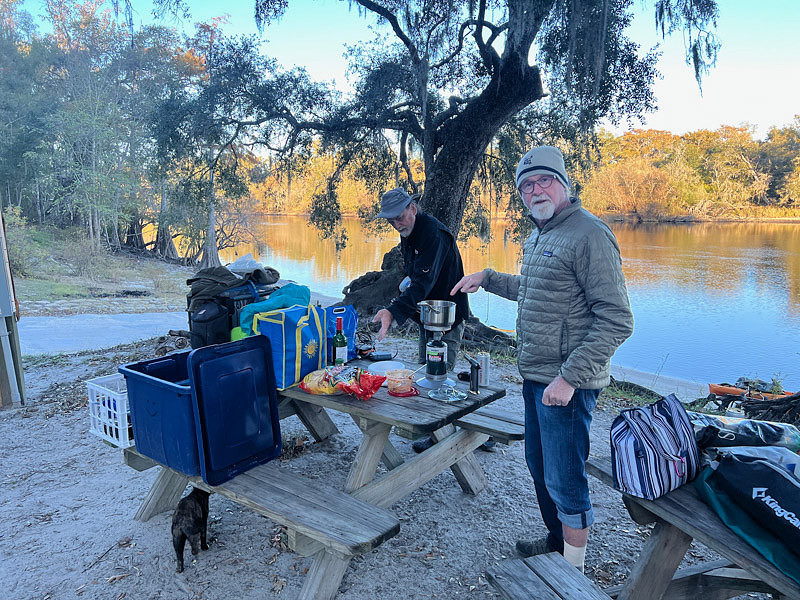
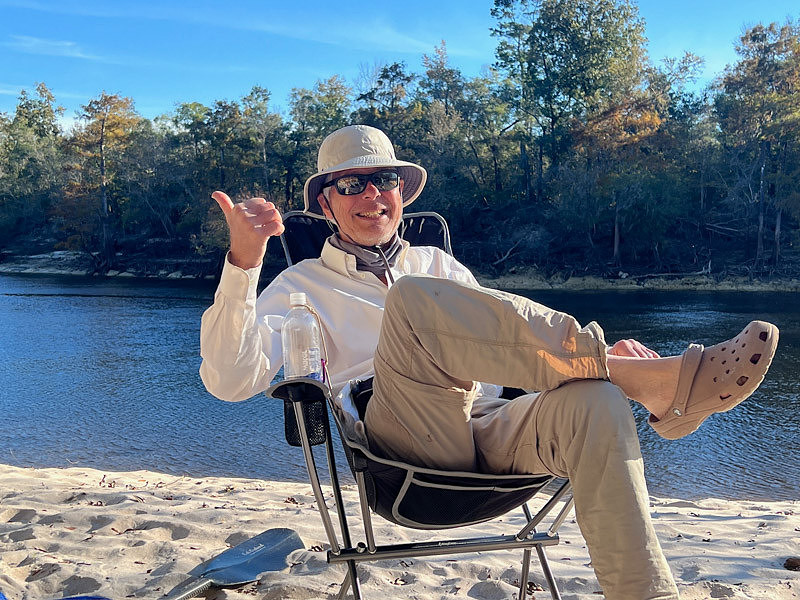
Yes, that's Jacques. He joined us for an evening at Gornto Springs.
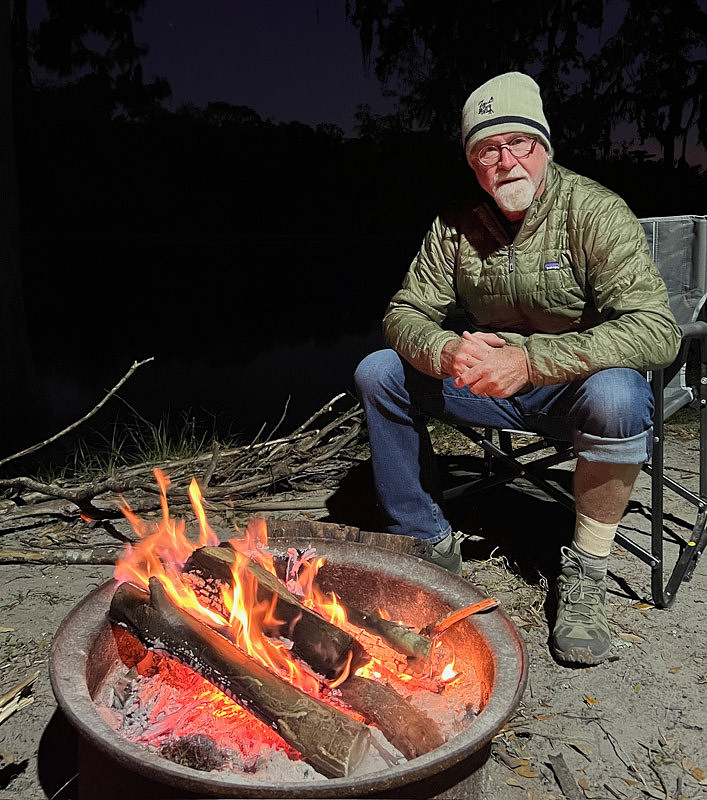
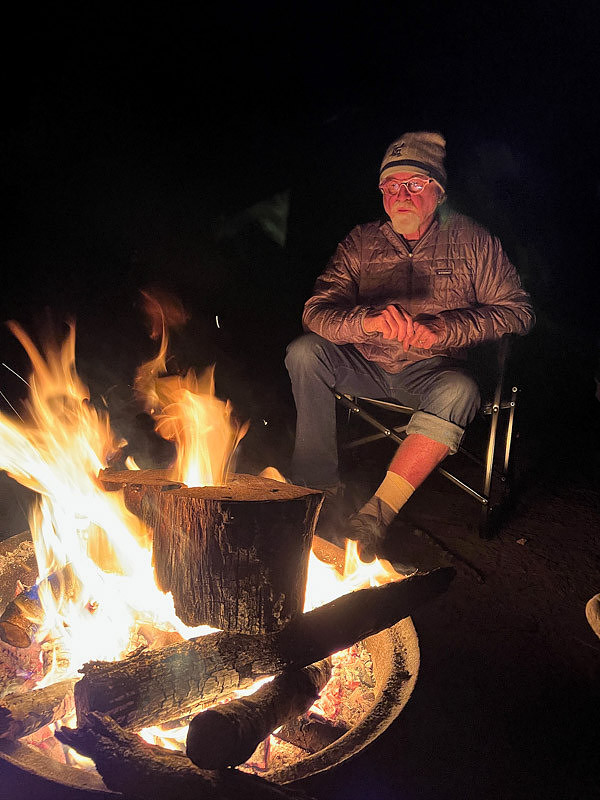
Over our years as a group, Jacques has become Firemaster, for his unique and artistic fires.
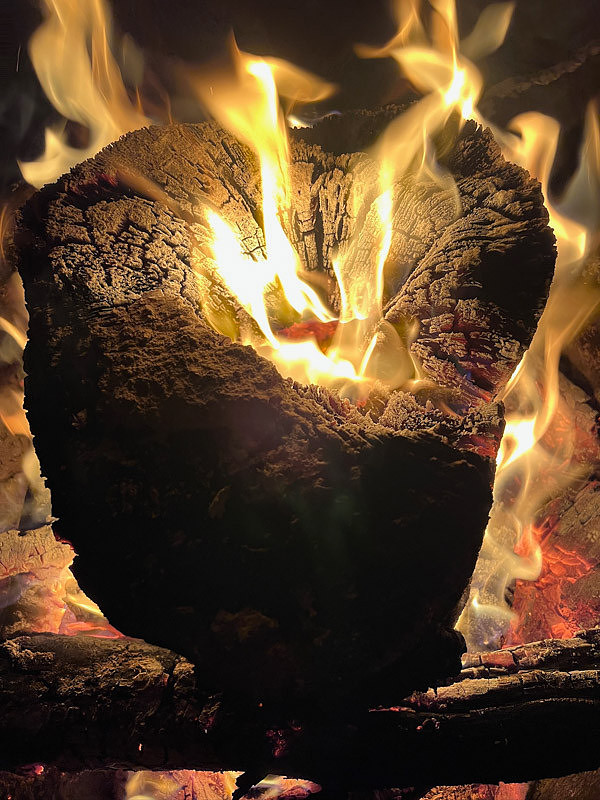
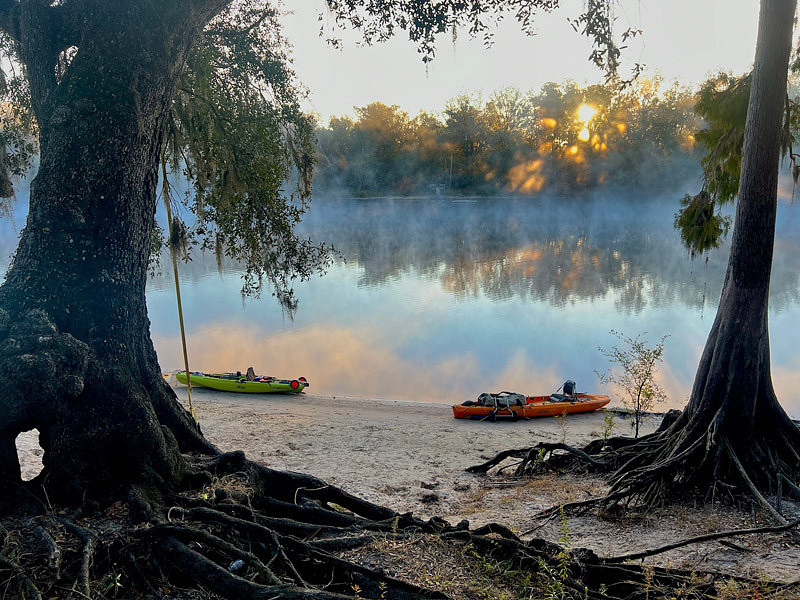
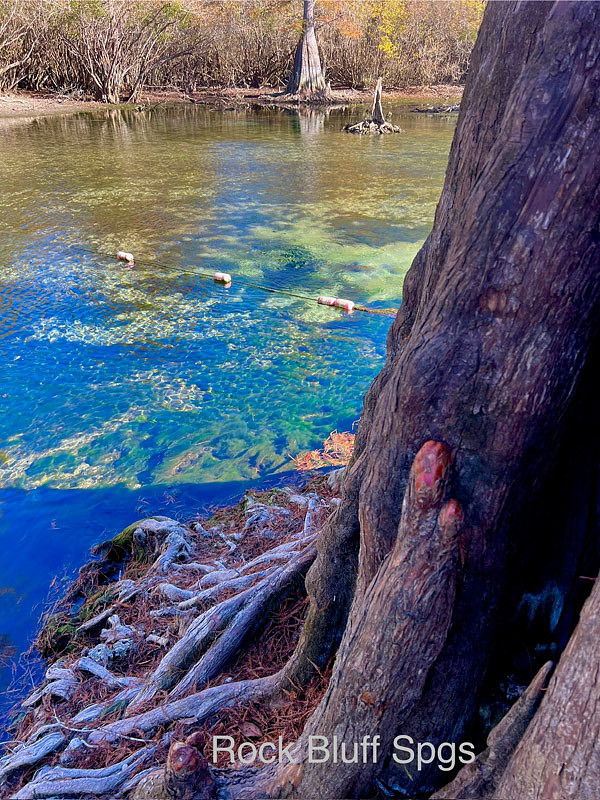
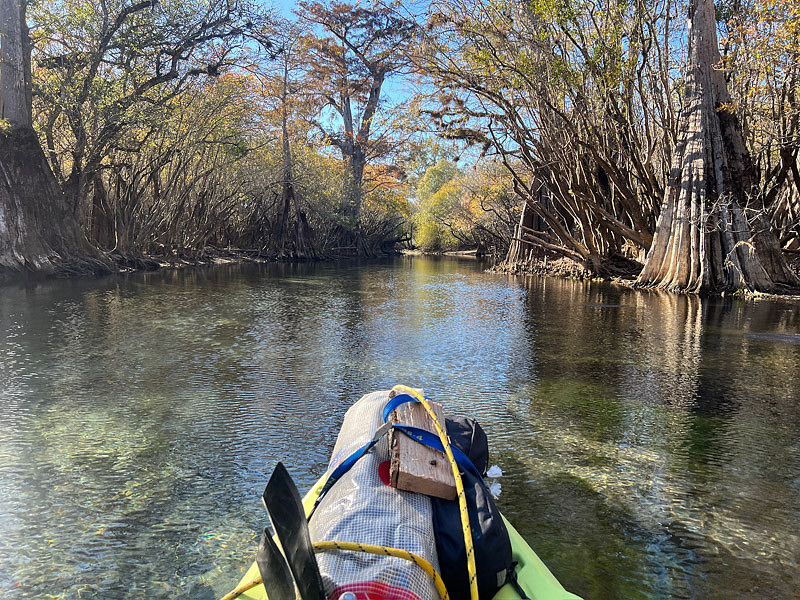
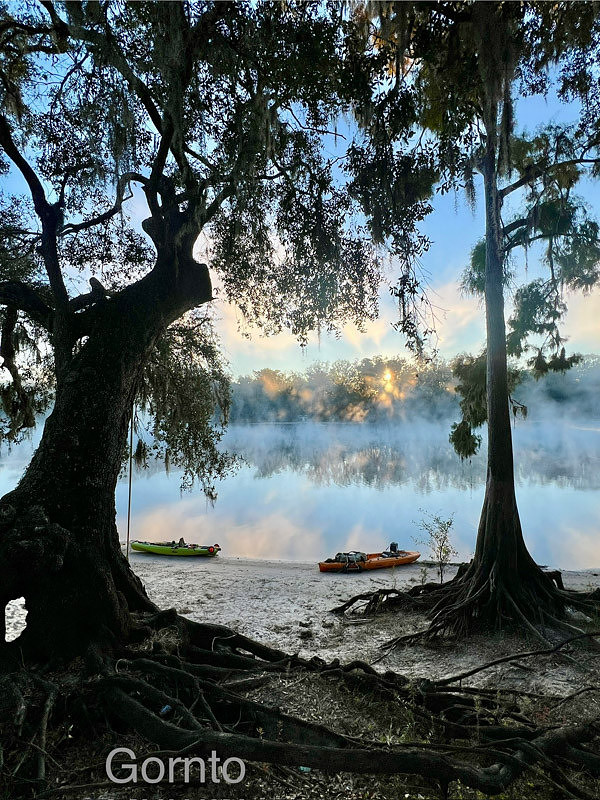
Despite the subfreezing temps, I was up around 7 and got the fire rekindled. And, to stay warm, got my gear stowed. We had coffee and breakfast and I took off around 9:30, about an hour ahead of Steve and Dave. I had a tailwind (N) all day (sunny and cool) so good sailing and easy paddling. I stopped briefly at the confluence with the Santa Fe River (where we'd tentatively planned to rendezvous), but it was all uber-developed and uninviting, so I went on. In another couple miles, I stopped at a sunny patch on a beach to have lunch. About a half hour later, Dave arrived. He stopped for lunch as well. A bit later, Steve paddled up. We paddled together a few miles, stopped at Rock Bluff Spring which was quite developed but pretty, with a beautiful run. It was mid-afternoon and our destination was only a couple miles ahead. Steve and Dave lingered to have a beer, while I paddled on to Gornto Springs County Park. Jacques was meeting us there. Rachel was taking him to pick up his truck at SOTS, and then he was driving to Gornto with beer and dinner (delicious chili by Rachel, including a vegan potful just for me! Much appreciated❤️) ...and more Lemon Snaps. The hosts, an elderly couple, charged us $6 (total) and told us to camp anywhere we'd like. (Top of boat ramp in a flat grassy area). The park had a playground and RV hookups but was overall a bit shabby. The spring was fenced and not very inviting. But there was an ok toilet and we found a power source to recharge devices. We were the only ones there. We also found a huge cache of firewood (trashpile) and had a lovely fireside meal with Jacques. So great to see him, and he was looking quite happy. He'd also brought his tools and changed Dave's pedal drive fins to larger ones (turbo). Uh oh, now I might be left in the dust. One minor snafu - we had to get into a panel box on pole with a huge bright street lamp just overhead to turn off that awful light for our fire and sleeping... but we did remember to turn it back on in the AM. We said bye to Jacques about 8ish. Our usual bedtime and Jacques needed to head home.
Wednesday 11/12/25. 12 miles to Hart Springs.
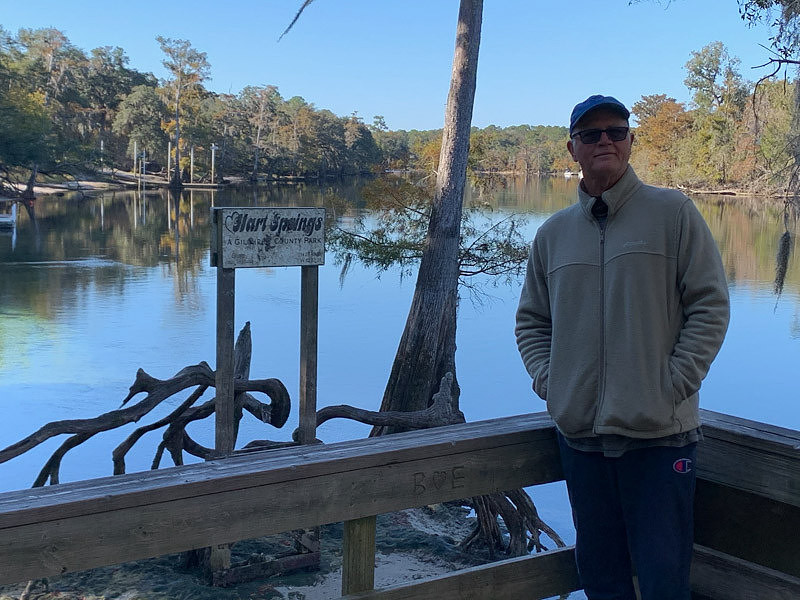
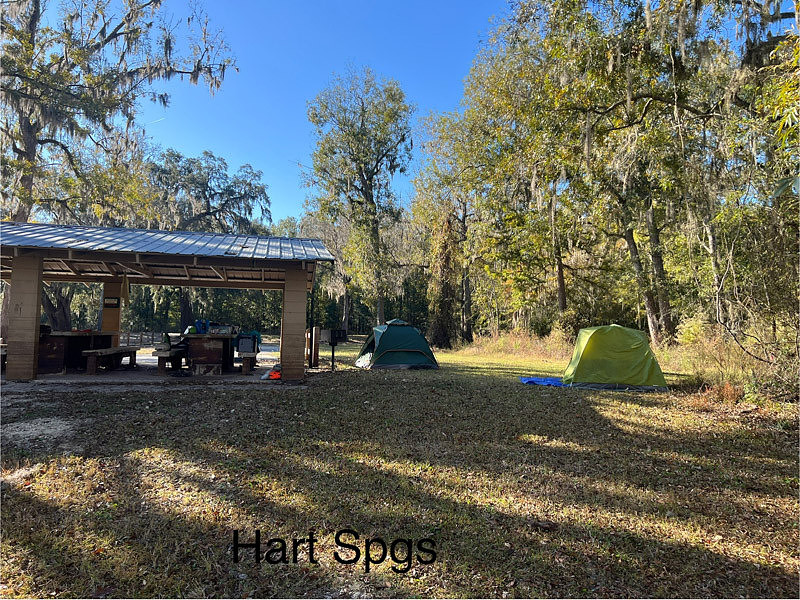
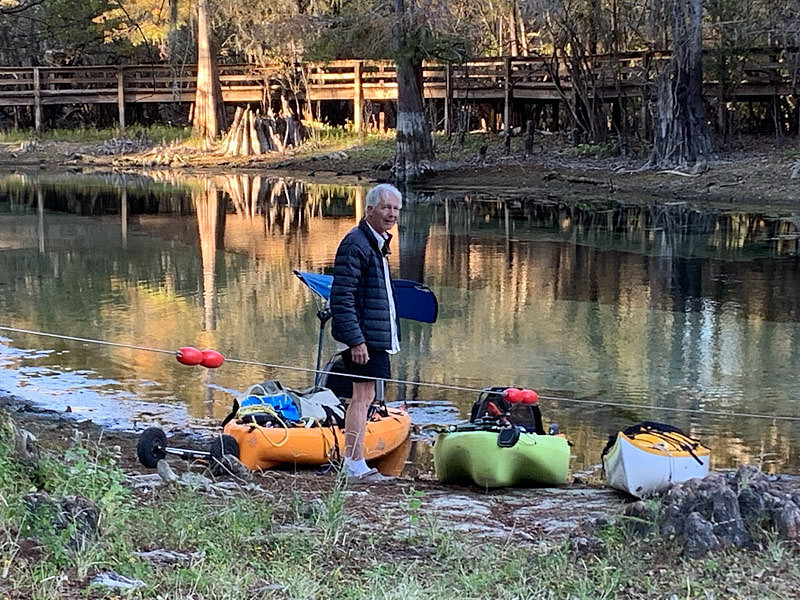
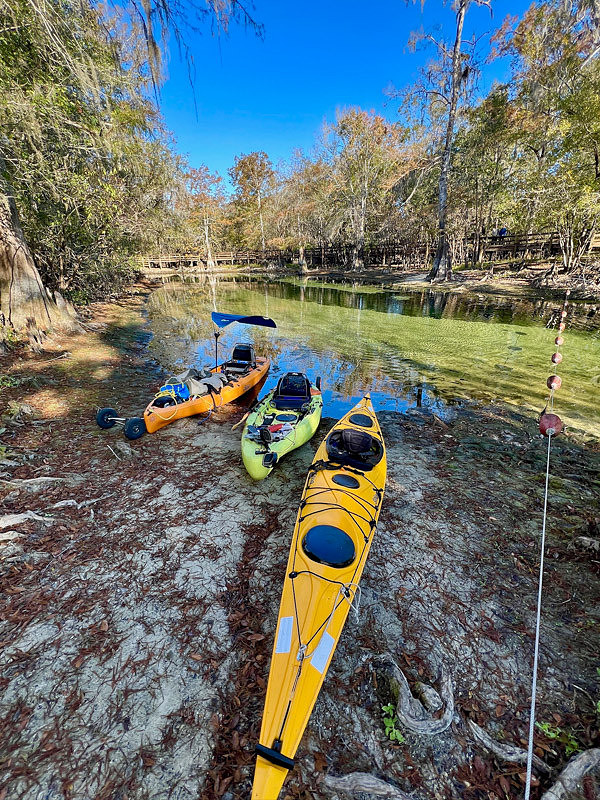
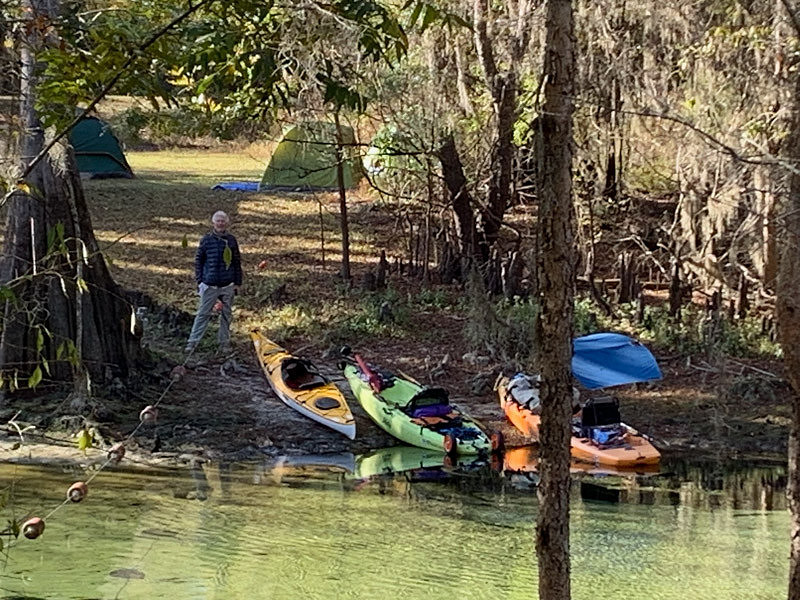
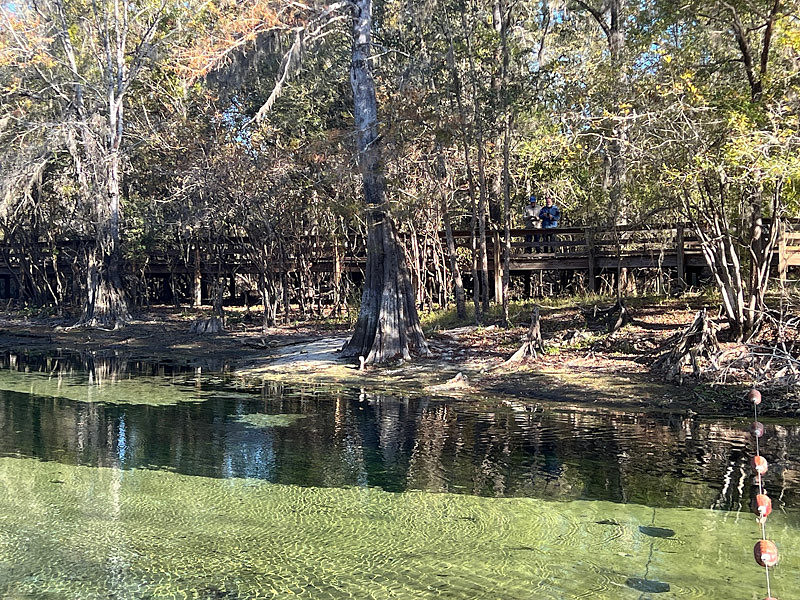
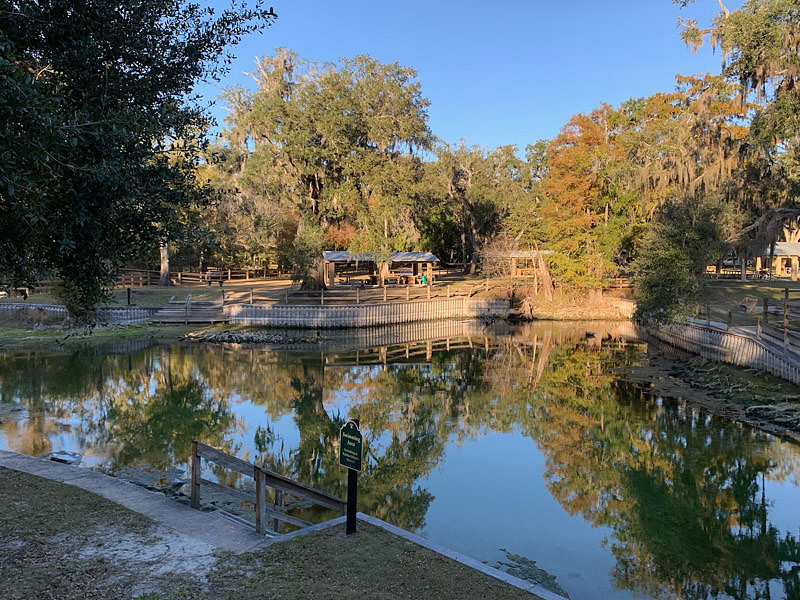
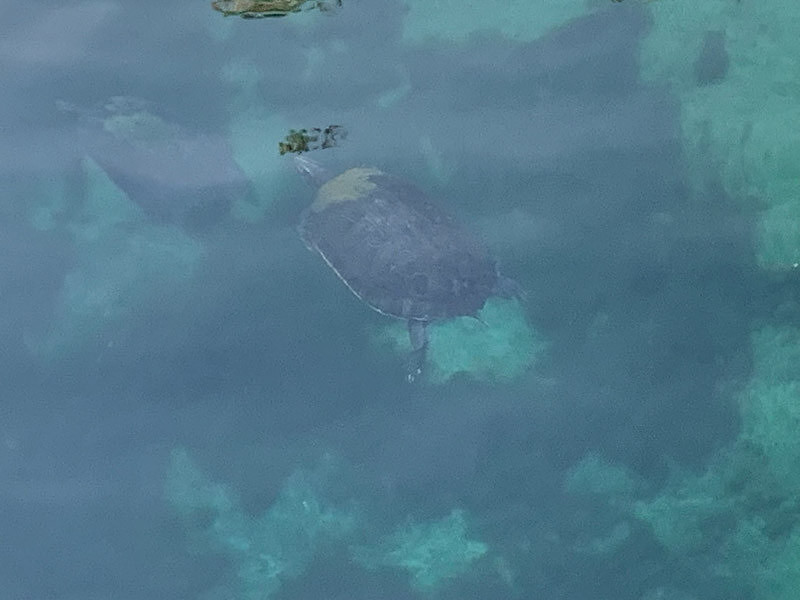
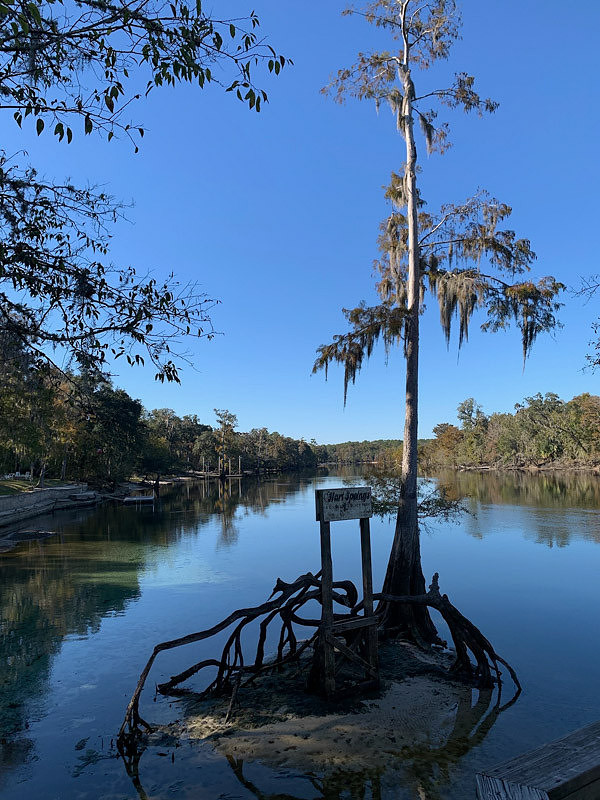
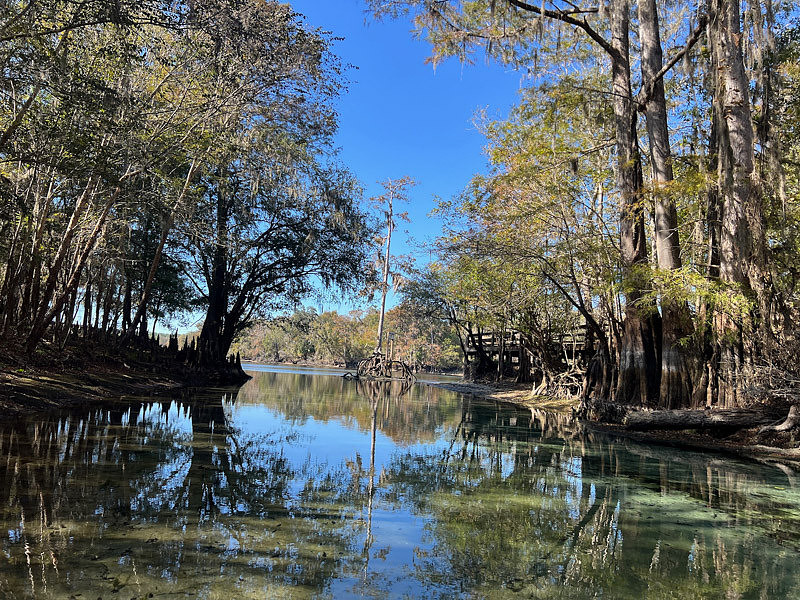
Another cool sunny day with a light wind. The river snaked around in every direction but overall continued southbound. We hit a record 4 mph, covering our day's run in just over 3 hours. I felt surprisingly exhausted after arriving, and discovered new sores on the tops of my feet, a red swollen toe that had been hurting a bit that day, and the sore on the inside of my R foot that had been getting worse for a few days despite a bandaid. And I plucked an engorged tick off my R clavicle. Damn, it'd been there several days. I dipped into Dave's First Aid Kit again and took the time to really clean, treat and bandage all my wounds. Then I kept my feet dry (as much as possible), and in socks and crocs for the next few days. That worked. Whew. Easy to lose control of a skin wound when out in nature for more than a few days. Could become a trip-breaker.
Hart Springs County Park is a very developed family-oriented park, complete with a bath house, gift shop, sidewalks, pavilions galore, a dive platform, and numerous walls surrounding the springs. The spring run (paddling in) is lovely, with a boardwalk along one side. Steve talked with management and we had to pay $75 to camp there!, but at least we were allowed to camp close to the beach where our boats were. Steve swam in the spring and was first to the showers. He used up the entire tank of hotwater before Dave and I got there. Even the woman's showers were cold. We never did get a hot shower there. Way too cold to shower in the morning. Bathrooms not heated. No fires allowed. Water yellow and sulfury.... overall mediocre accomodations for $25 each, especially compared to the lovely $6 river camps.
Thursday 11/13/25. 9 miles to Fanning Springs.
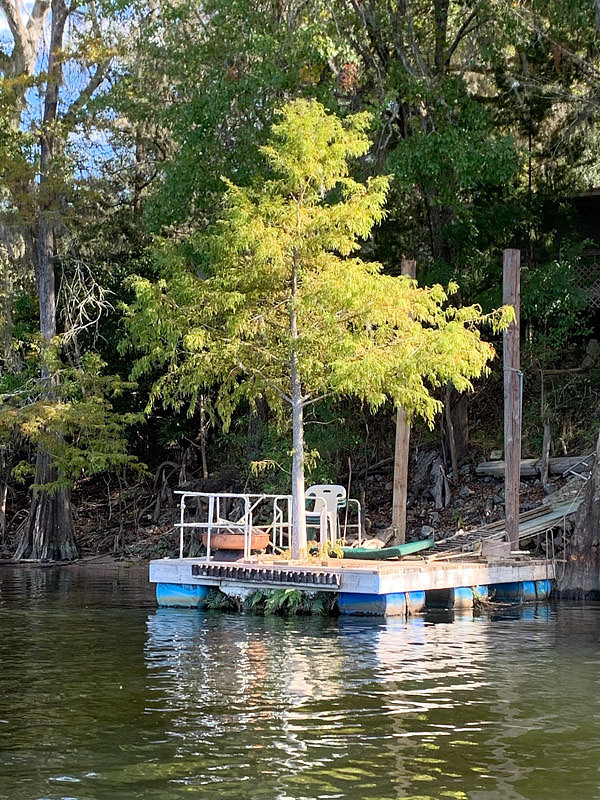
Interesting dock built around a cypress tree.
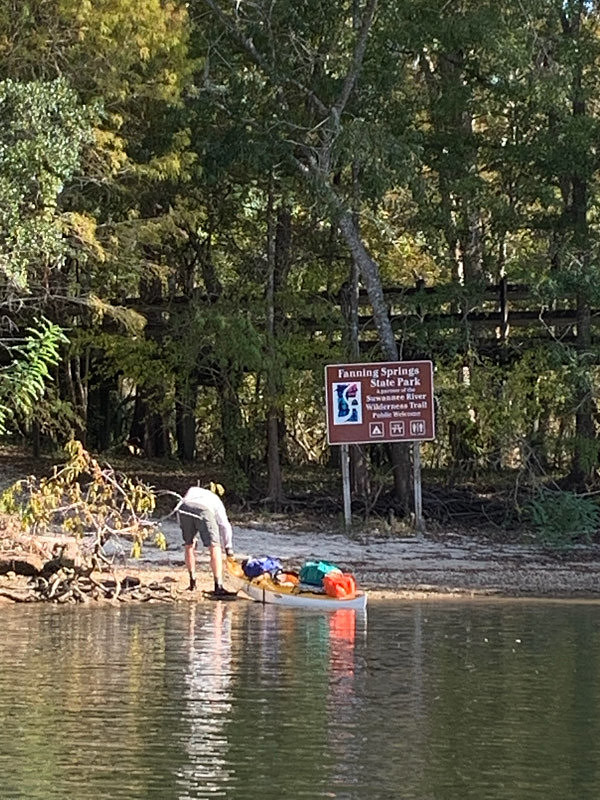
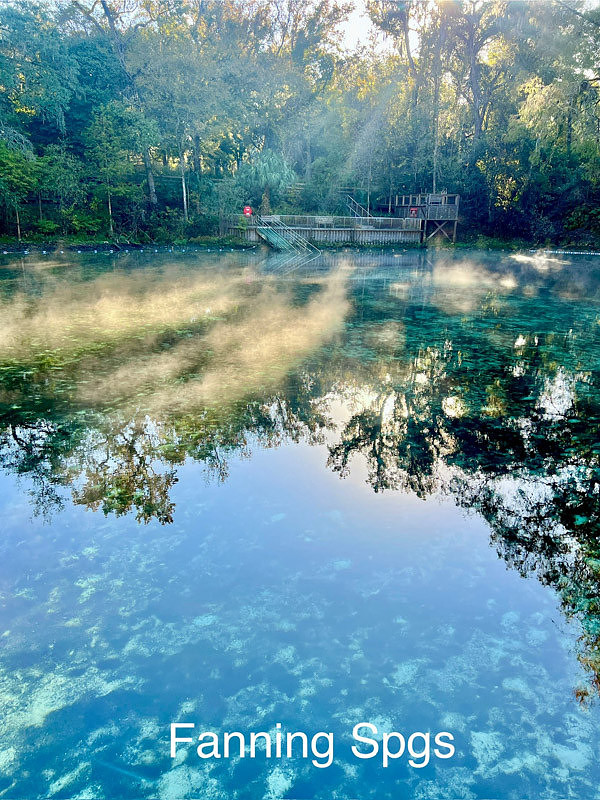
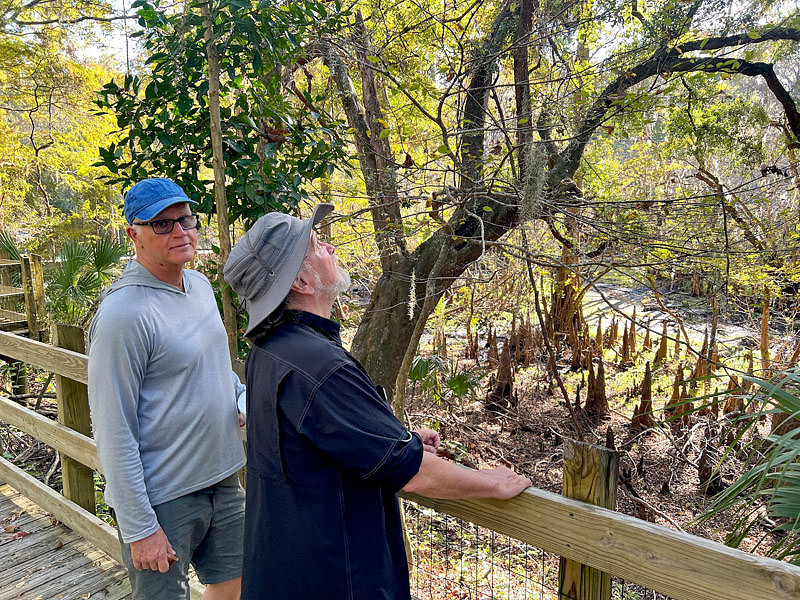
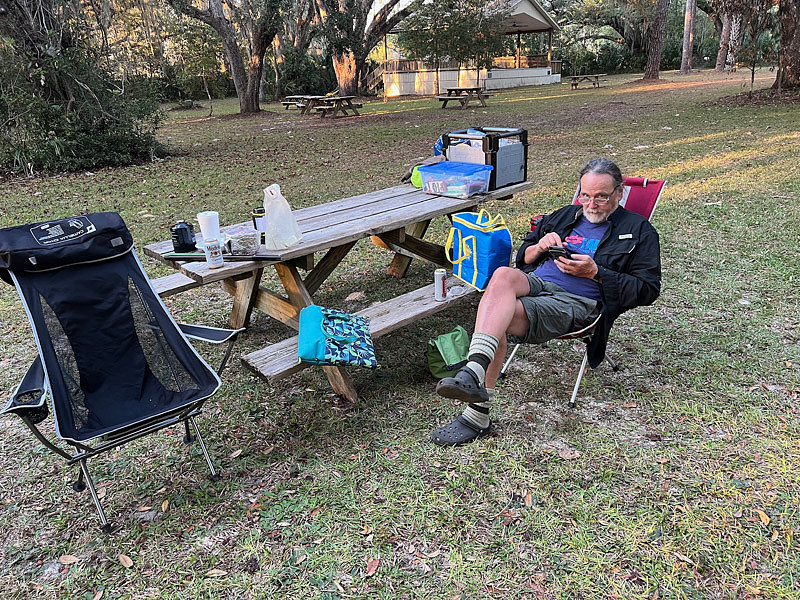
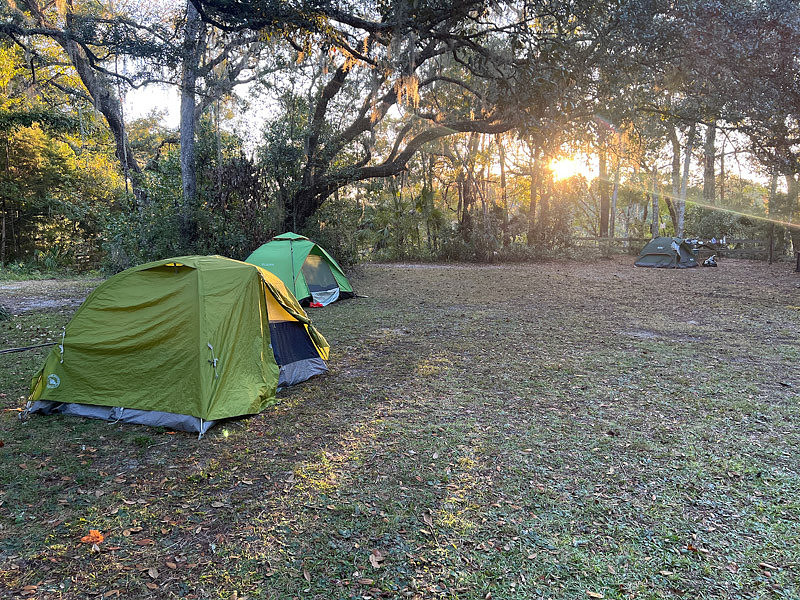
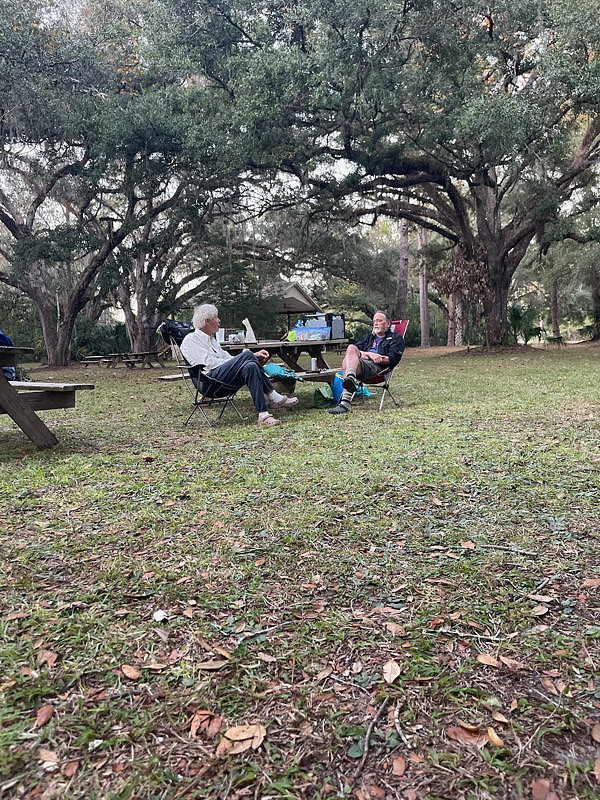
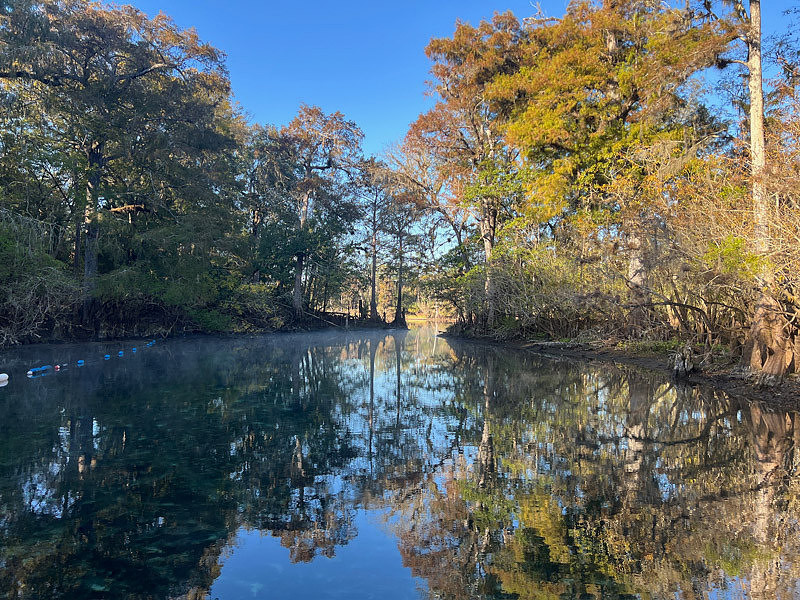
Easy and calm day. Paddled it in 2 1/2 hr. Steve was familiar with the layout, so we pulled our boats up at a beach near the primitive group campsite. Big yard with live oaks, picnic tables, a spigot with good water, and a central firepit. Plenty of firewood around. We were the only ones there. Nice. After setting up, we walked into nearby town to buy lunch. I had a fish sandwich while S and D had barbeque. We had a swim in the lovely big spring with a manatee. (No hot showers here.) Then a relaxing evening around the fire. Minimal dinner after the big lunch. Next morning while packing up, Liz Sparks, a friend from Tallahassee, showed up for a surprise (to everyone!) visit. She and girlfriends had just camped 2 nights on the river. Later, a ranger came by (we'd been unable to find any rangers on Thursday) and told us we owed $6 each and should drop it in the box by the ranger station at park entrance, which we did.
Friday 11/14/25. 17 miles to Fowlers Bluff. 9:20 - 3:20 including 1 hour stop at Manatee Springs.
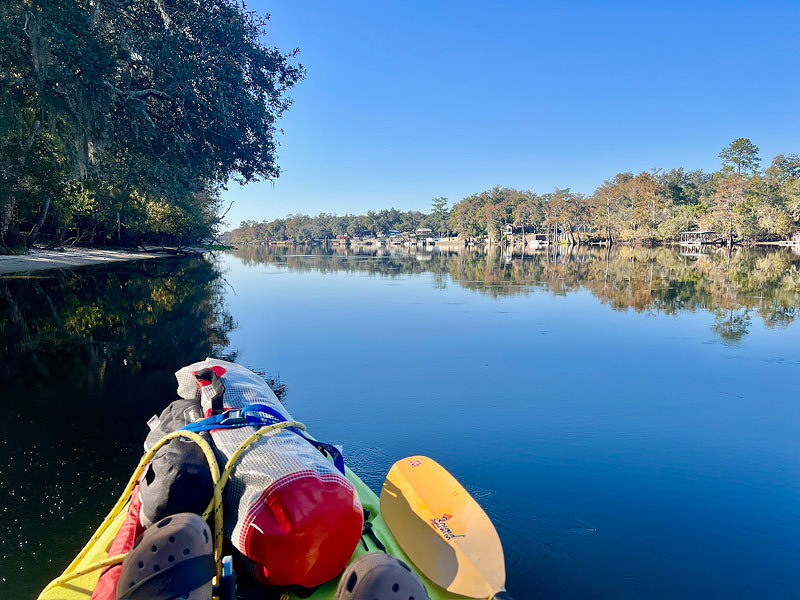
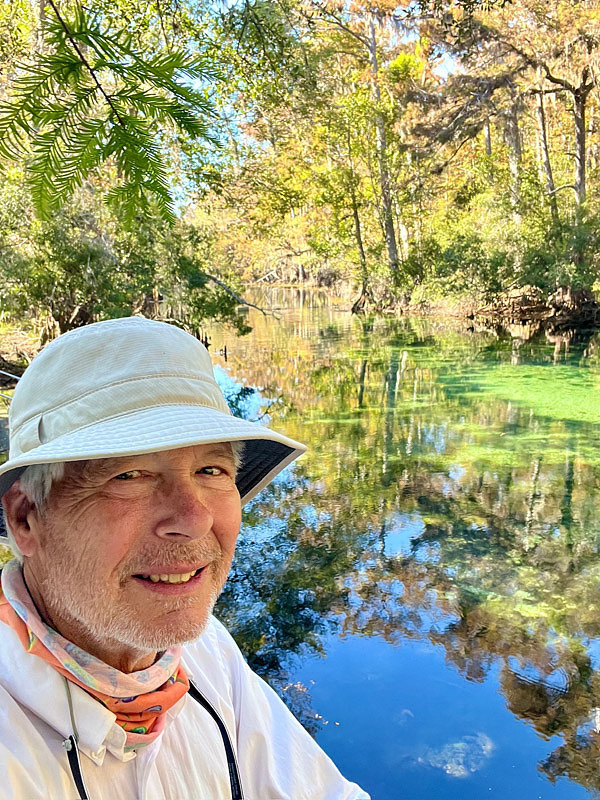
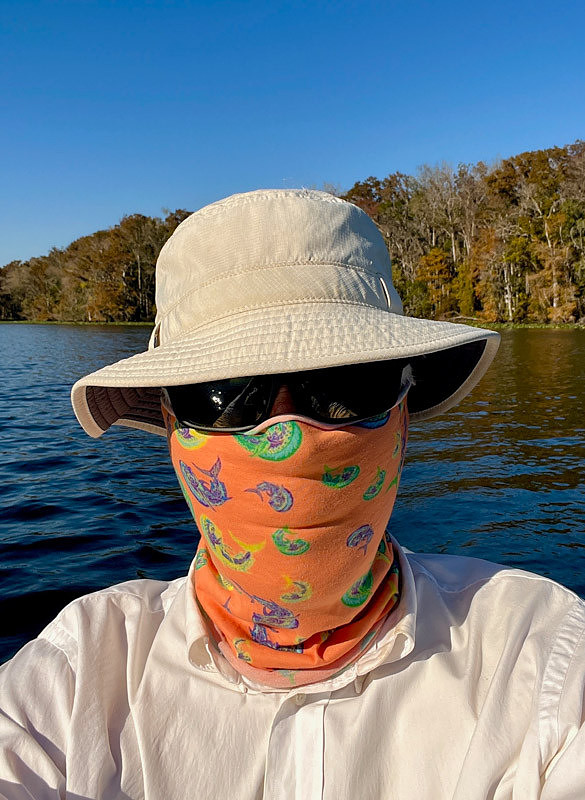
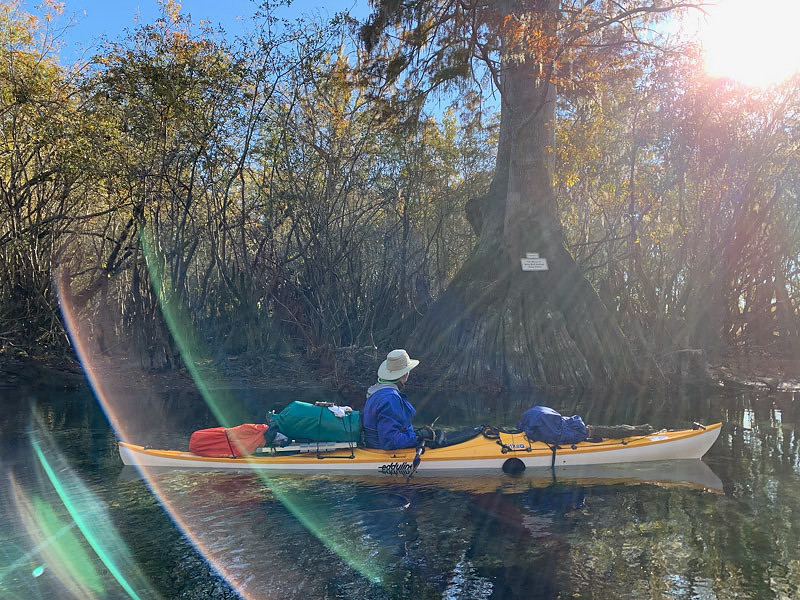
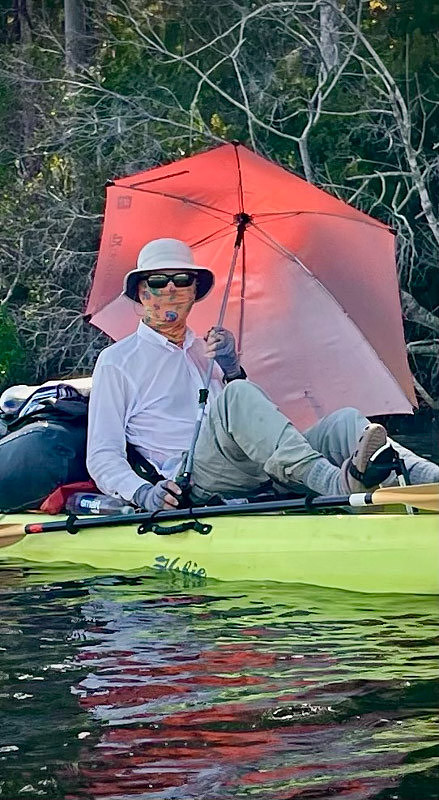
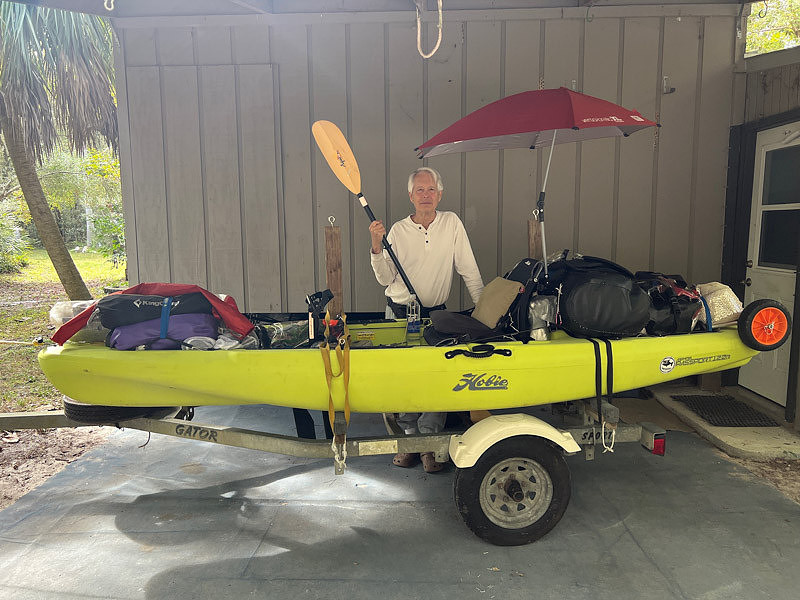
This was my getup whenever we paddled under sunny skies. (I dislike sunscreen.)
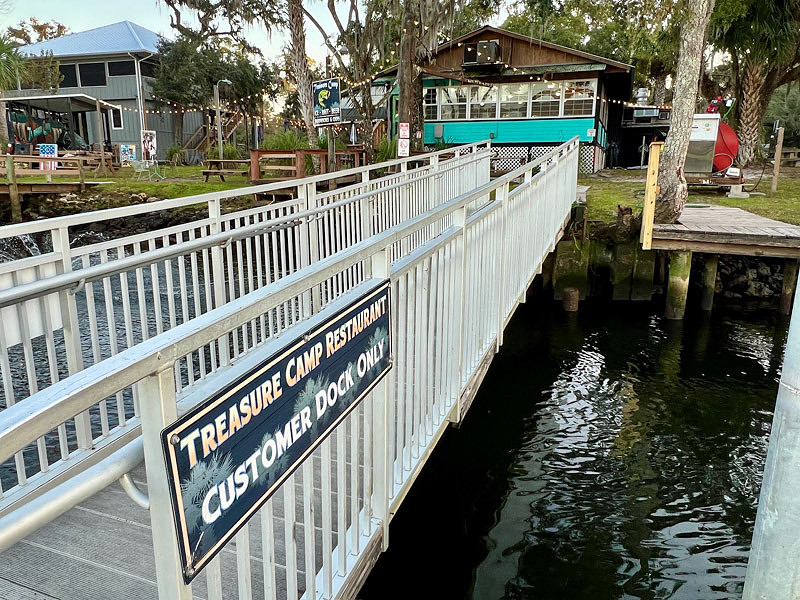
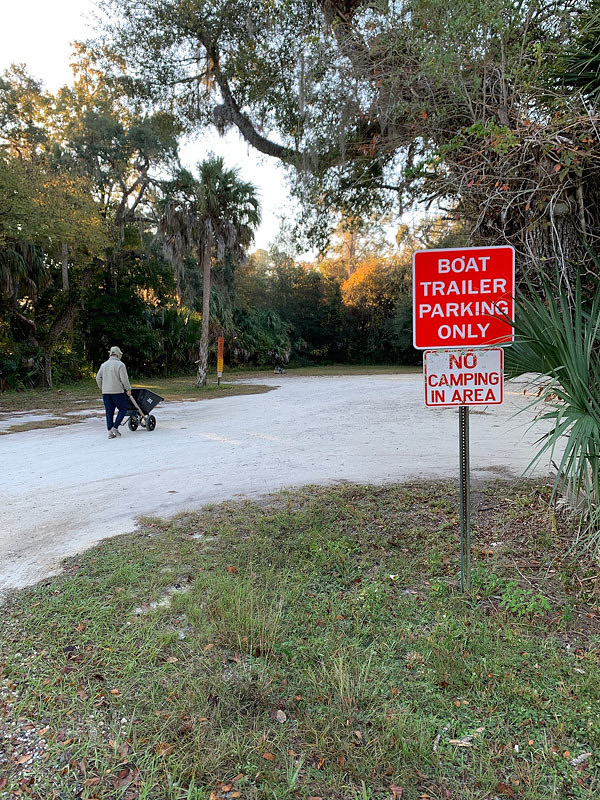
Camping in the No Camping Parking Lot across the street.
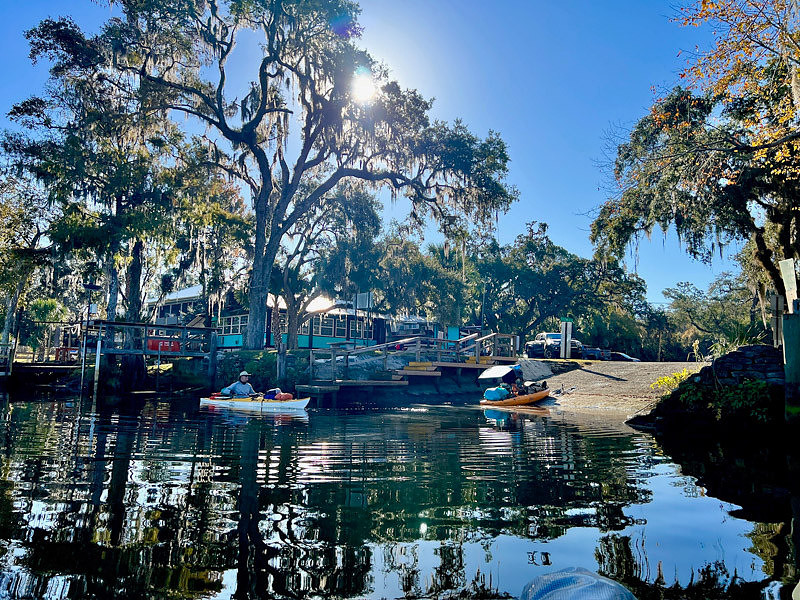
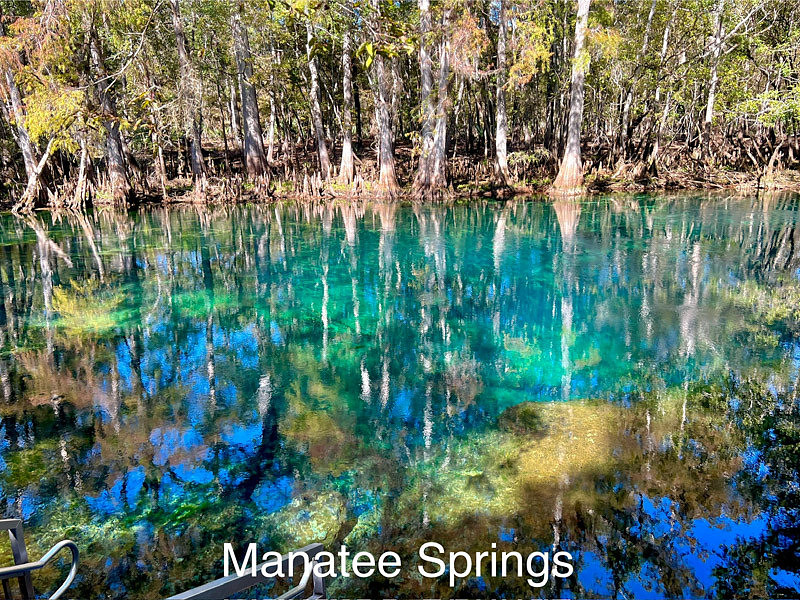
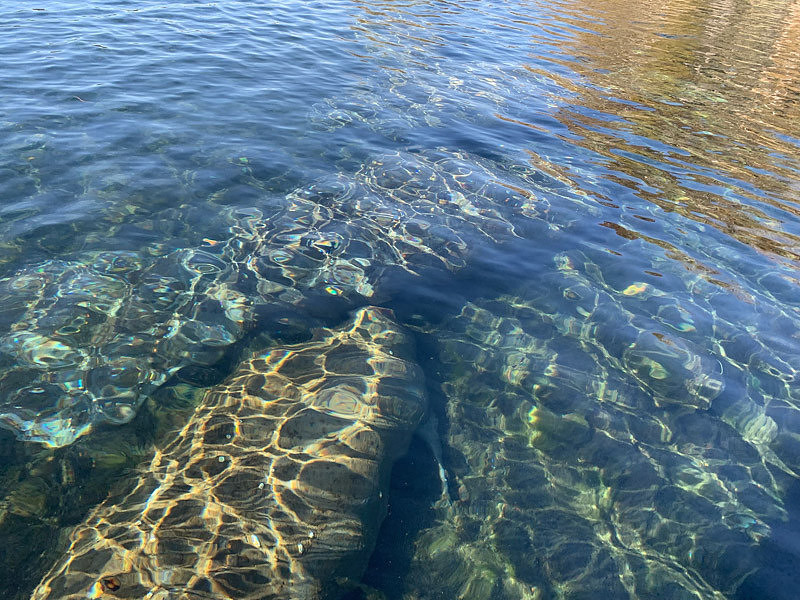
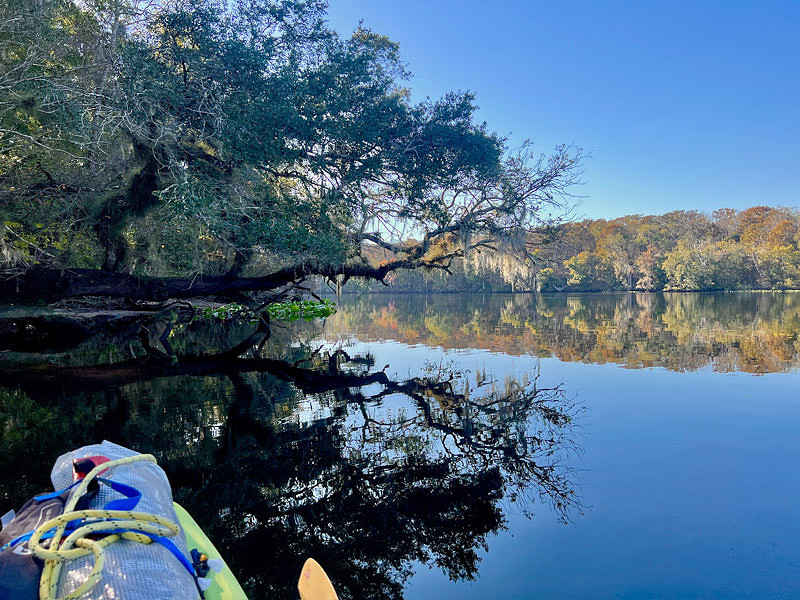
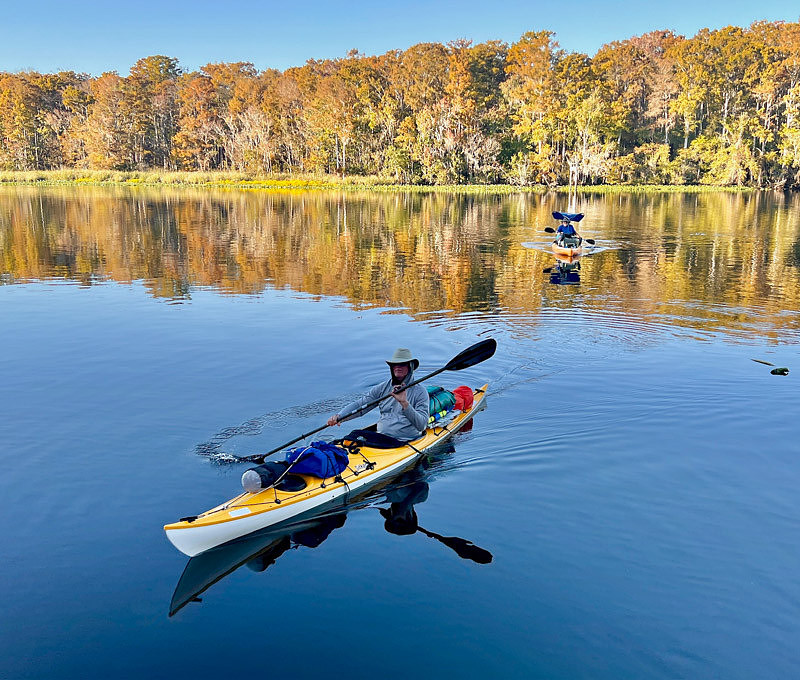
This was my solo paddling day. I left Fanning camp about an hour or so ahead of Dave and Steve. The day was glorious and clear. No wind, glassy calm. I stayed covered from head to toe the whole day and used my umbrella constantly for shade. Found that soaking my shirt and neck gaiter in the river every hour or so, then putting them on wet, cooled me nicely as long as I had the shade of my brella. I stopped at Manatee Springs where I was greeted by a manatee at the mouth of the spring run. But there were signs with icons that appeared to say no boats (even kayaks) in the run. Luckily, there was a woman on a paddleboard there. She said she'd just paddled down the run, and there were kayaks for rent as well. So up I went. I beached near the rentals. It was a fairly busy day with tourists (including a family I'd met at Fanning when I swam there). I walked the path to the main spring and looked down into the deep turquoise. It was one of those magical moments. No one else around. My heart really opened wide as I slipped down into that spring water. A few minutes later, an elderly woman with a dog came up and called to me from the walkway and then reminisced about her younger days swimming there. I suggested she come on in… not too late. We had a sweet exchange. I had lunch (now from my easy-access topside lunchbag, compliments of Dave.) The others hadn't arrived after an hour or so, so I paddled on. I got to the ramp at Fowlers Bluff mid-afternoon, right by Treasure Camp Restaurant. We had understood there was camping allowed, but all I saw was "No Camping" signs everywhere. At the restaurant, I talked with a staff person who said it was fine to camp in the parking lot across the street (where there was also a No Camping sign). It was a fairly long haul (200 yds) from the water to the gravel lot where there was a port-a-potty and way in the back, a live oak and patch of grass. I set up there. Later, after Dave and Steve had set up, the owner of the restaurant told me that she'd prefer that we not leave our boats along the edge of the ramp, and welcomed us to put them in the adjoining grassy areas (her yard on one side and the restaurant yard on the other.) She said some trailer drivers are terrible at backing down the ramp, plus the river is very tidal here. She just wanted our boats to be safe. Nice. Understandably, they couldn't allow us to camp in those pretty riverside yards since they had no public toilets. The parking lot across the street was county, and they said no one enforced the No Camping. Plus it had a porta-potty. It was fine (with a great restaurant at hand.)
We had a wonderful dinner at Treasure Camp. (I had a grouper reuben sandwich). And then spent our fireless evening nursing beers at the riverside bar outside. The next morning we had a full breakfast at TC as well. What a treat.
Saturday 11/15/25. 21 miles to the Gulf of Mexico.
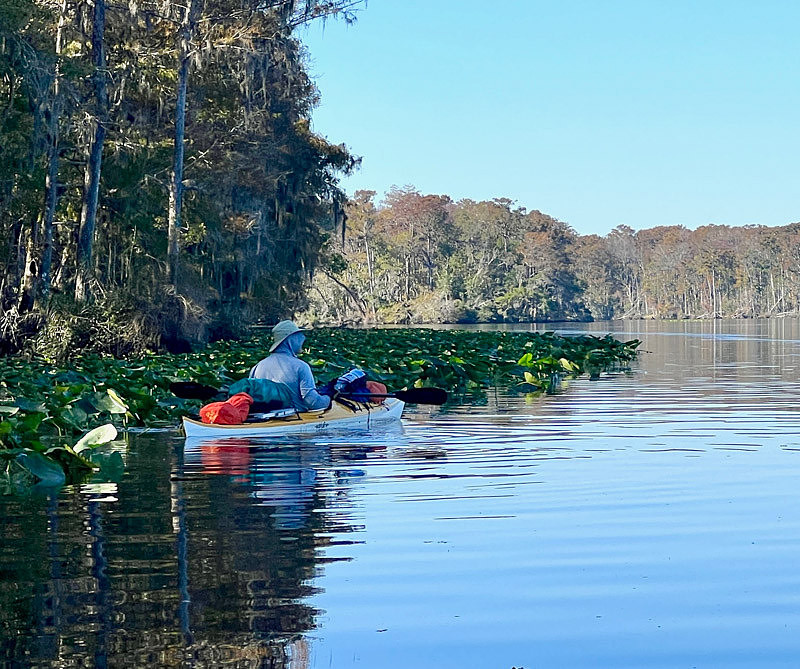
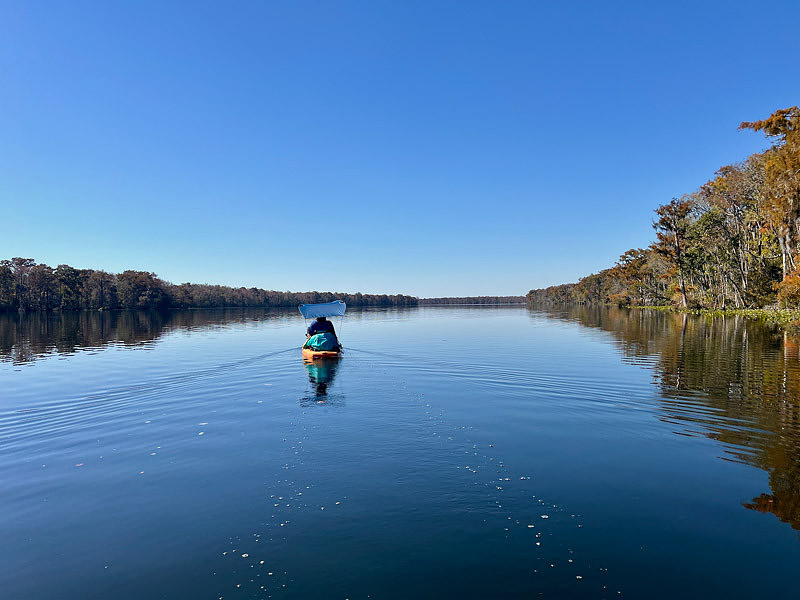
What a glorious day!
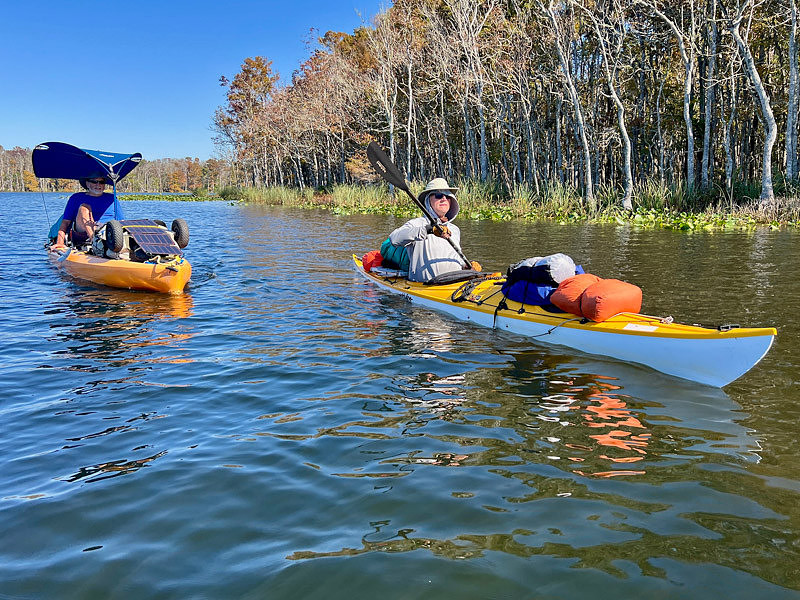
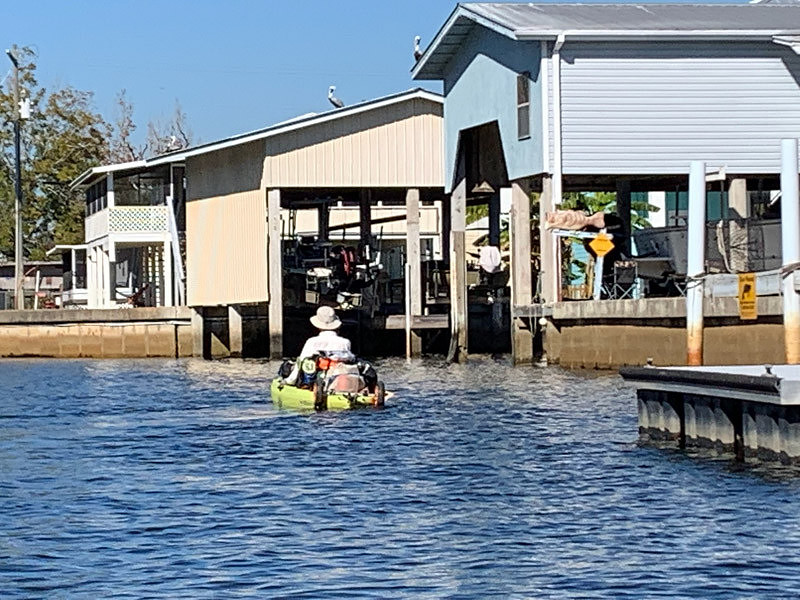
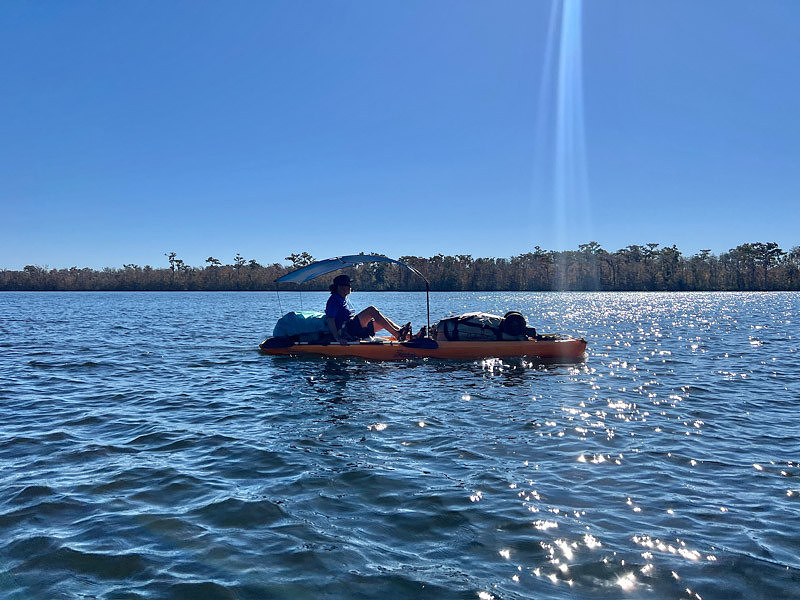 Town of Suwannee ahead.
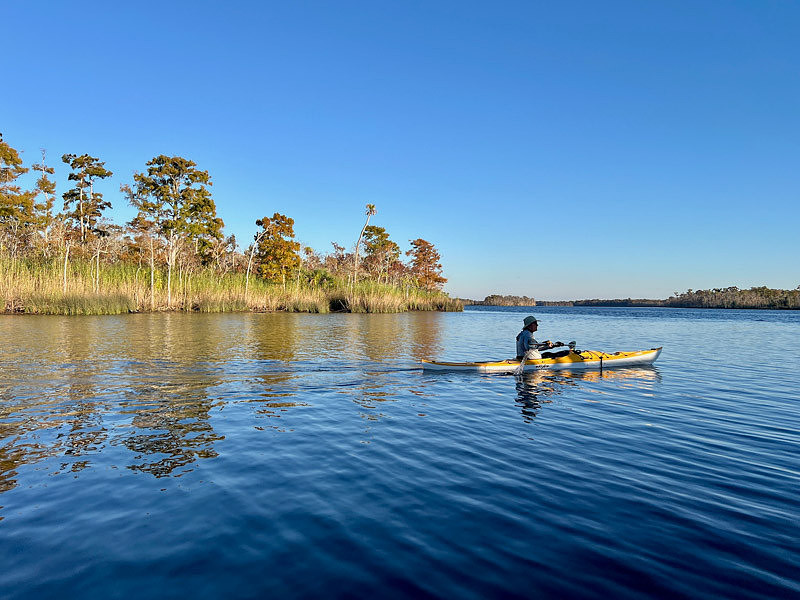
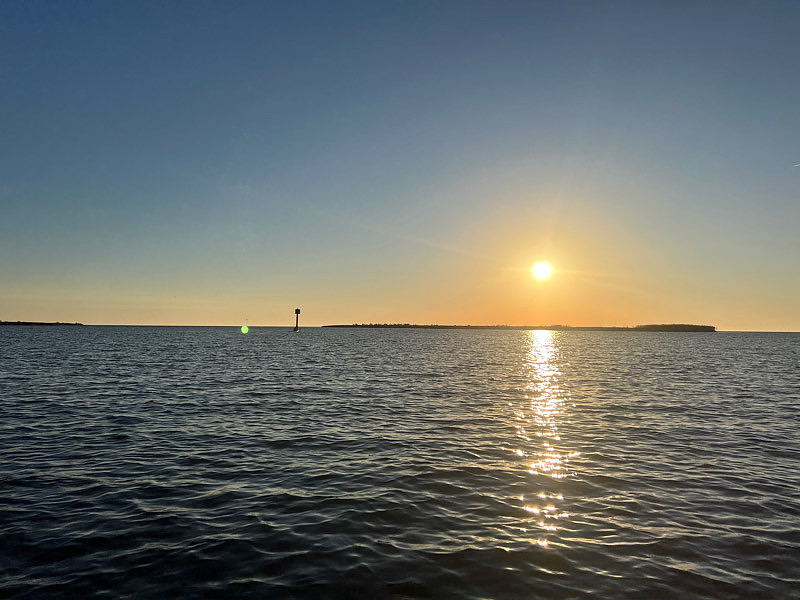
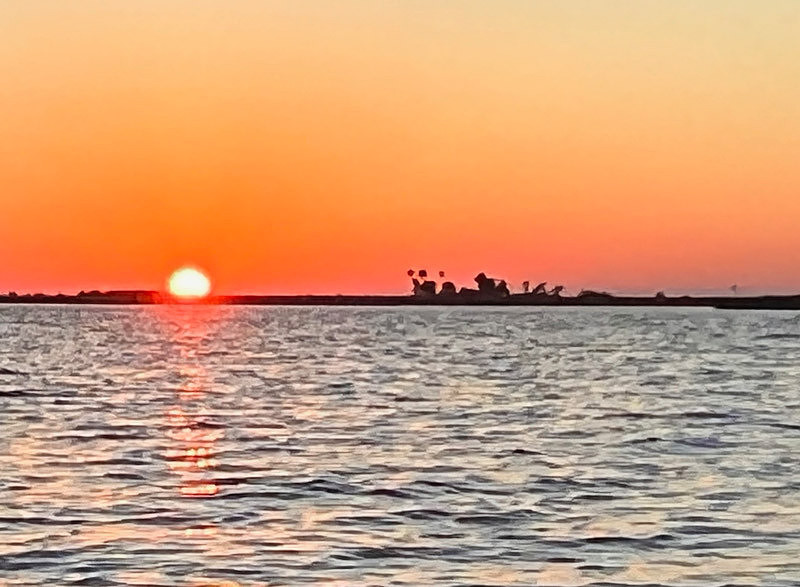
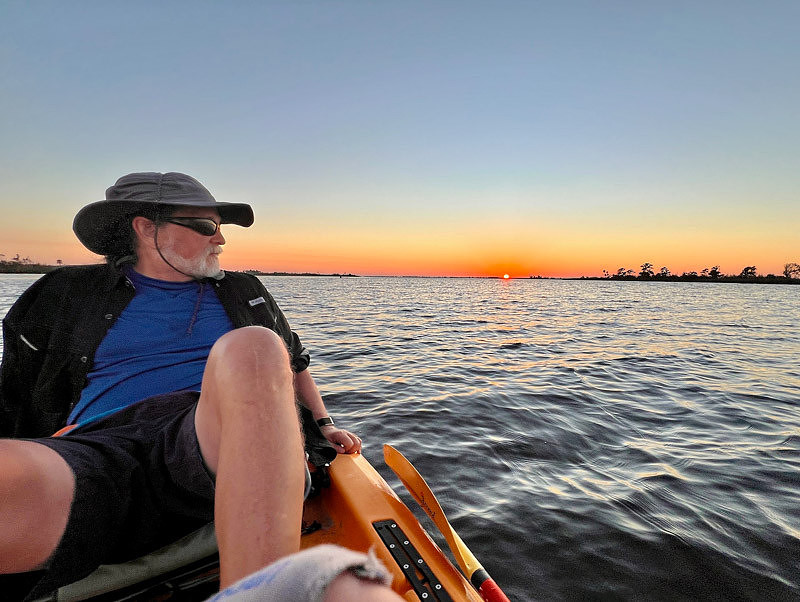
Heading out into the big Gulf waters at sunset.
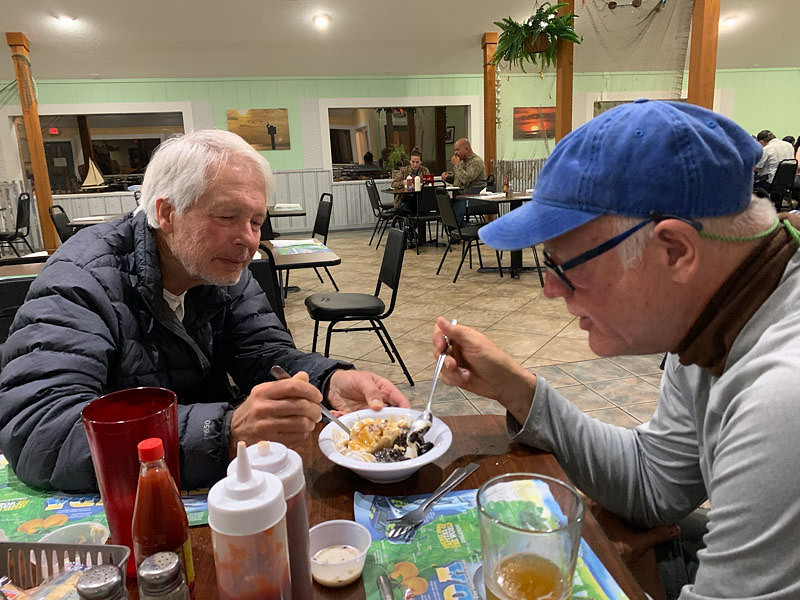
Slap-Yer-Momma Cake alamode
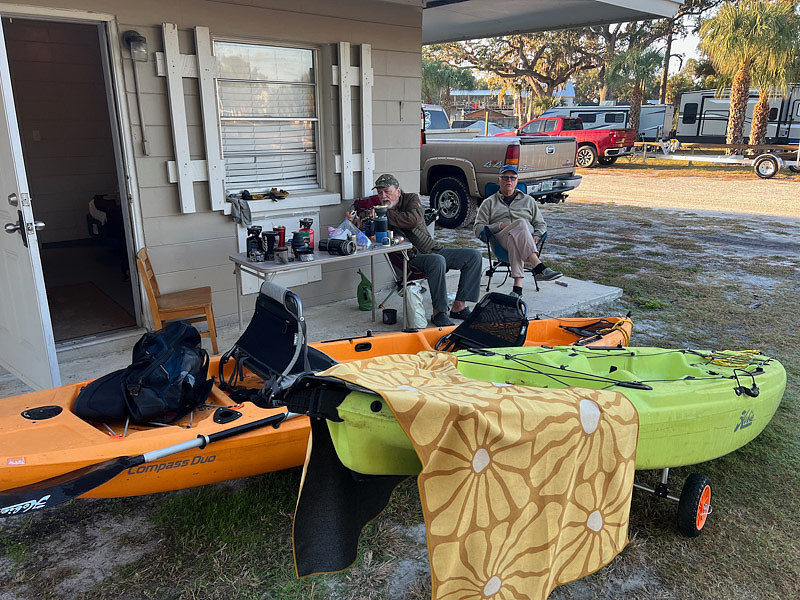
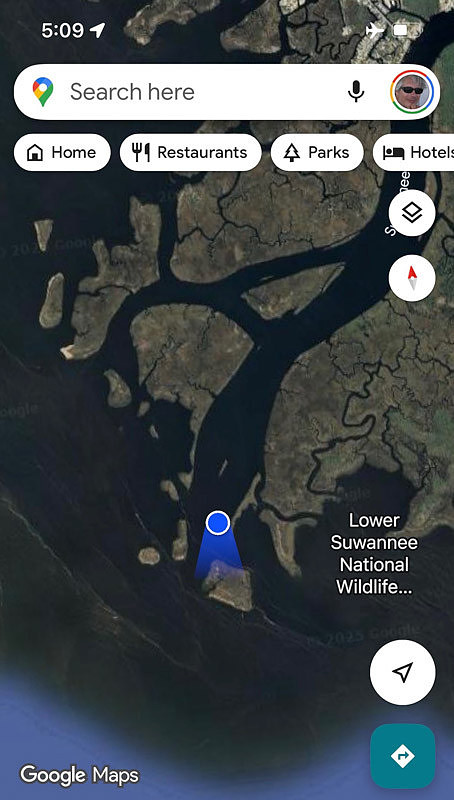
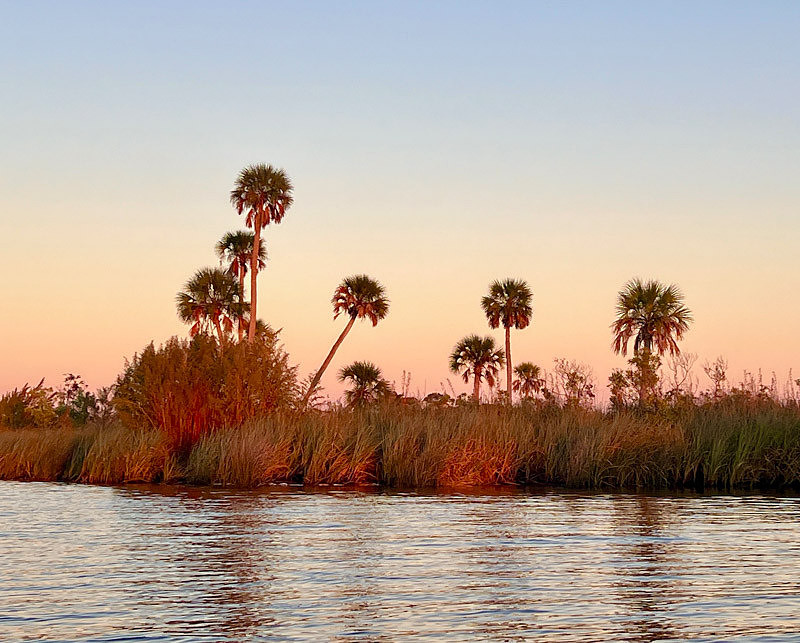
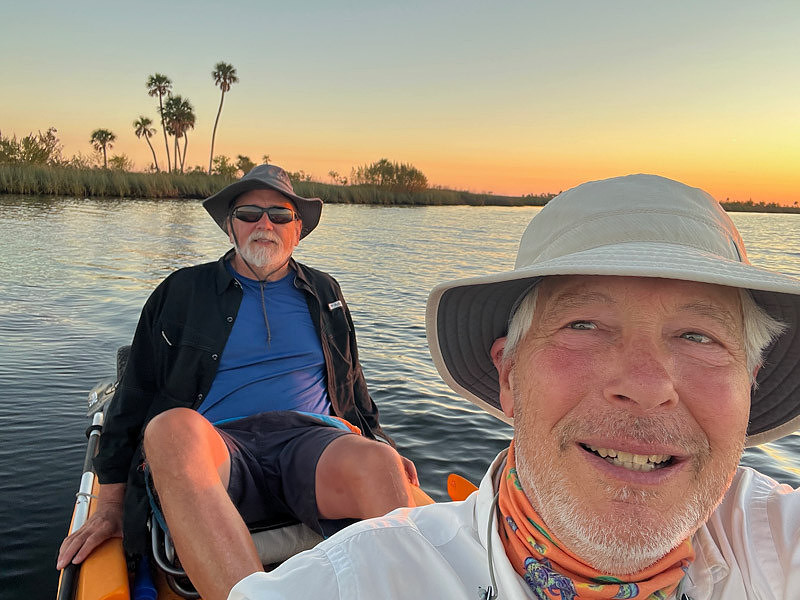
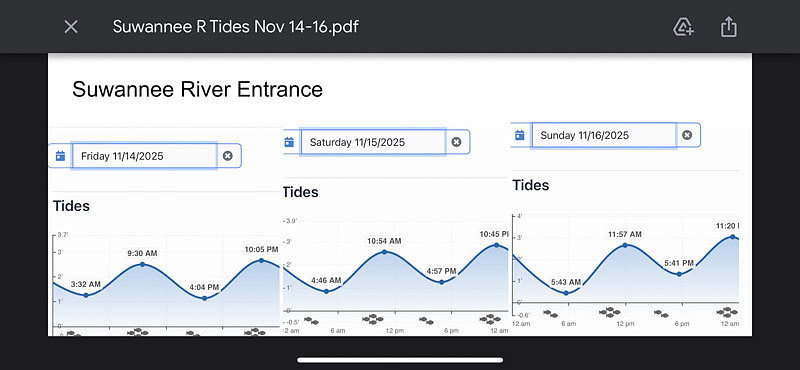
We got into our boats about 9:30. Another beautiful calm day. The tide at Fowlers Bluff was still coming in, but tide tables said it should be turning mid morning, so we'd be paddling with an outgoing tide (faster current) much of the day. I had had low expectations of the lower section of the Suwannee (Manatee to the Gulf) having read that it is wide, windy, full of motor boats (wakes), with uninteresting inaccessible shoreline. Maybe it was because we were lucky with the wind (none) and tide (favorable), gorgeous weather, nearing the end of our trip... or... who knows? But I loved these last two days of paddling on the big river. The glassy calm allowed us to see dozens of rolling sturgeons, some right beside our boats (though none jumped). We saw very few motor boats, and none with significant wakes. The shores were all scrubby woods and some palms. No accessible land for miles. We got to the town of Suwannee about 3:30. Weird paddling into a town (a very water-oriented town with docks everywhere and boats and buildings hanging over the water.) We found our way (using Google Maps - - there were no signs directing us as it said in the guide) up a series of canals to Anderson's Landing (a ramp) and Bill's Fish Camp where we could camp. Except that we couldn't camp! The "camp bathroom" was out of order so no camping allowed. But there was a motel and we could rent a room for $66. And then we could camp because we had a bathroom. OK. Steve and Dave opted to camp out waterside under a big live oak. I stayed in the shabby but comfortable little room. We unloaded our boats completely and attempted to dry things that were wet. Dave and I then reconfigured our seats and pedal drives onto the tandem boat he'd been pedaling. About 4:15 we launched again, presumably approaching dead low tide (5:00 pm by the tables) and paddled 4 more river miles through the salt marsh and palm isles, and tidal creeks, out into the Gulf for a magical sunset closure to our day and trip. We paddled back to the Landing in twilight in fairly slack tide. I saw a big racoon climb up a tall palm tree. Saw murmurations of small black birds, and numerous shorebirds heading to roost. It was a thrilling end of our journey.
We showered and walked down to Salt Creek Restaurant (a block away) for dinner, ending the meal with a slab of Slap-Yer-Momma Cake alamode.
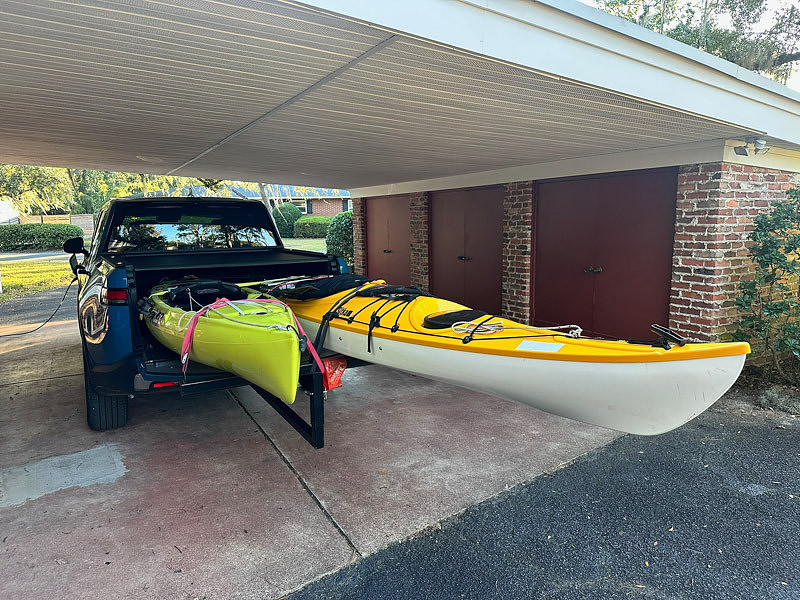
SOTS Canoe Outpost (Willie) picked us up at 11 AM Sunday and brought us back to Live Oak where Dave's truck and Jacques awaited. (Canoe Outpost fees were $15 each (four of us) to take 2 drivers to Blue Sink put-in, and $60 each for picking up 3 of us and all our gear at Suwannee. Plus we gave Willie generous tips.) A great and much appreciated service.
We still have the "Upper 80" to paddle - from the Okeefenokee to Blue Sink...
but not until the water levels are good. Stay tuned.
ADDENDUM
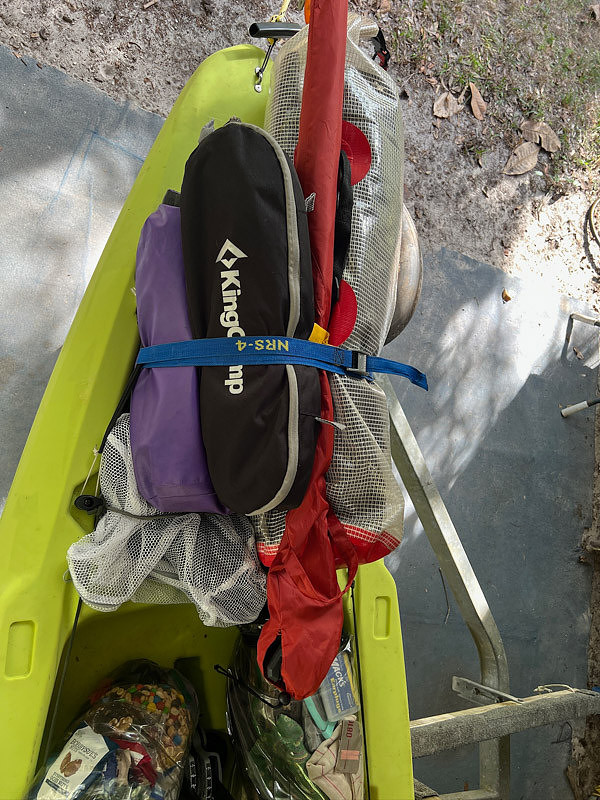
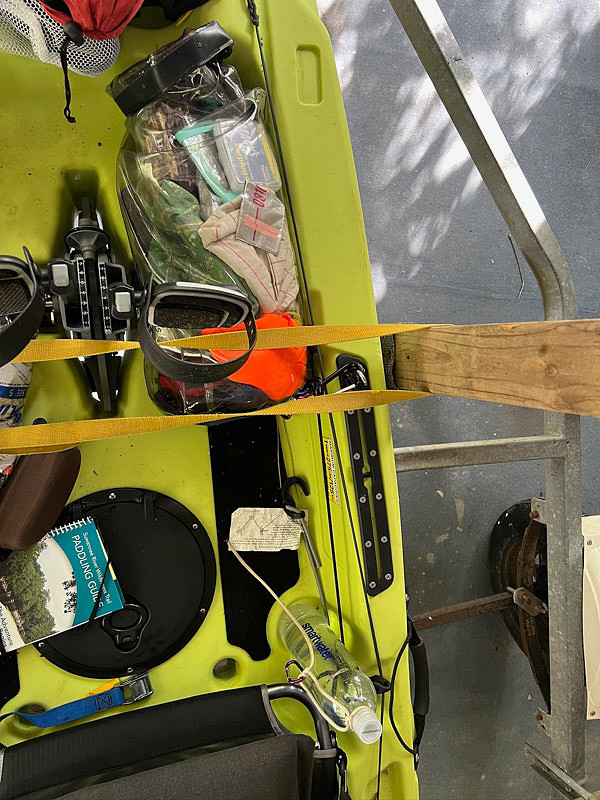
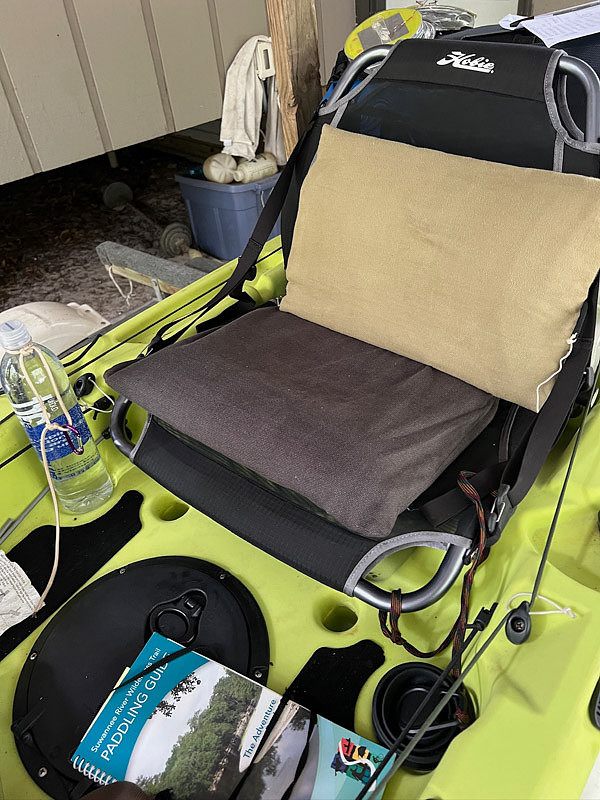
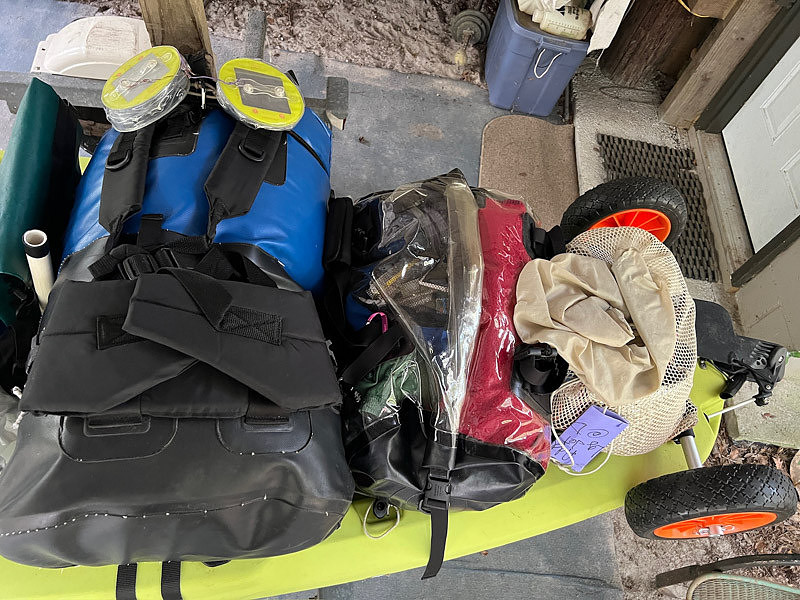
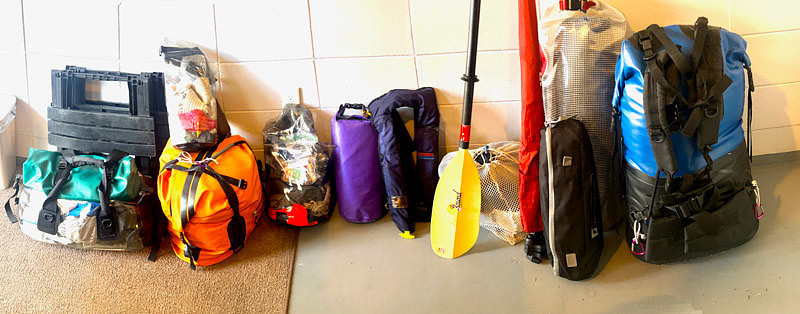
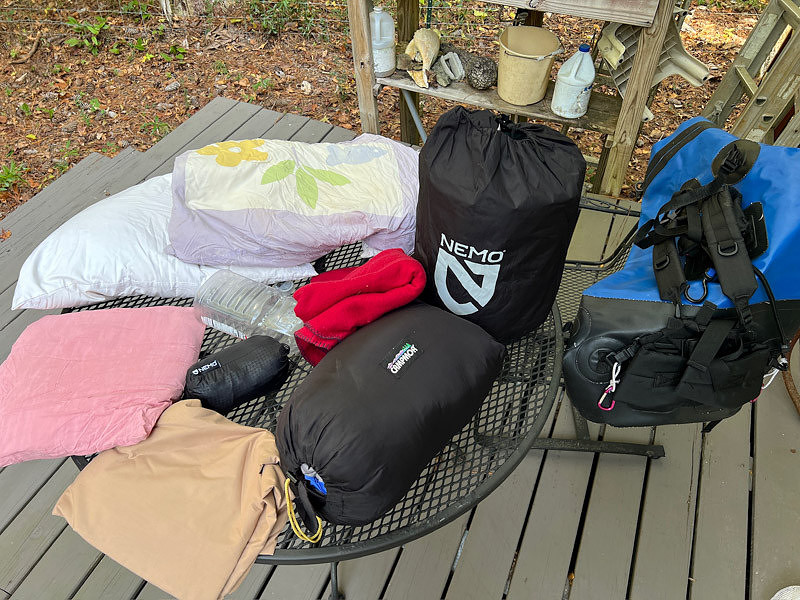
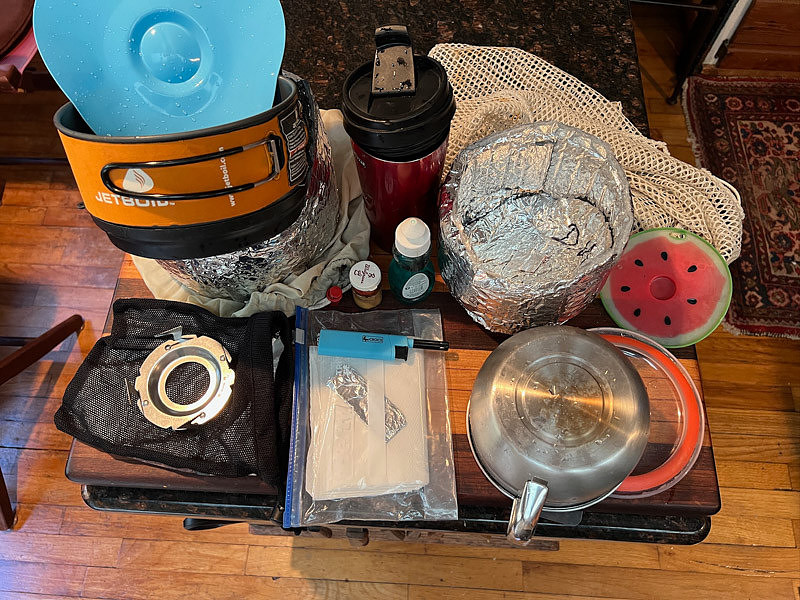
I'm adding some "gear photos" to help us gather and pack for the next trip.
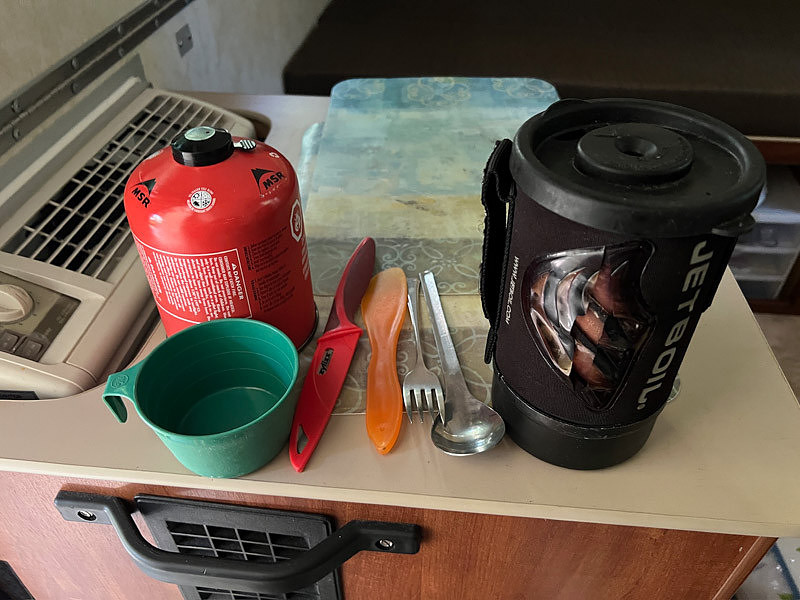
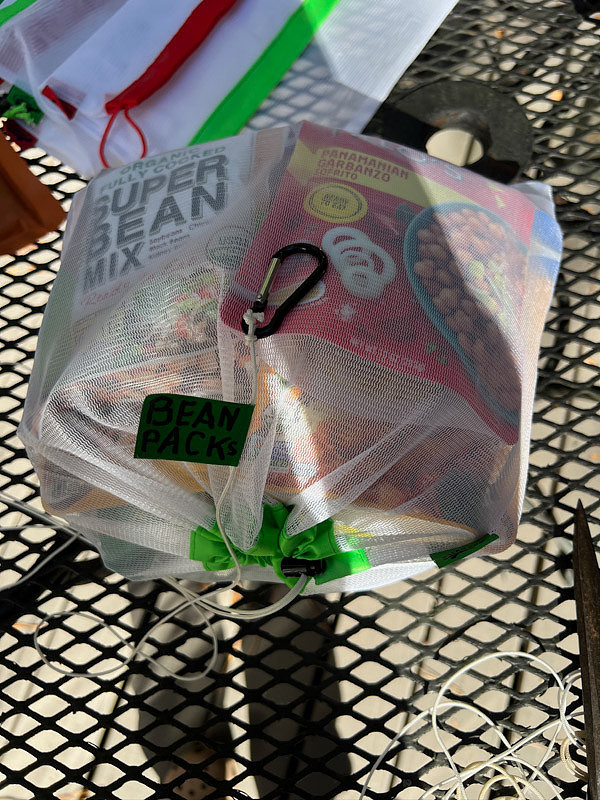
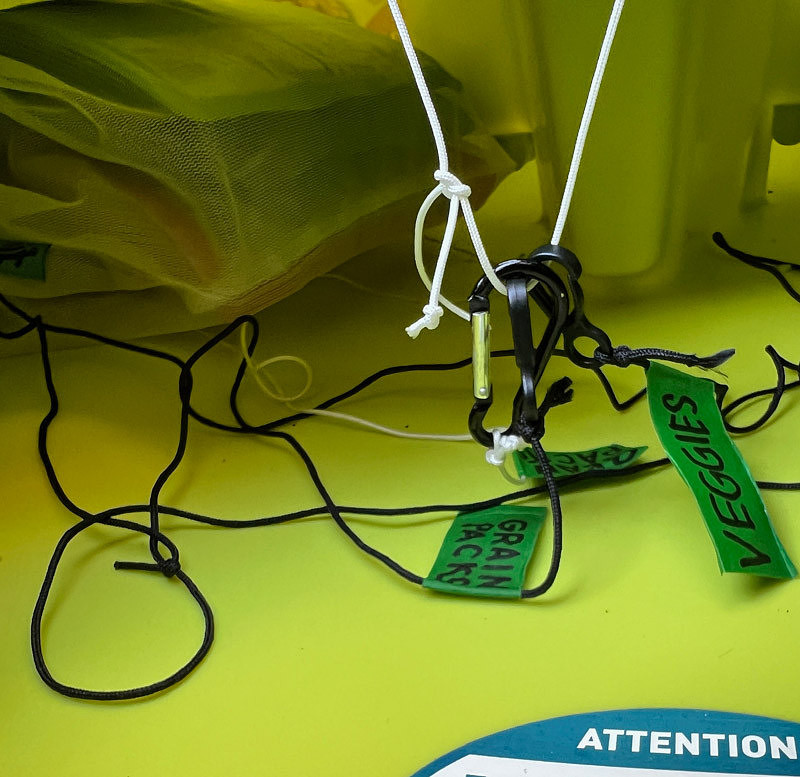
My in-hull system for storing and accessing food
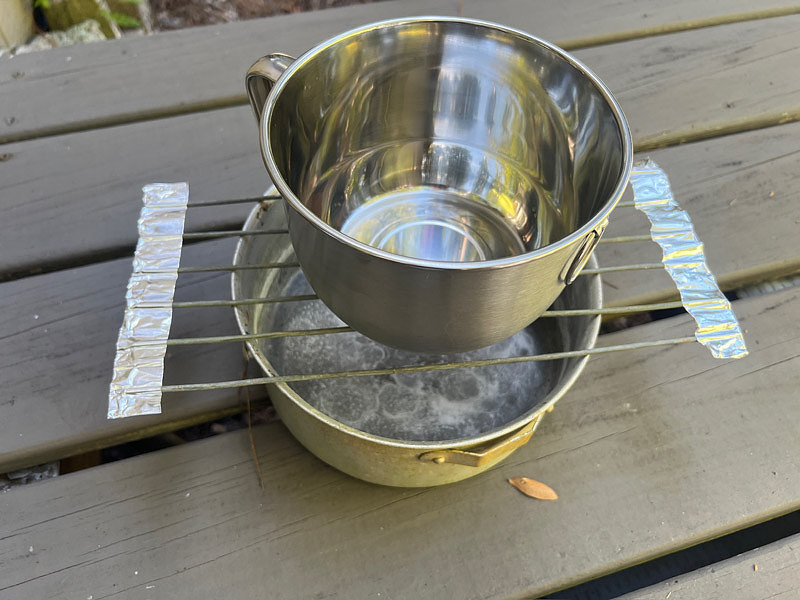
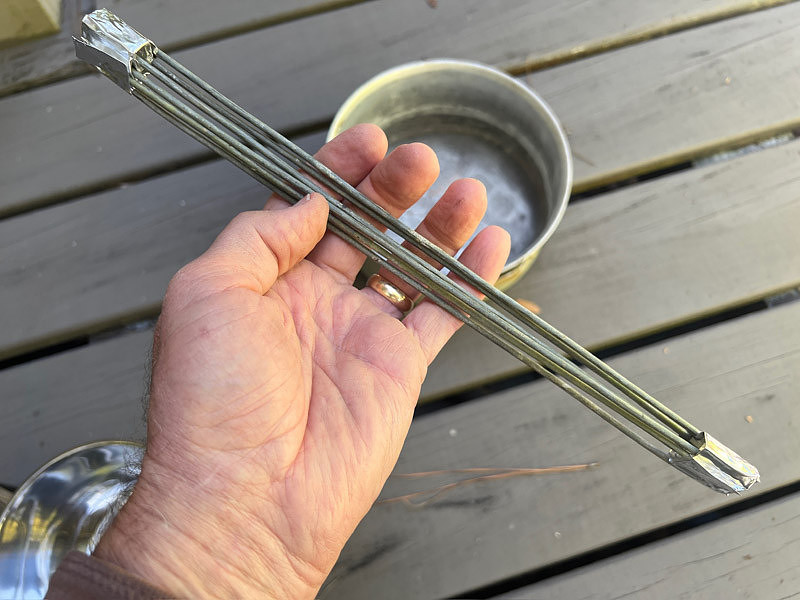
Invented a roll-up grill for reheating over coals.
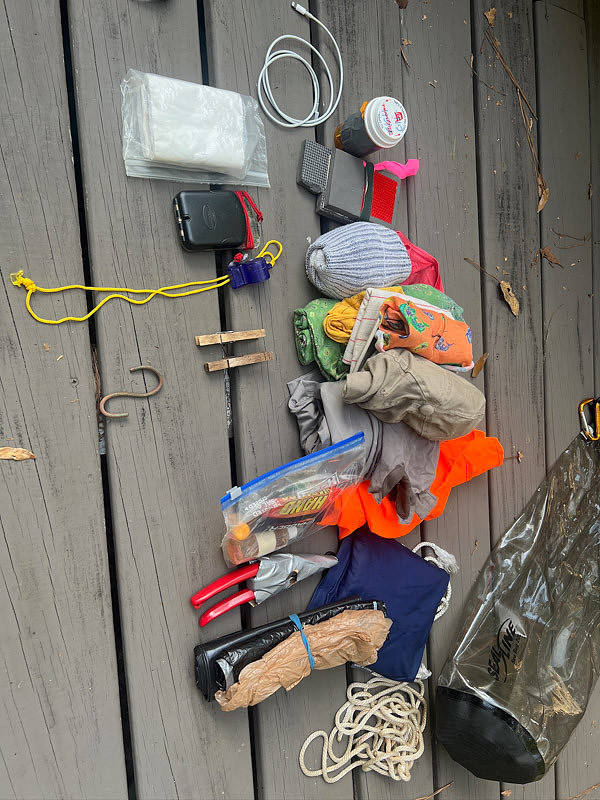
My Macgyver Bag contents. (A smaller toolbag not in photo.)
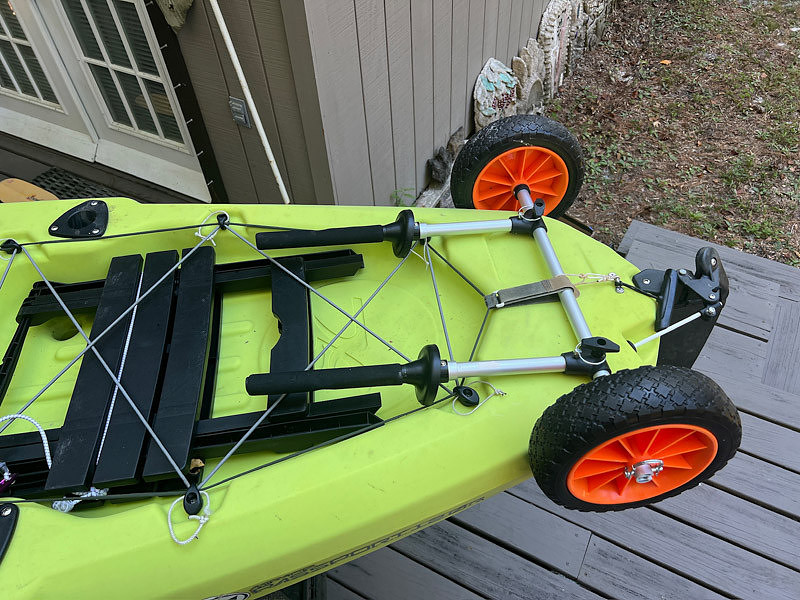
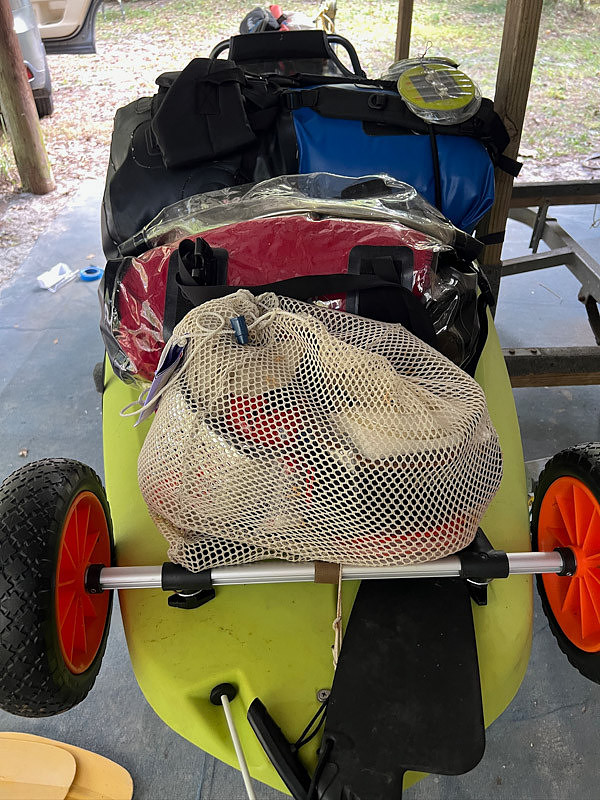
The wheels were handy several times. Well-worth having.
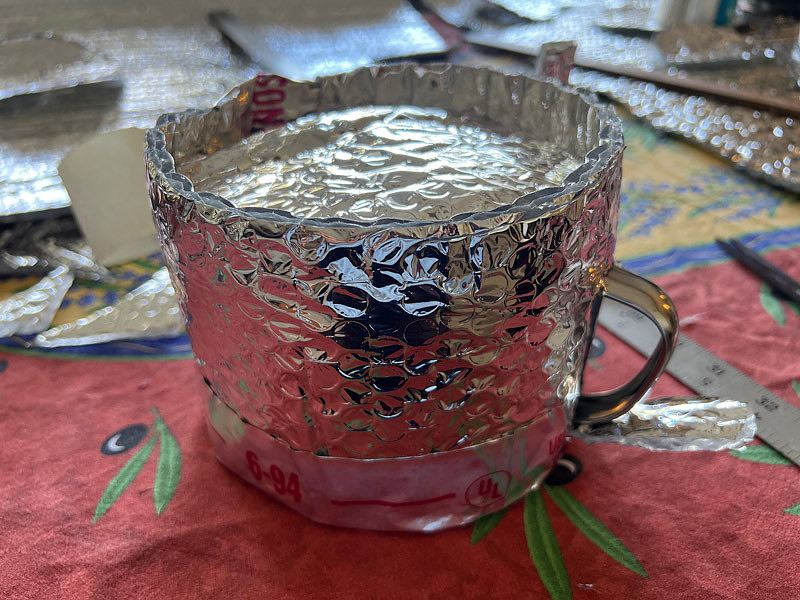
Cozy for ramen bowl, to keep pot hot while freeze-dried food rehydrates.
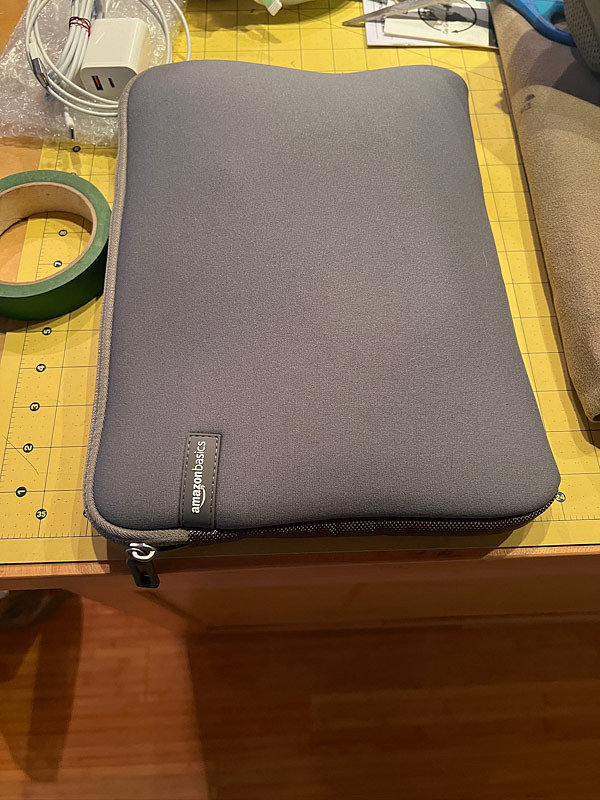
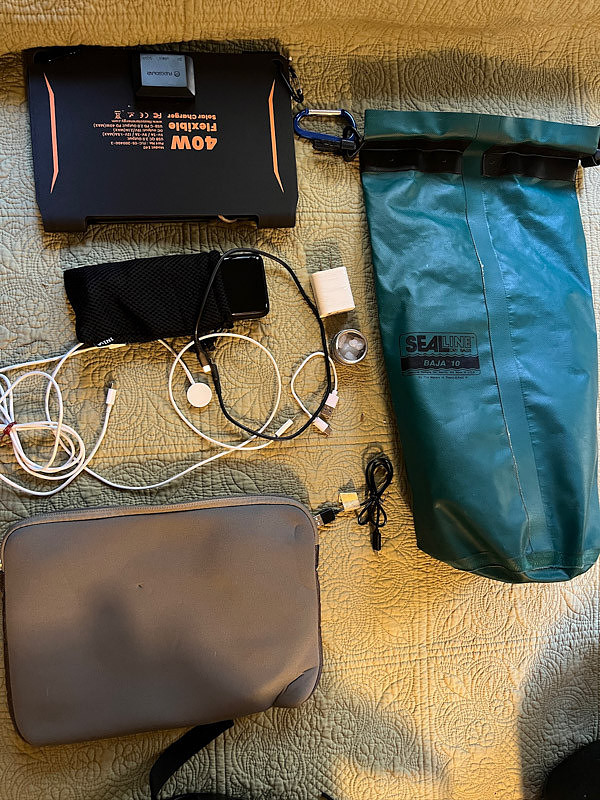
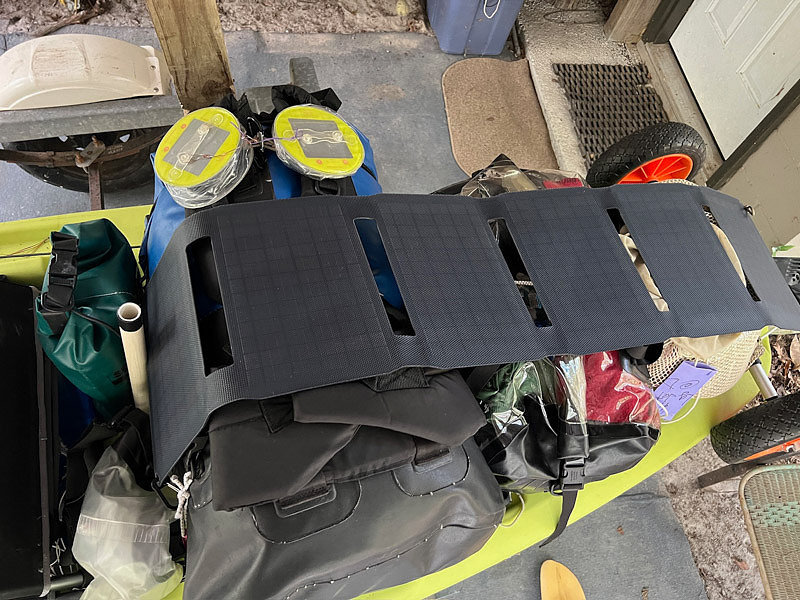
Perfect pouch for electronics, including solar panel. Fits into a drybag.
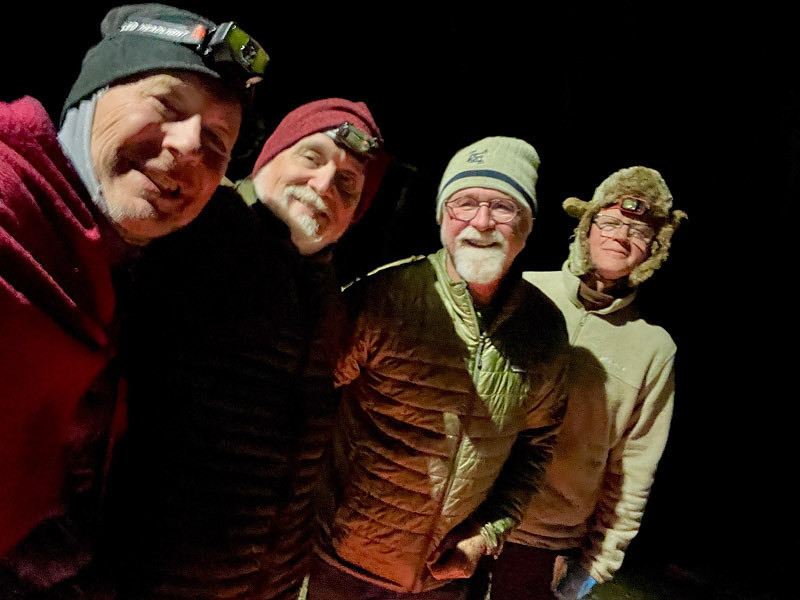
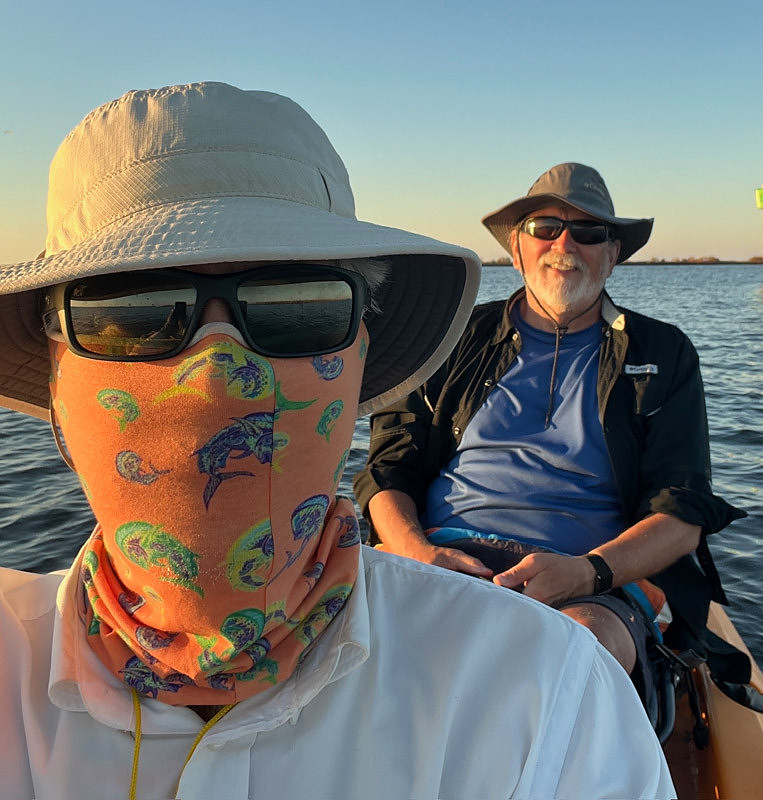
David Dave Jacques Steve
For a year, four of us, Jacques Depart, Dave Johnson, Steve Mills, and I had been planning to spend the first two weeks of November 2025 paddling the full length of the Suwannee River - from the Okeefenokee Swamp in Georgia to the Gulf of Mexico. Many factors figured in to whether we'd be able to actually pull it off. Jacques's bilateral knee surgeries, timing of Dave's closing/moving to a new home, Steve's nervousness about the long break in his work and grandparent duties, and my daughter, Lumin, dying in NY from a glioblastoma. In the end, it was the river itself that thwarted our plan. We were in a severe drought. We hadn't had the usual summer storms and hurricanes that dump tons of rain. The river was reaching record low water levels. That made the uppermost parts of the river unpaddleable, a mighty river down to a trickle from the swamp. Steve was staying in touch with Willie at the SOTS Canoe Outpost about conditions. We met two weeks ahead of our trip and all four of us committed to doing the trip anyway, starting as high on the river as possible.
That required a mental adjustment for each of us, letting go of the bucket-list-worthy accomplishment of the WHOLE river, for just a portion, albeit still 180 miles of it! Little did we know of the adventure awaiting us (especially due to the low water), of the trials and dangers, the thrills and disappointments, the sheer joy of daily rhythmic pedaling while watching our beloved river glide by. It wasn't going to be just a prolonged version of our 25 year history of annual long-weekend river camping trips (as I'd vaguely envisioned). Each day of the trip, I scratched out quick notes. Here they are, fleshed-out, sort of a hit-and-miss blow-by blow as I perceived and remembered it. The added photos are all snapshots made with our iPhones (not fancy portfolio images).
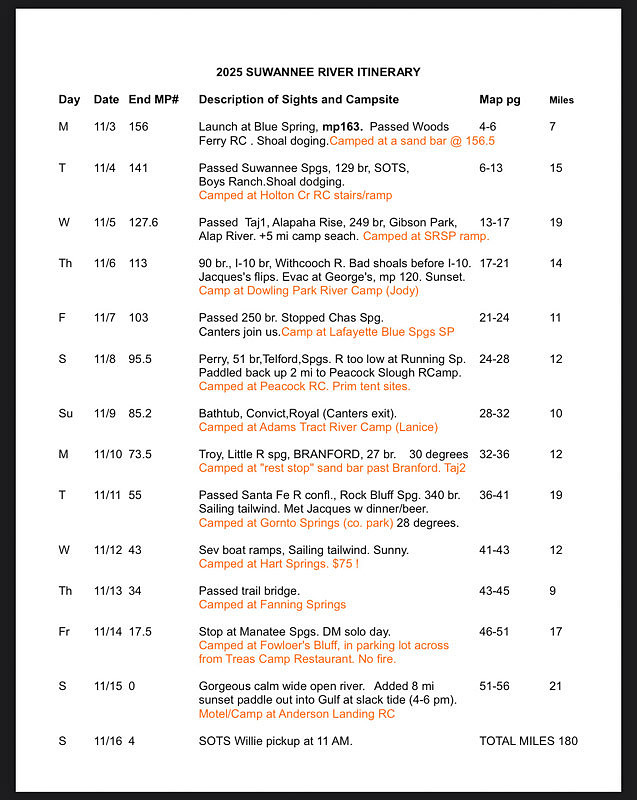
Monday 11/3/25. 7 miles from Blue Sink Launch (milepost (MP) 163) to an anticipated sandbar camp.
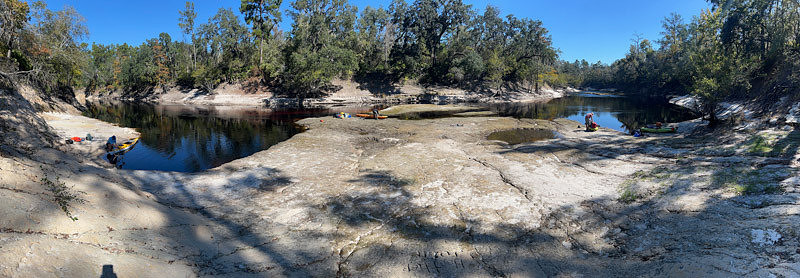
LOW River at Suwannee Blue Sink Lauch
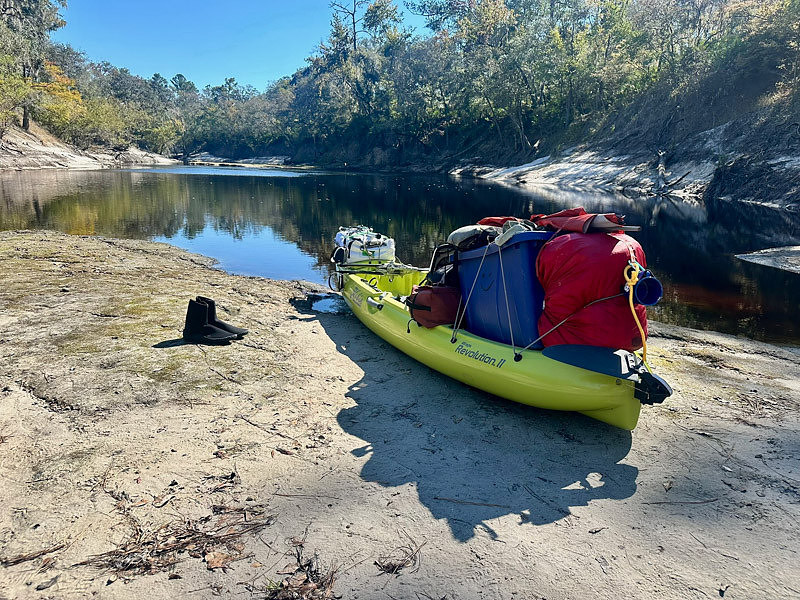
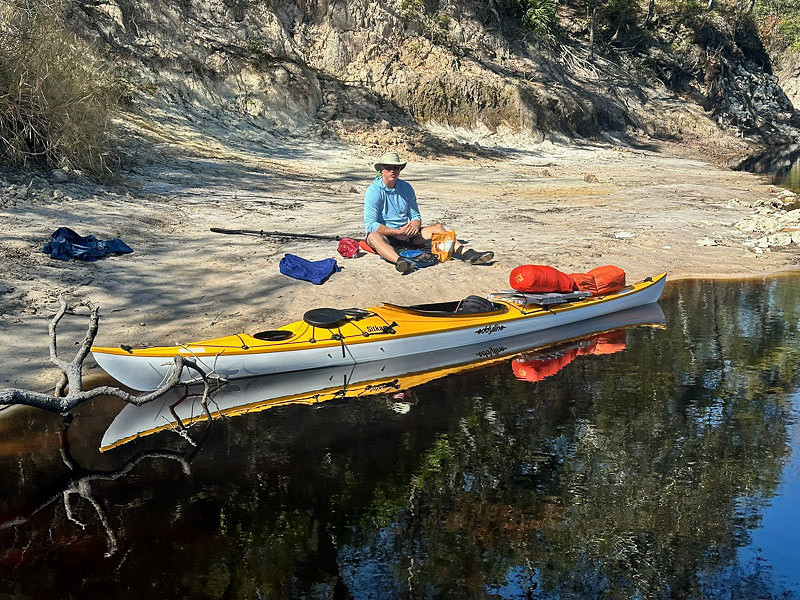
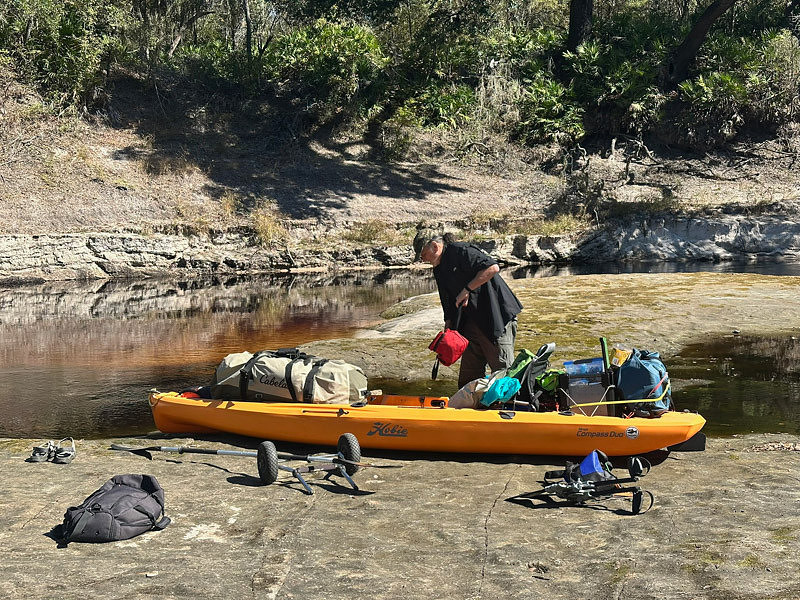
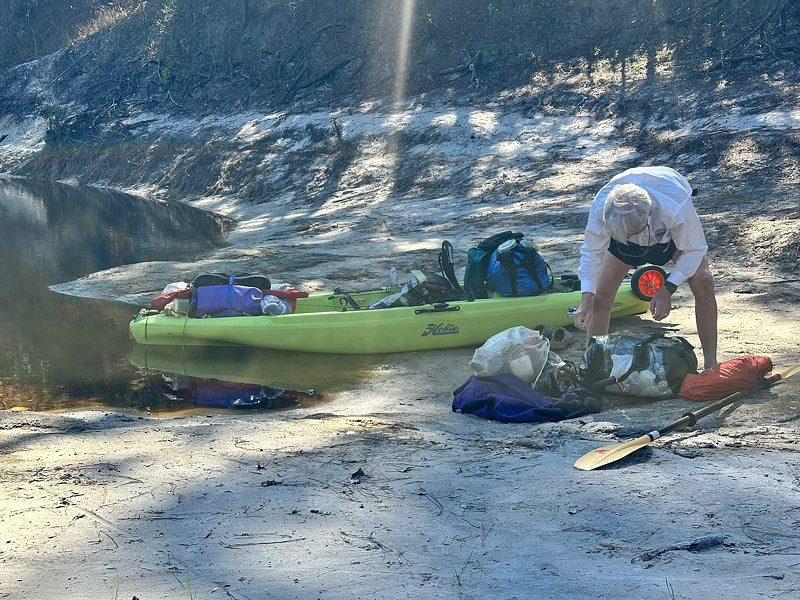
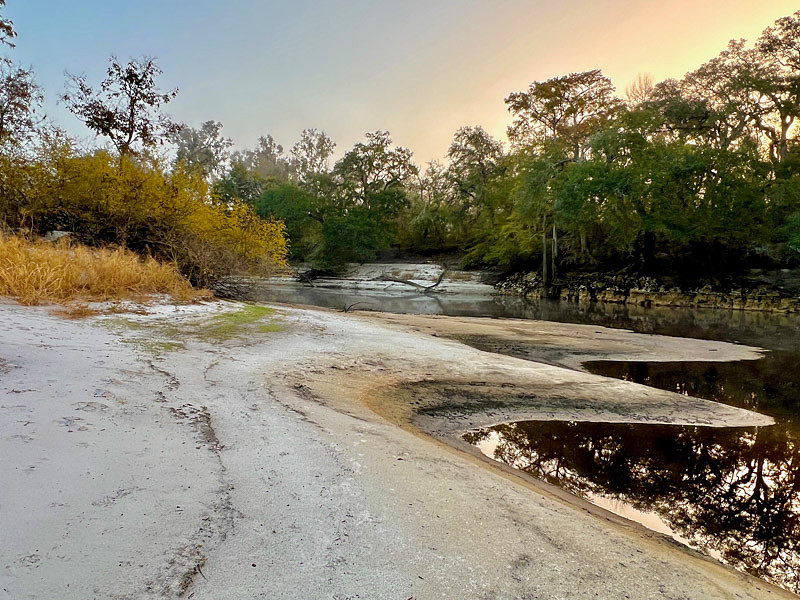
We launched at Blue Sink Canoe Launch, a strange long ramp and stairs narrowly switchbacking down from the parking lot through a canyon of oversized concrete block walls, (not quite wide enough for kayaks to go around the bends!!) At the bottom, the wide riverbed of rock and sand sprawled before us, dry, except for a small channel along the far bank. So surreal to see this mighty river so empty.
We shoved off at 2:30 pm after eating half our sub sandwiches Jacques had picked up at 7 AM, our boats carefully packed. Willie had shuttled our 2 drivers back from SOTS Canoe Outpost in Live Oak. We paddled past Woods Ferry River Camp, not stopping for water or a look. (Kind of wish we had.) Dave, Jacques, and I were in Hobie kayaks with pedal drives, pedaling - paddling with our legs instead of our arms. We pedalers had to zigzag carefully downstream seeking the deeper channels, switching to our paddles when we got into shallows. There were shallow sand shoals the whole way for the next few days (adding miles, and slowing our pace). We traveled 2-2.5 river mph, with the river accounting for an estimated 1 mph of that.
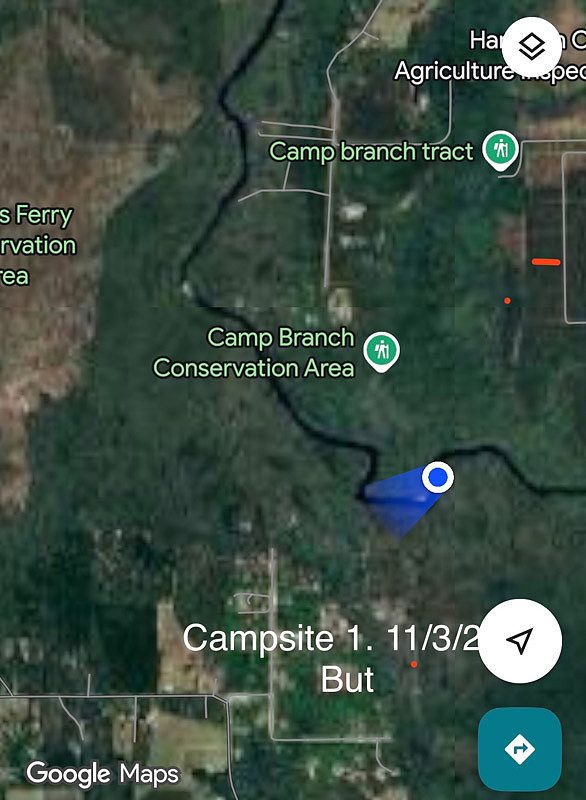
Traveling the river via Google Maps in the weeks ahead of the trip was so helpful.
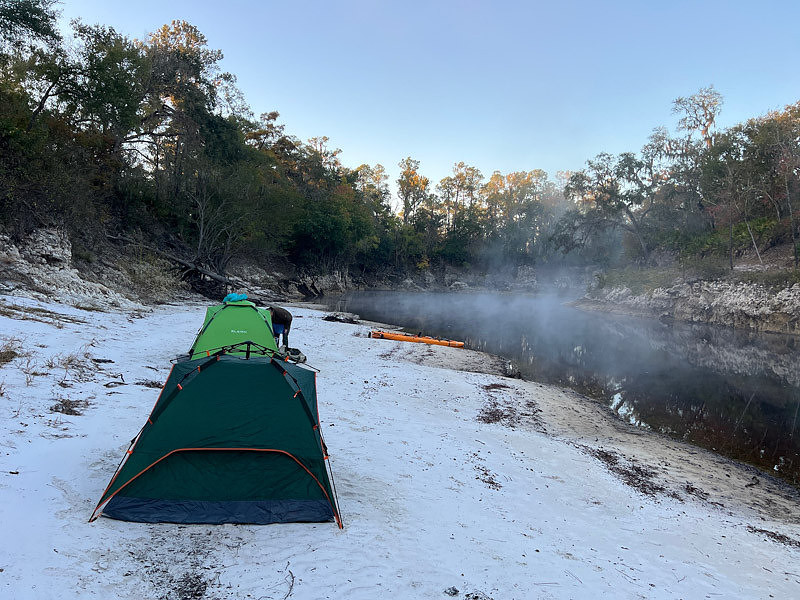
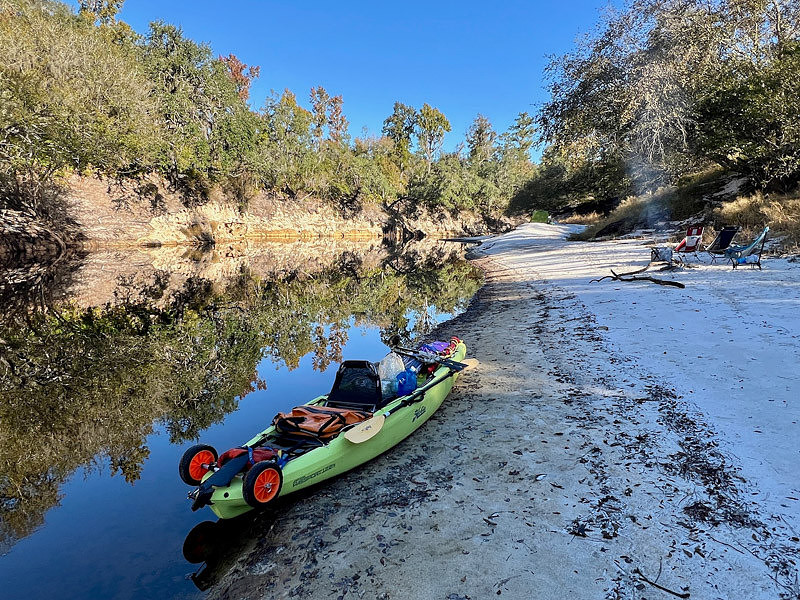
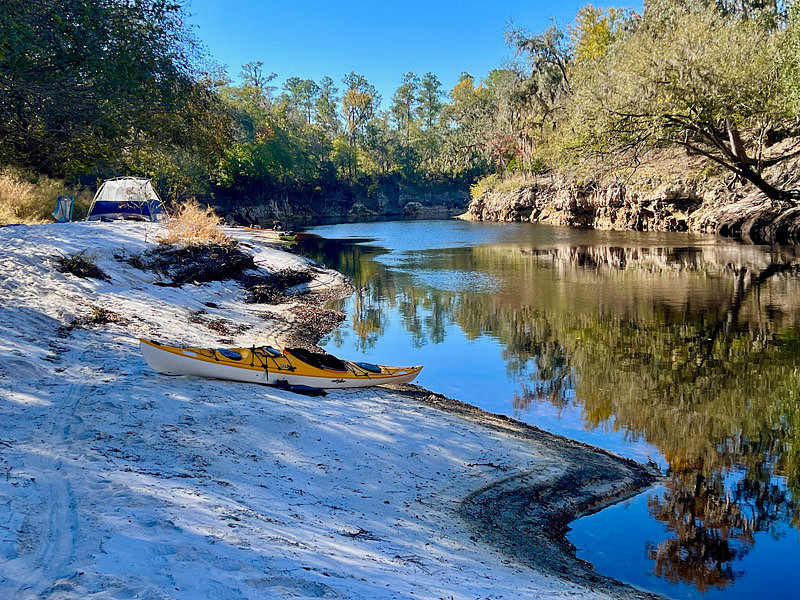
We camped at this nice sand bar @ MP156.5 and felt we'd made a good first day test run. It had been a warm cloudless day, with that night dropping to around 40 degrees. Dave had made some fire starters with lint, wax and egg cartons. Good thing because there were no palmettos (great natural starter) to be seen. The lint wax worked great, and became our go-to firestarters the whole trip. "Power of Lint"! Light was fading as we set up camp. I was disappointed to have so little daylight to prepare dinner.
That very first night, sitting down at the fire for the first time Steve’s trusty camp chair collapsed, one leg broken. He sat down too hard with the chair on uneven sand. Tossing the dead chair aside, Steve was resigned to sit on the cold ground for many days. He groused and took a bit of teasing. After awhile I put on my Macgyver hat and took a closer look at his chair. I found it was a relatively easy repair resulting in an almost-good-as-new chair, only slightly cockeyed. The chair served him well the rest of the trip.
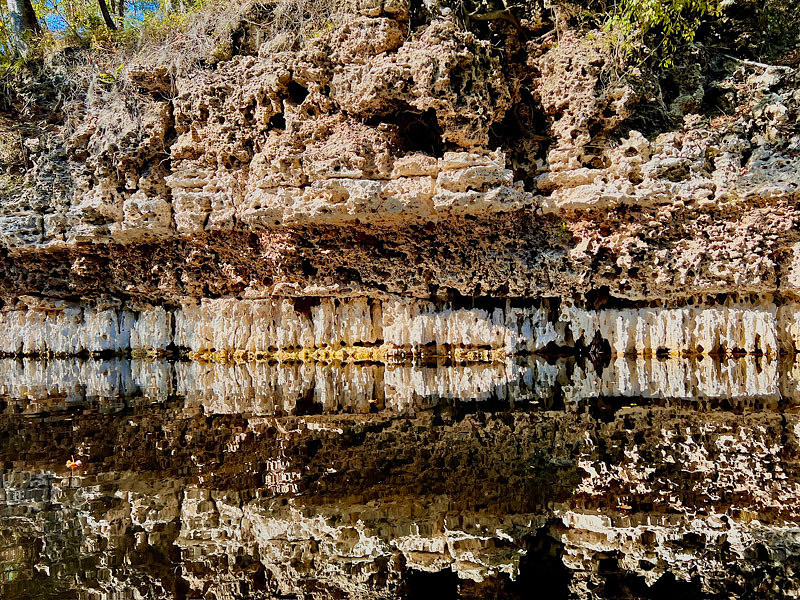
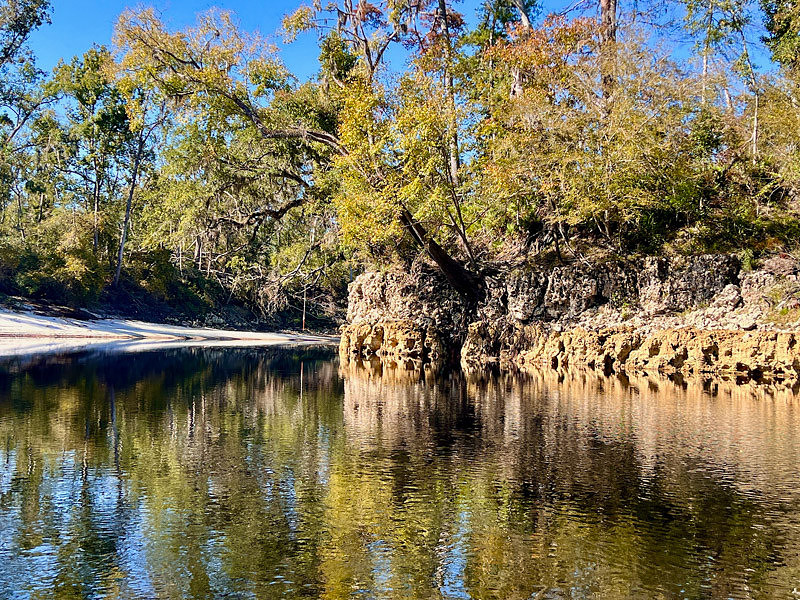
The Suwannee Limerock walls along much the upper half of the river are spectacular.
Tuesday 11/4/25. 15 miles to Holton Creek River Camp beach.
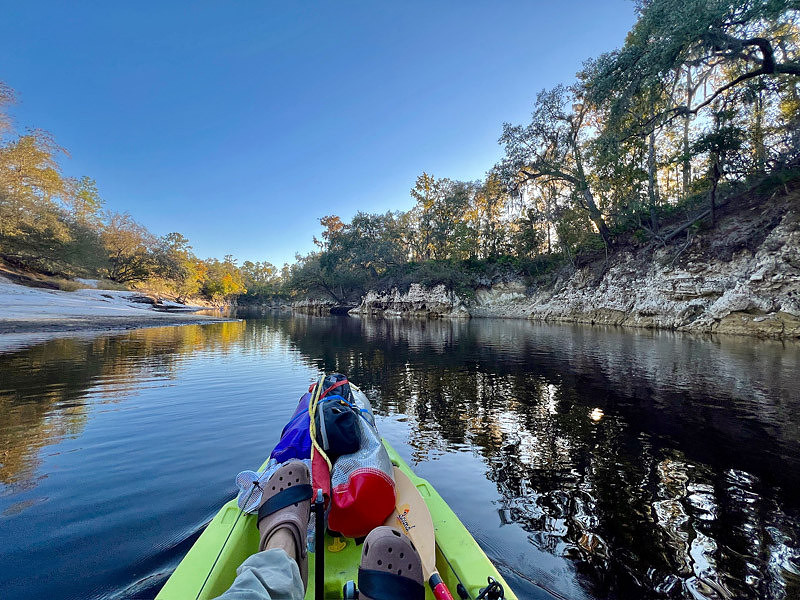
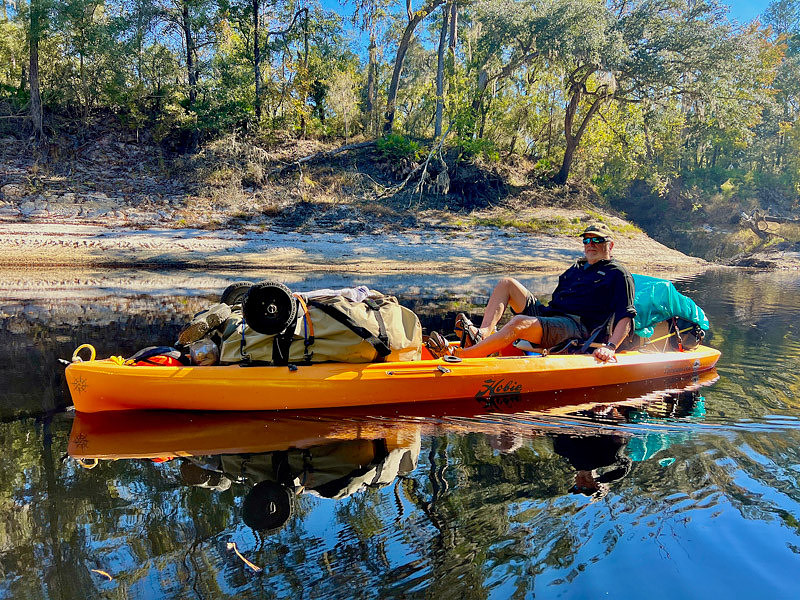
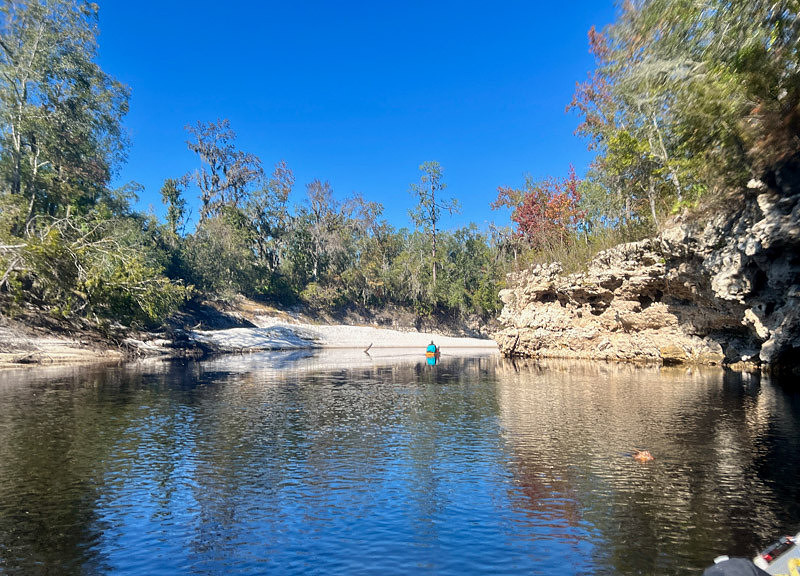
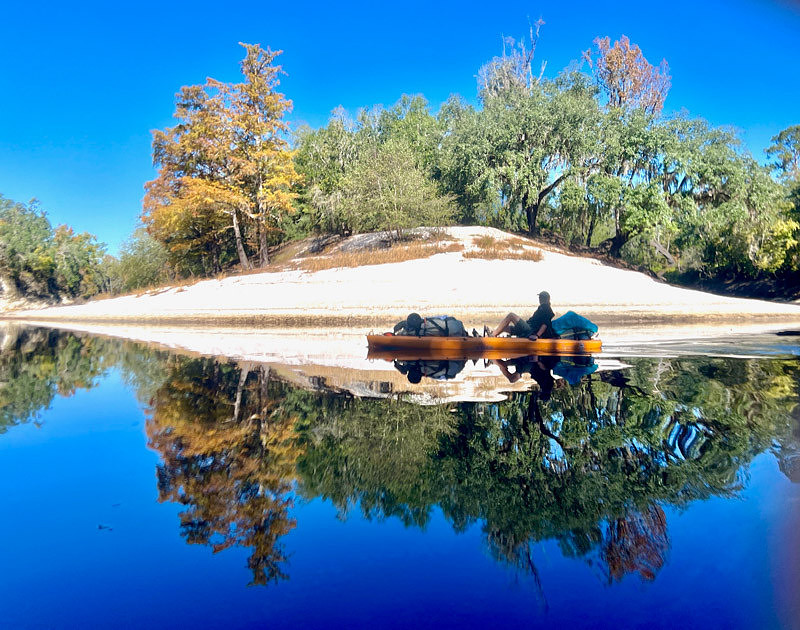
Slow pack-up our first morning. Still getting our organizational systems down. Plus we enjoyed a long slow coffee and breakfast by the fire.
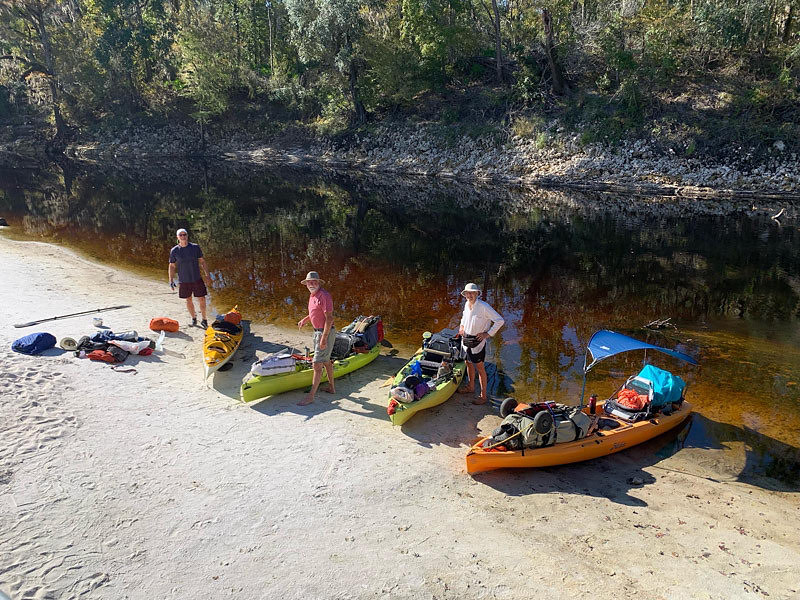
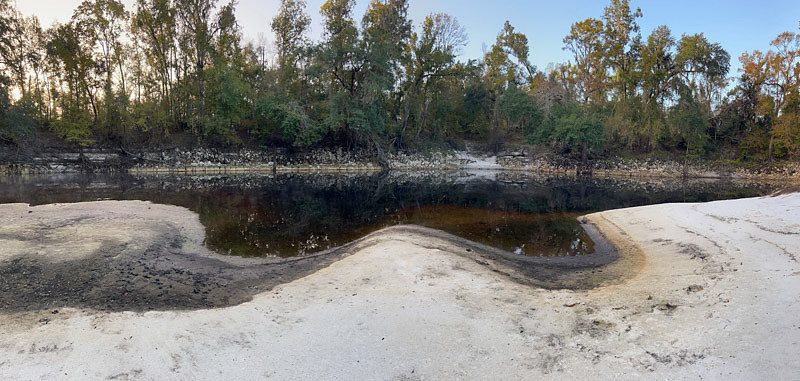
We got on the river at 10:30 and paddled 15 miles (double yesterday), still dodging sand shoals much of the way. Along the way, we passed Suwannee Springs, the 129 bridge, SOTS (stopped briefly at our cars), and the FL Sheriffs Boys Ranch property, all familiar landmarks. Finally stopped at Holton Creek River Camp expectantly, but found it closed, overgrown, no water or power. Steve proposed paddling on to our old "Taj" sandbar (2.5 more miles), but we voted to stay at the HCRC beach and ramp. The daylight was fading and we were exhausted. It turned out, the River Camp decking provided tent sites and cooking platforms, level and firm. Steve stayed in first screen house at the top of ramp. He had a surprise encounter with two FL Trail hikers who came through well after dark. Where the rest of us would have curled up quietly at the sight of lights bobbing toward us in the nearby woods, hoping not to be noticed, Steve went after them (after scaring them with his own light), met and talked with the night hikers.
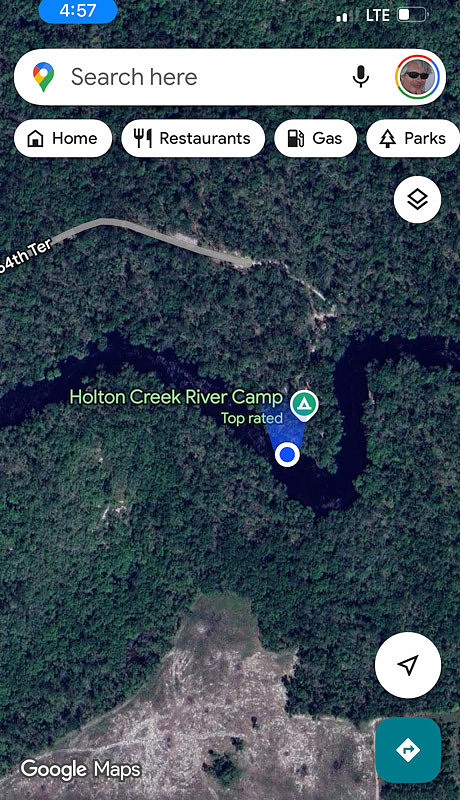
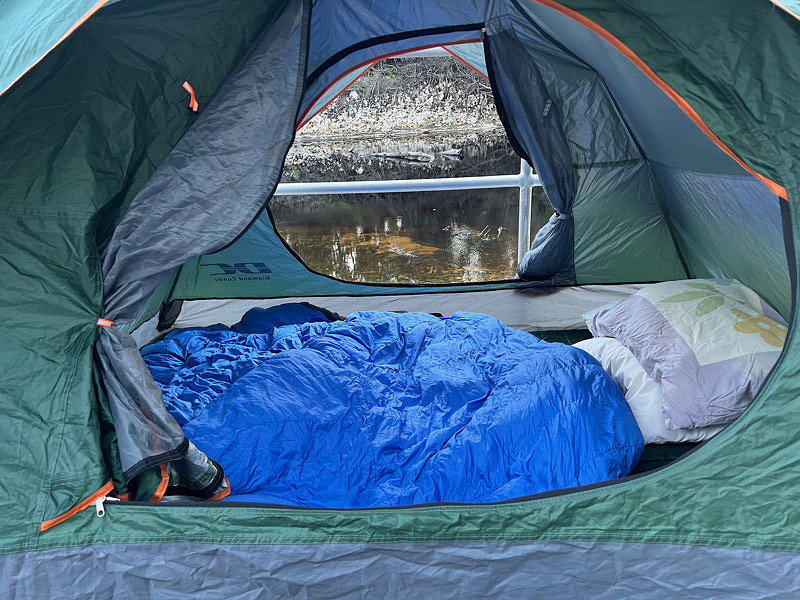
Morning view from my tent perched on a deck landing.
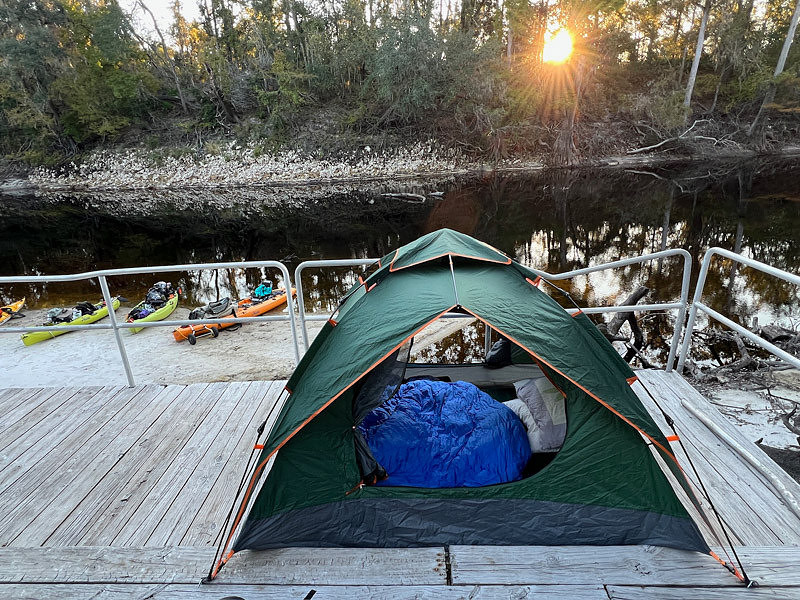
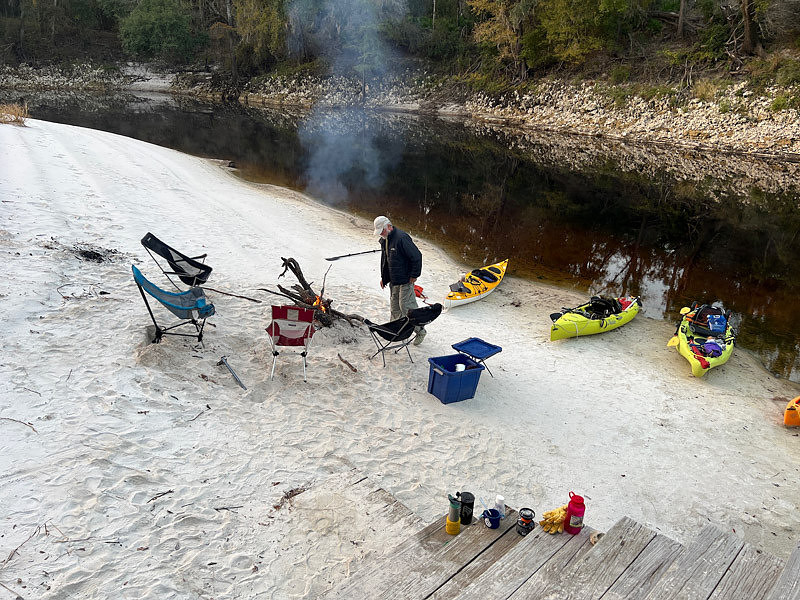
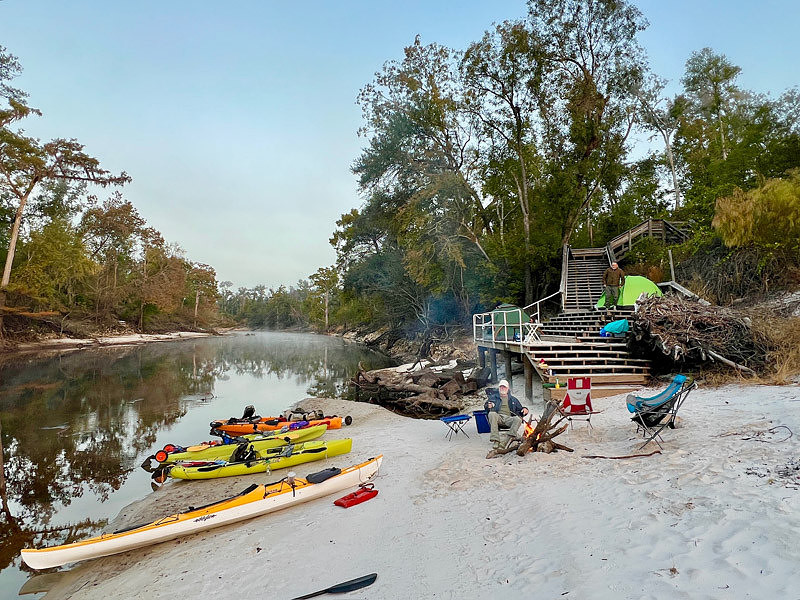
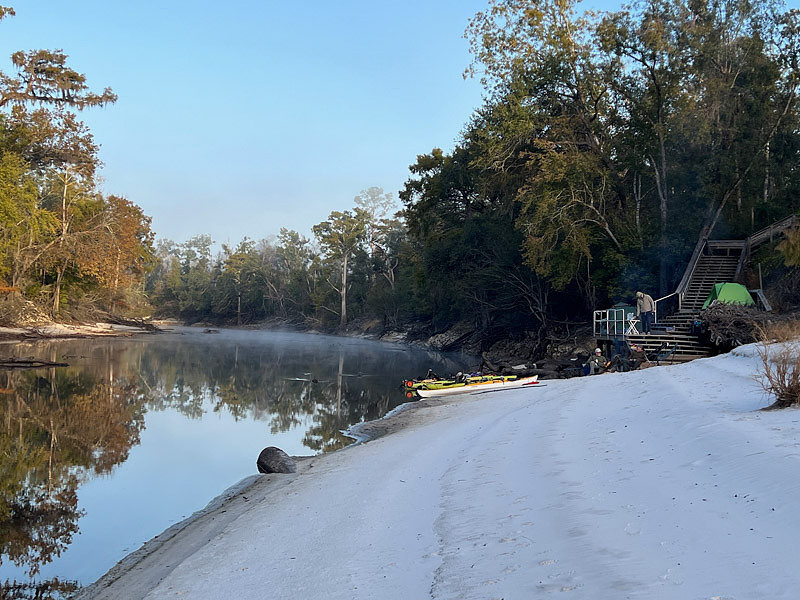
It had been another cloudless day (and our 2nd night night was about 50 degrees). We had a nice beach fire and enjoyed the evening.
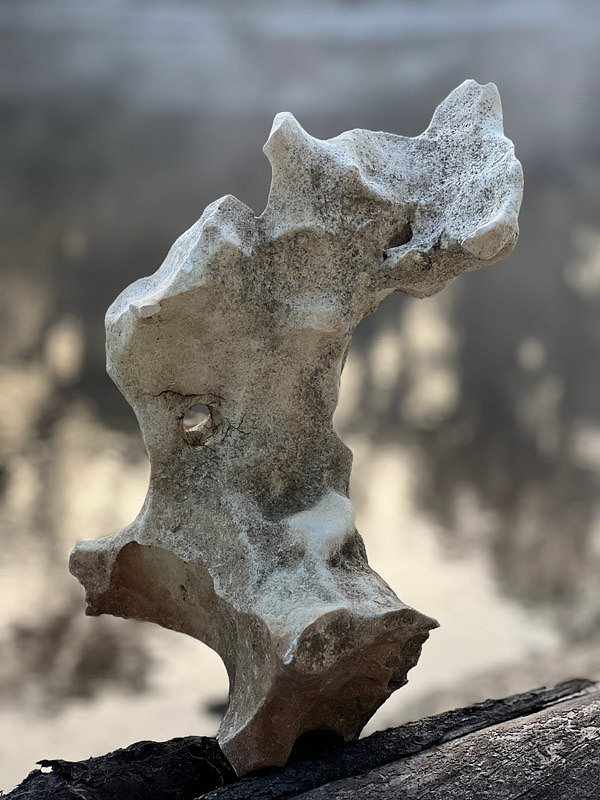
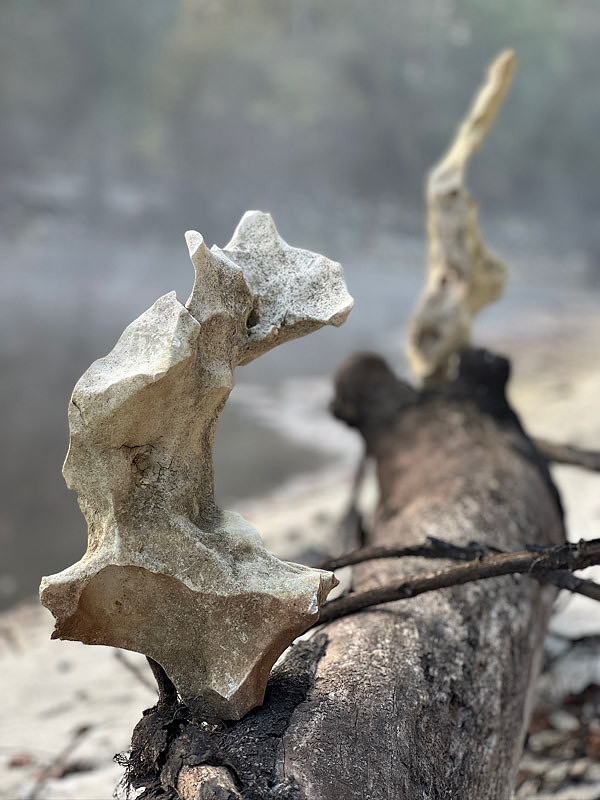
We were much refreshed in the morning and very close to our boats so packing up was easier. I found some beautiful sculptural river rocks strewn at the upstream end of our sandbar. I made some photos. And saw the one sturgeon jump from the river. A good omen?
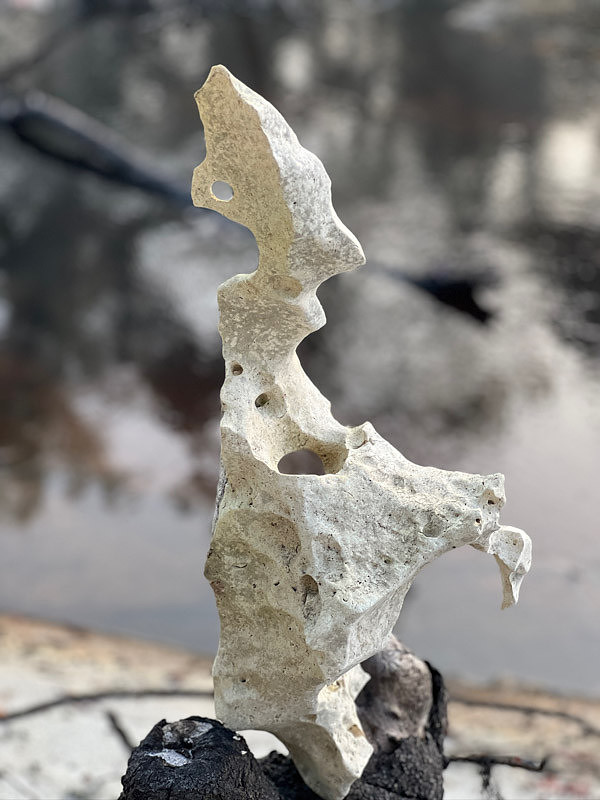
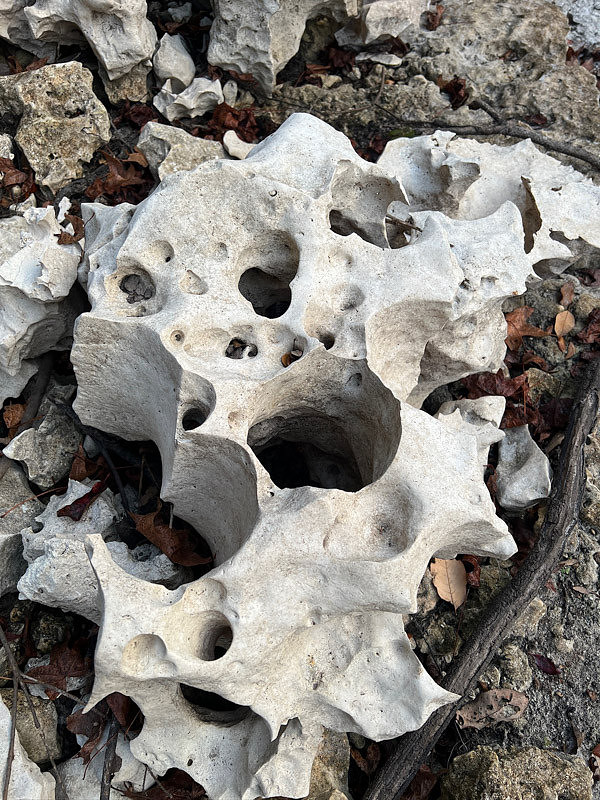
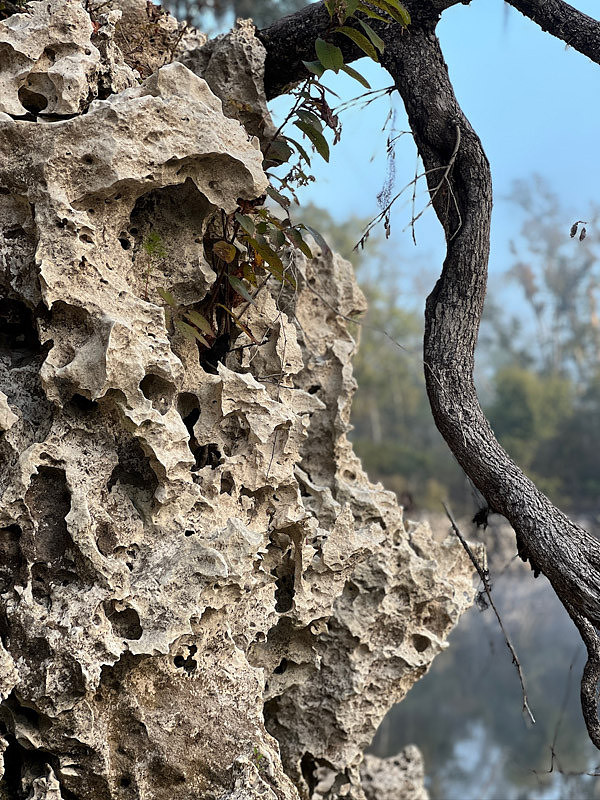
Suwanee River Limerock is unforgivingly sharp
Wednesday 11/5/25. 19 miles to Suwannee River State Park.
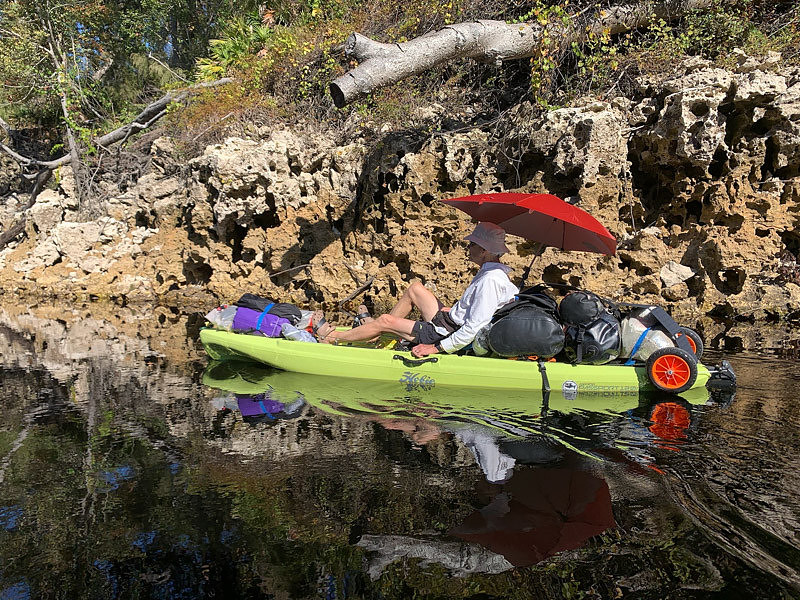
Me, in my 12 foot Hobie, kindly lent me by Dave's wife, Corine. I rigged an umbrella stand, though it turned out better to hold it.
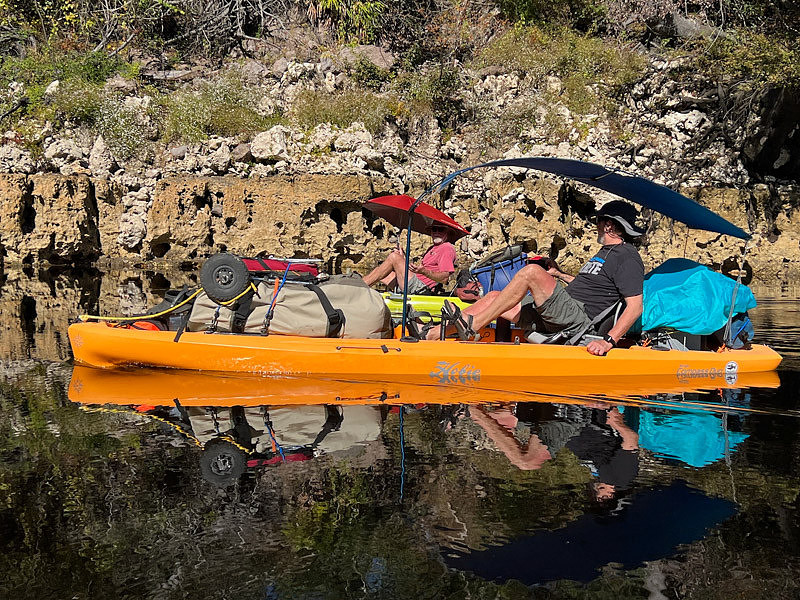
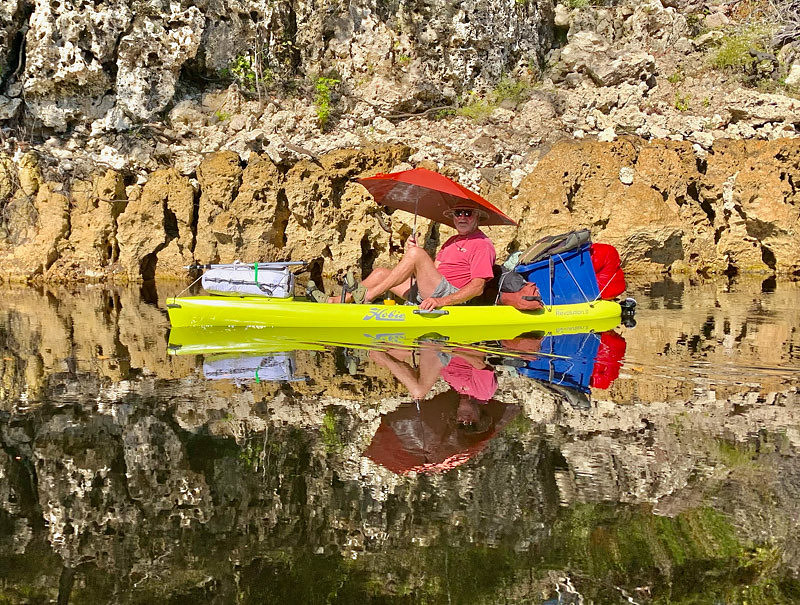
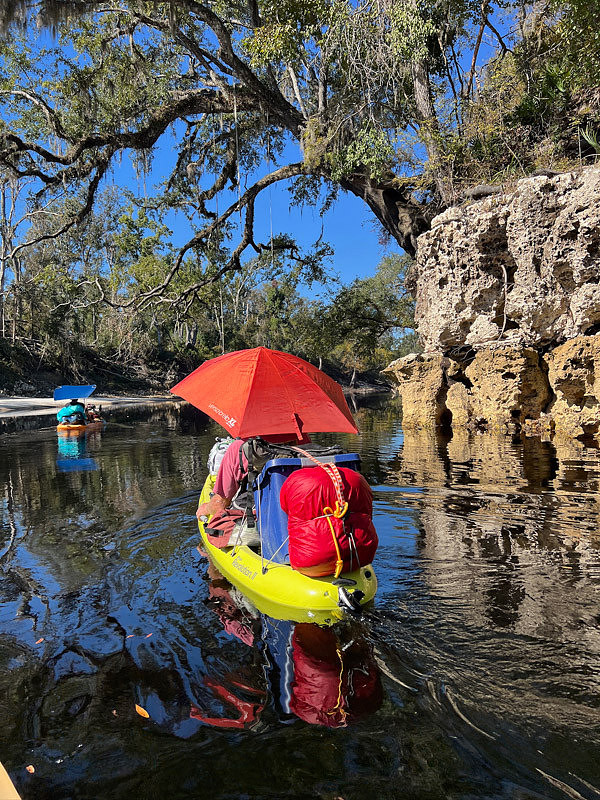
Arriving at the Suwannee River State Park boat ramp as our planned stop, we found it a dismal campsite. No amenities, no fire option. Water was 1/4 mile away and no bathrooms nearby. We couldn't find a ranger etc. We had passed old Taj, Alapaha Rise, 249 bridge, and Gibson Park. We were very near the Withlacoochee R confluence where there was a known campsite, high on the bluff, so back into our boats. But that site was occupied. Jacques and I paddled downstream a mile and found nothing. I recalled an old site I camped in 20 yr ago that was within a mile upstream of the boat ramp. (This was confirmed by the bluff campers) so we all paddled back upstream looking and looking. 2 miles up and nothing. Losing daylight, we returned to SRSP ramp after 5 pm, having added at least 5 more miles of paddling. Exhausted and discouraged, we all skipped dinner and went to bed early, stealth camping in the parking areas and ramp zone. Night low 55.
How was I faring 3 days in? My down bag was too hot even as a loose cover on these warmer nights. I needed to figure out other options. Sleeping was fair so far... Lots of wake ups but >8hr in bed. Low back pain (muscle tension and spasms) on and off during river time. Exploring cushioning and position options. Happy with knees and legs - holding up well. A little rubbed sore spot on inside of R foot. A worry. It had been another solid sun hot day. The tops of my legs got mildly sunburned, though I was using my umbrella as shade, hat, long sleeves, etc. No good. Total body cover needed for rest of trip including long pants and socks, along with umbrella shade. Great to be able to use brella with my right hand (pointing it at sun which moved all around as the river wound in every direction) while steering with left hand and "paddling" with my feet. It was also hard to stay hydrated as thirst is not a strong sense and I generally forget to drink, but I was getting better at frequent water breaks (as well as peeing in a bottle while pedaling along).
Thursday 11/6/25. 14 miles to Dowling Park River Camp.
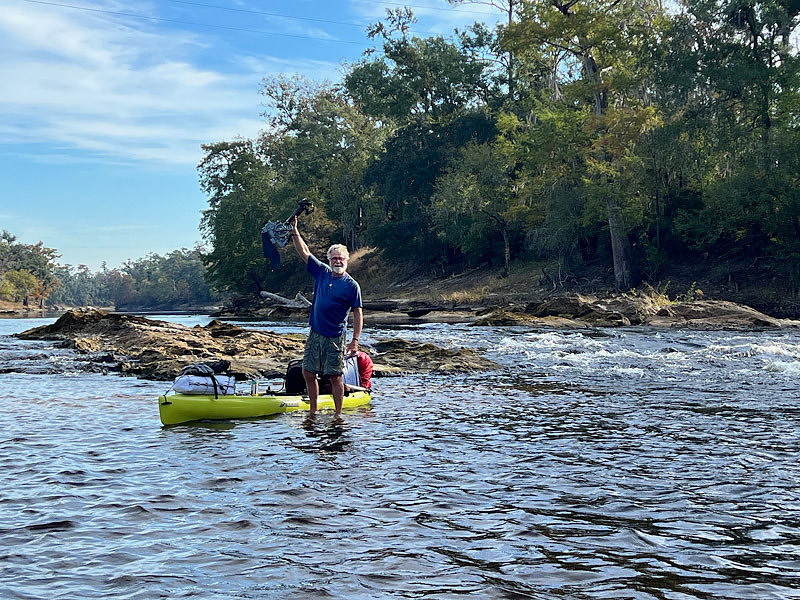
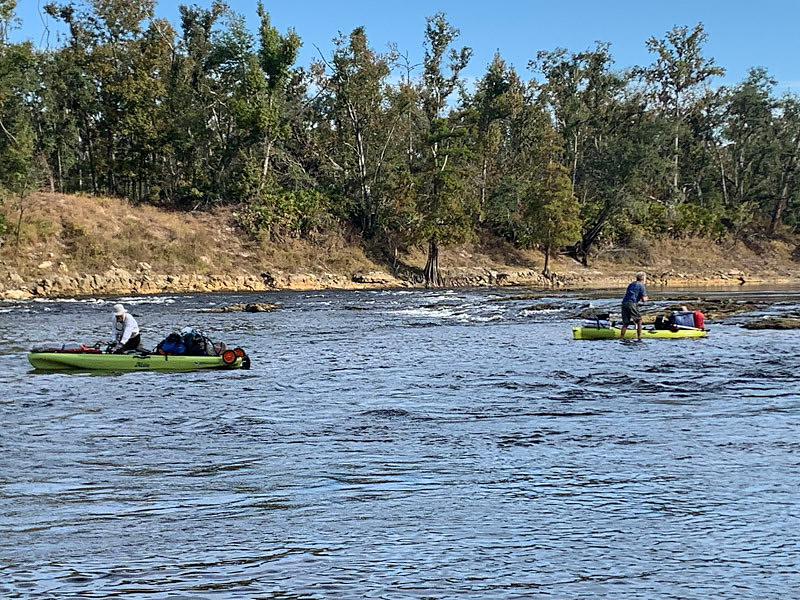
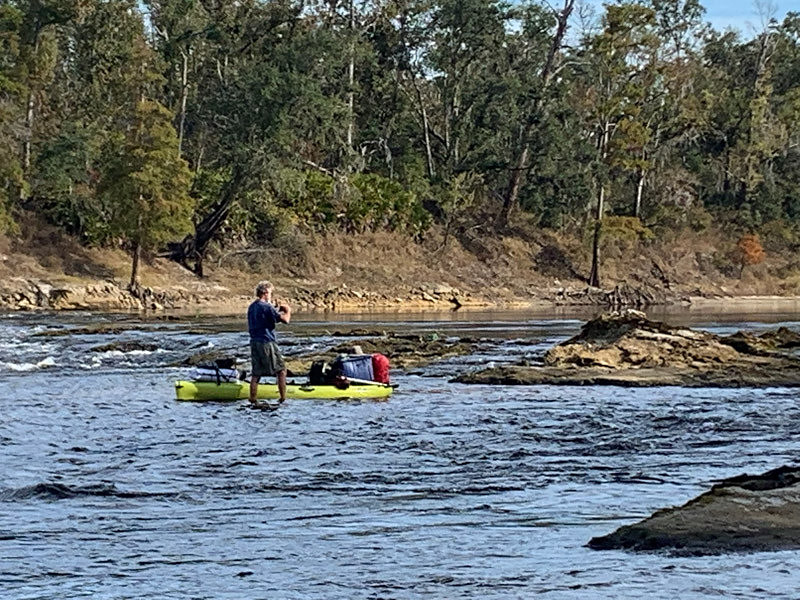
We got onto the river by 8:30! Earliest start of the whole trip. We came to two sets of rocky shoals just before I-10 (within an hour of leaving camp). The first was short with a fairly clear path. I went through, then Dave without mishap. Jacques followed, passing through the "V" smoothly. Thinking he made it, he let the flow carry him and got sucked in a big eddy which spun his bow hard right. He was dumped over downstream. He was able to stand and right his boat. Luckily a sandy bottom. He thought all was ok until he realized he'd lost his pedal drive. Bad news! I paddled back up, tied my boat to a snag and together we searched. Luck had it that I found it, dark against the light sand in thigh-deep water. Back in business. We 3 concluded that we needed to tie our pedal drives into our boats whenever we detached them for shoalwater. (Steve was still upstream, having lingered at our starting point, since he is much faster in his sleek paddle kayak.)
A short distance later the three of us came to another, bigger broader shoal with multiple sections of whitewater and rocks. I chose a large V in midriver that looked promising and ran it. I paddled hard right against the flow to dodge a snag sticking barely above the surface. I still bumped it but moved on downstream. Dave had seen and heard me bump the snag, so he was wary of it and paddled through smoothly. Jacques, still rattled from his previous dump, entered the V with trepidation. He hadn't seen the snag and his bow got sucked into the trap, caught by the snag. He capsized downstream again, but this time, his boat hung against the snag and other underwater limbs, pinned firmly by the fiercest current of the whole shoal. The water was cold - probably about 66 degrees. Jacques saw his paddle floating, grabbed it and headed for a nearby rocky island.
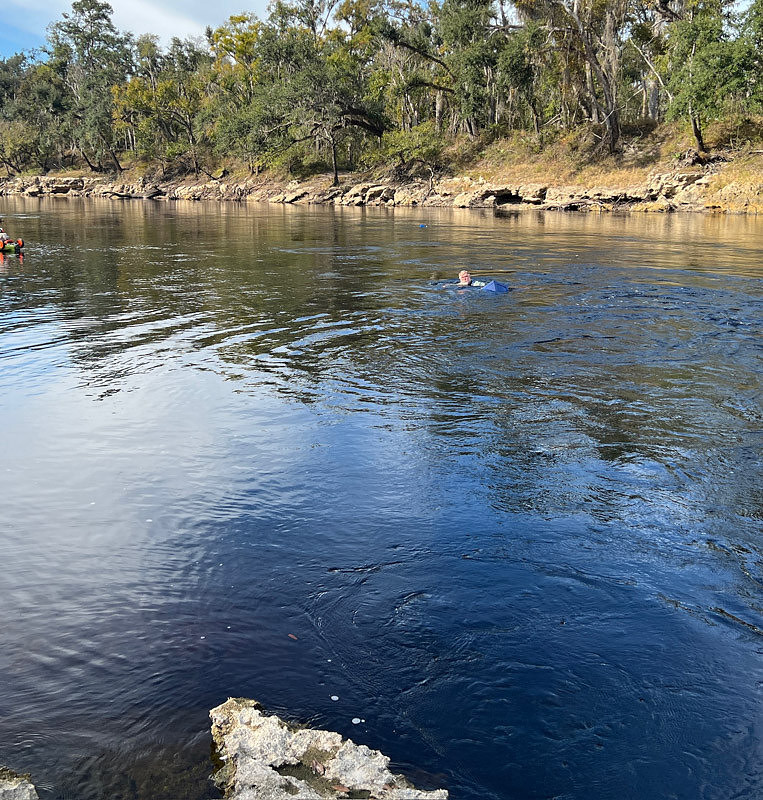
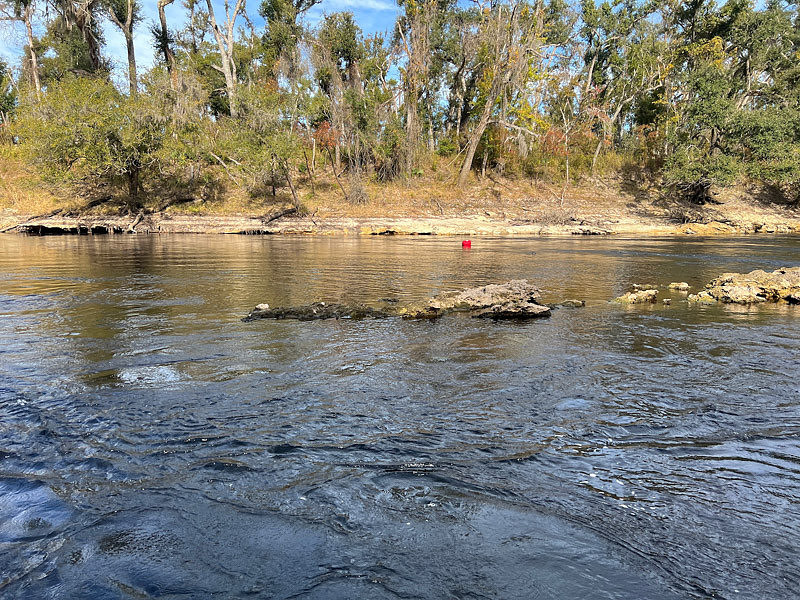
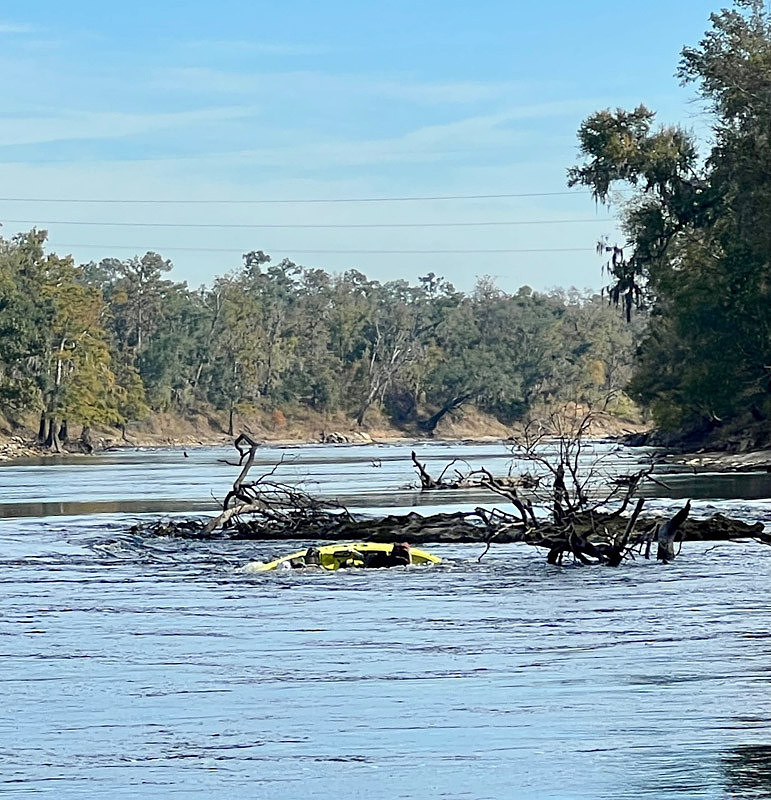
Jacques's boat is pinned against underwater tree by fierce currents.
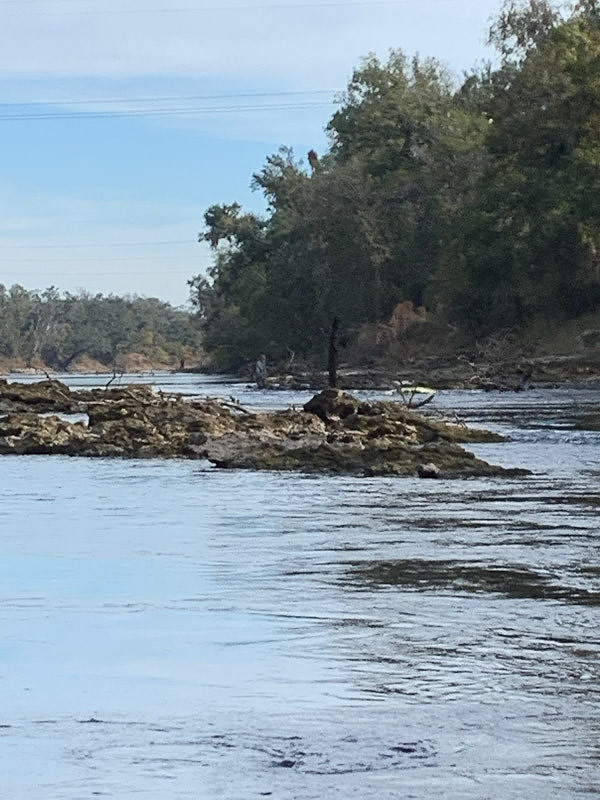
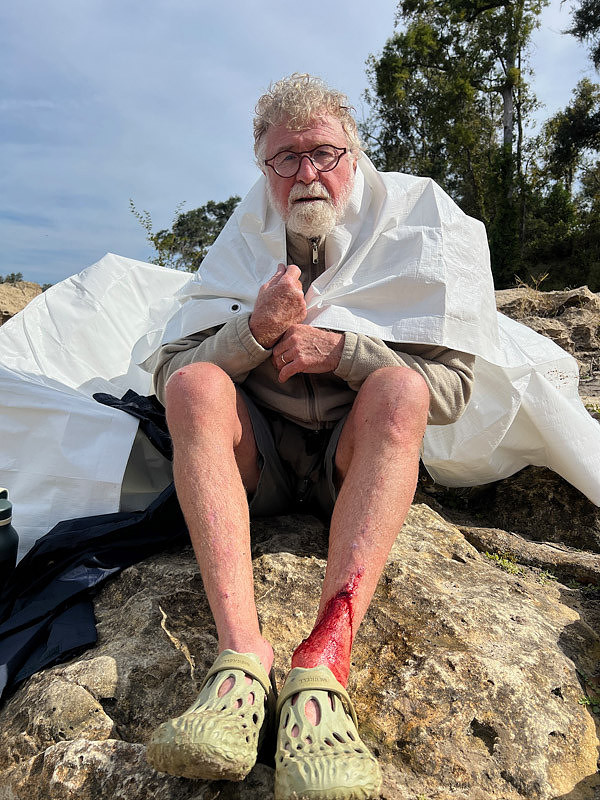
These river rocks aren't just smooth limestone. They are jagged, super sharp and slippery with infectious slime. What's more, these small rock "islands" (islands only in this very low water), have been undercut by the severe current over the decades. So, what looks like an easy climb out, is actually treacherous and very difficult. Jacques got out, but gashed his left leg badly in the process. He threw his paddle to me on shore, then saw a big red bag floating by (his sleeping bag) and leapt back into the water to chase it down. Right about then, Steve came from upriver and saw Jacques leap into the river. At first he thought we were taking a play break, but then he saw the capsized boat trapped in the mid-river channel. Steve checked out channels on the right side of the river, found a safer passage and ran it without difficulty. He brought his boat around to the left bank (where we were) and pulled into a gap in the rocks.
Jacques got to shore with his red bag, not far downstream from his imperiled boat. Stuff was coming loose from J's boat, so Dave was out there intercepting all the flotsam. I followed Jacques upriver along the shore, trying to formulate a plan. Jacques had seen his boat trapped and could imagine only ONE plan to do ASAP... rescue his boat. So he had already found a walking stick and was wading into the shin-deep water upstream. Shallow as it was, it was very difficult to walk due to the intense flow. Jacques came to a deep fast trench between him and the rocky island that led near his boat. He struggled across, though as I waded and watched from 20 yards back, I saw that it took all his will and strength to do it. When I got closer and he was climbing up, he said "don't go this way. It was really difficult." I reached another point where I was about 6 feet from the island. I was leaning hard on my stick just to hold my position, with no idea how to get across the deep racing trench before me. Meanwhile, Steve had also picked up a stick, more like a tree (stout and about 7 or 8 ft long) and was wading along the same path. We were so close, and yet. Then I saw a cup-like hole in the rocks across the trench and pictured Steve's stick jammed into it with me leaning hard on the other end, creating a rail for crossing. A stable lifeline? Steve tested it, holding tight, and on about his third step into the deep races, he was swept off his feet, but clung hard to the "rail". He swung his feet to the rocks and found a purchase over there. Whew. I knew I was still stuck, and more wary than ever of the crossing. Jacques was out as far as he could get on the tree snag, but still a good four feet from his boat. Steve opted to wade along the right side of the island, perhaps nearer or less sharp? And then I saw him drop in deep up to his neck, and knew he no longer had footing on anything. He was moving fast toward Jacques's boat. Then, just before he reached it, I saw him very suddenly go down, hat and all... and he was gone. Seconds passed, long enough for my heart to sink. And then, he popped back up on the far side of the boat, where he and Jacques managed to grasp each other and Jacques pulled him up. Steve said he was just as surprised when he got sucked under, and that he'd been briefly hung up on the same limbs holding Jacques's boat. He had flashes of his death and...., and then his leg came unstuck and he was popped back to the surface. Wow, what a relief I felt when I saw him reappear. I can't imagine how he felt.
So, there we were, the two of them out there and I could neither hear nor talk to them over the roar. I decided I'd be more useful in my boat downstream, so I began making my way back to shore. Once there, I saw Jacques leap across the narrow raging channel onto his boat's starboard upturned rail and grab fast to the handle there. Insane stunt, I thought. But like Jacques, I thought that might just release his boat. It didn't. Jacques clung to his boat for a long time, probably not a full hour, but it sure felt like it. He'd just been through a traumatic accident, had a bad bleeding cut, was exhausted from the challenging efforts already undertaken, was hypothermic, probably numb and stiff... I was worried. But I remembered Jacques telling me weeks earlier, that his M.O. has always been to take action as soon as a problem presents itself. He hates to suffer from worry or uncertainty about things unfinished. So this progression of actions was simply Jacques being Jacques. With his free (stiff and numb) hand, Jacques began trying things. Could he move the snag? Break off anything? Move the boat fore or aft? He did succeed in shifting the boat's position a bit. He also began untying things.
Meanwhile I got back into my boat and tried to paddle hard upstream. I could make it up to within 30 yards from J's boat, but no closer. I just couldn't keep my bow pointed into the strong current, and once deviated a bit, I'd swing wildly off course. Clearly this could capsize me, so I gave up. I was wishing we had all put on our life vests. None of us had. And I was fantasizing about a plan where we had run a long line down the river from above Jacques's boat, tied it to the bow of an emptied boat with paddler, and then pulled him up to Jacques' boat. From there a line could be attached and tugged in any number of directions, my mind whirring... Just then, Jacques sprung his boat free. He had just untied the last bag, his white foredeck bag, and whoosh, he was floating downstream with his swamped boat, looking bewildered. I intercepted him in calmer water and moved to a sturdy snag where J climbed onto the limb, panting, out of breath and freezing cold. I tied his boat to my stern, and once Jacques was able to focus, told him to lie across the bow of my boat. I paddled slowly to shore to the receiving arms of Dave and Steve. Jacques was pale, had bluish lips, and chattering teeth. They changed him into dry warm clothes and wrapped him. The sunshine was full of warmth by then. Dave got a hot drink in him. Jacques's leg was still bleeding profusely. Getting my first close look, I saw a deep ragged gash that was definitely going to need assessment in an ER, stitches, antibiotics, and pain meds. Then rest and elevation. And that's not to mention his hypothermia and exhaustion in the moment. The leg hadn't started hurting yet... too much cold and adrenaline. But it would soon. Dave had a good First Aid kit, so I was able to wash out the wound, cleanse it and stop the bleeding. Once the wound was dressed and Jacques warmer, he was gung-ho to keep going. Steve and Dave had cleaned out and pumped the water from Jacques's boat. His gear was all soggy, including inside every drybag, even his meds had melted to mush and his phone refused to work. We called Rachel from a different phone and tentatively arranged for her to come to Dowling Park boat ramp - 12 miles and 4 hours downstream!!! - because there was no clear access point before that. Jacques insisted he could make it... until he began paddling. Then the exhaustion and pain reared up and told him NO. Meanwhile, on Google, we'd found two prospective "camps" near the right bank that were less than half that distance. The first one was invisible/inaccessible/nonexistent as far as we could tell from the river. Steve continued scouting ahead.
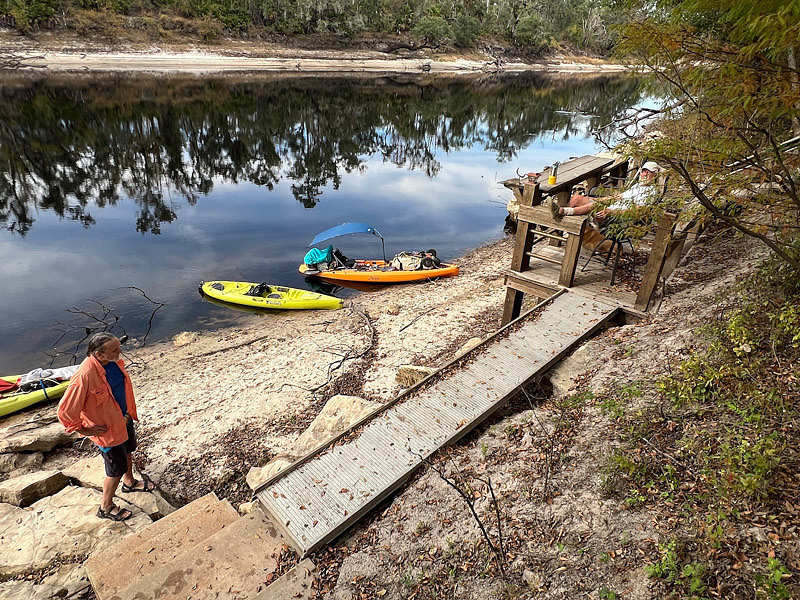
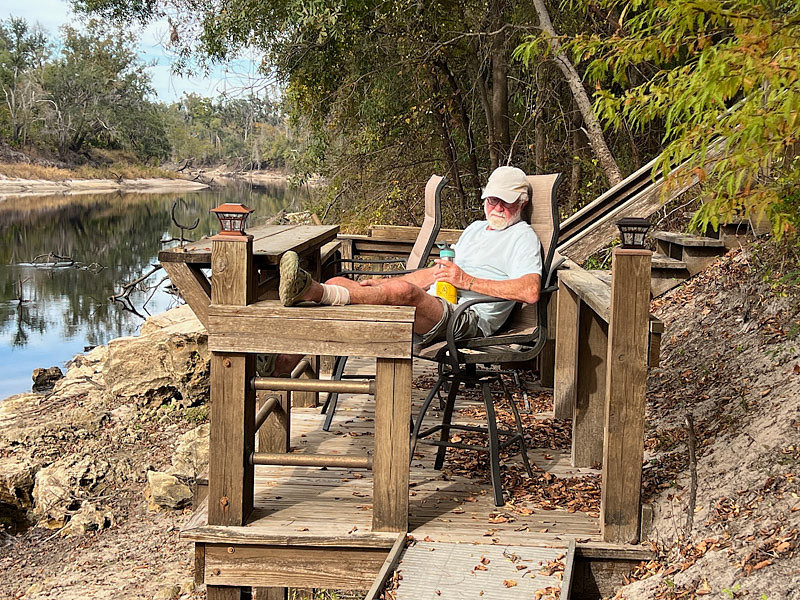
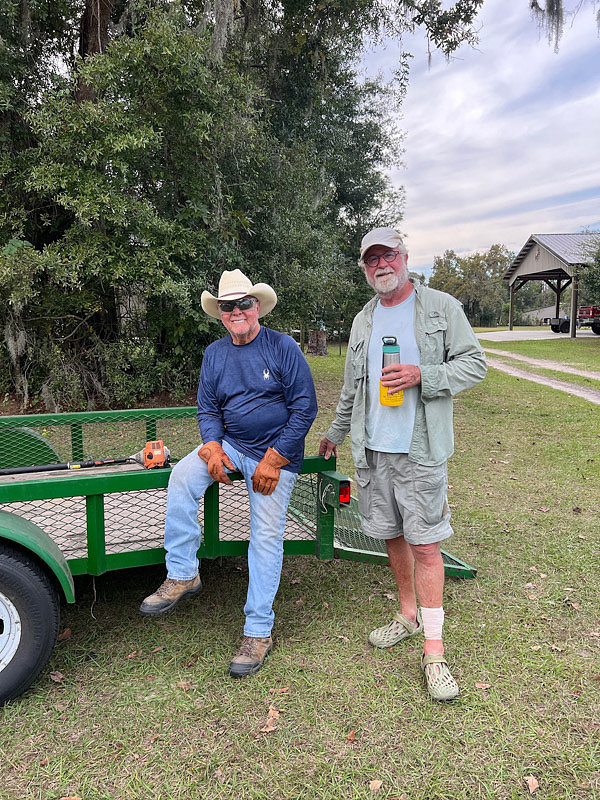
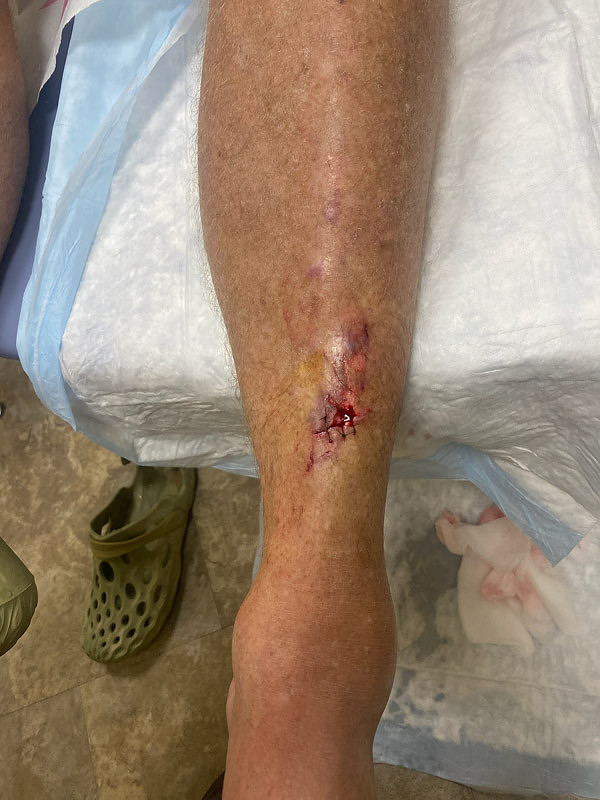
Rachel sent us this from the ER.
The three of us came to an isolated dock on a high left bank. No Trespassing. But it seemed worth a shot. Dave called Steve to return, and stayed with the boats. I ventured onto the property, with Jacques not far behind. I heard a tractor. Great. At least the owner's outdoors and I won't be a strange man knocking on his door. I spotted the tractor and tried to get the man's attention, but then he turned away. Oops, there was the big dog, lying on the dirt trail ahead. Shit. I cut over behind trees to try to intercept the tractor at the other end of the large garden plot. As I came into the clearing, the dog saw me and started toward me. I was waving my arms wildly and finally the man saw me - an older heavyset man with a cowboy hat and stubble (though less stubble than mine). He slowly turned off the tractor and told me the dog was ok. I had already turned to say "good doggie", who did turn out to be a sweetheart. I explained what was going on, pointed to Jacques who'd limped up not far away. He seemed willing to help. So I quickly called Rachel - Facetime - handed her up to the man and introduced her. George gave Rachel his address and directions. From the start, George couldn't have been nicer or more helpful. He did tell us we'd landed in "conservative country" and that his dog's name was Trump (but he clearly held no grudge toward our liberal-looking asses). George drove us back to the river in his four wheeler. Dave and I got all of Jacques's stuff up the bank including his boat. Meanwhile George went to get his flatbed trailer. We loaded everything and drove out to his gate along a dirt road. Steve arrived, so he and Dave walked up from the river. Rachel arrived after about 40 minutes. (This left bank was the closer side of the river, and a much shorter drive than Dowling Park.) She and Jacques decided to head back to Tallahassee for medical care and to sleep in their own bed. We said goodbye to George and Trump and got back on the river. Steve had found the 2nd potential access point downstream (on river right, and hard to reach by car), so we stopped there to eat lunch and gather our wits. We were all pretty shaken and traumatized. And couldn't stop talking of all the day's events. We paddled until sunset - a gorgeous one - and arrived at Dowling Park River Camp just in time for night and a much needed rest. 14 miles. Full-sun day. (Steve had paddled an extra 6 miles scouting.)
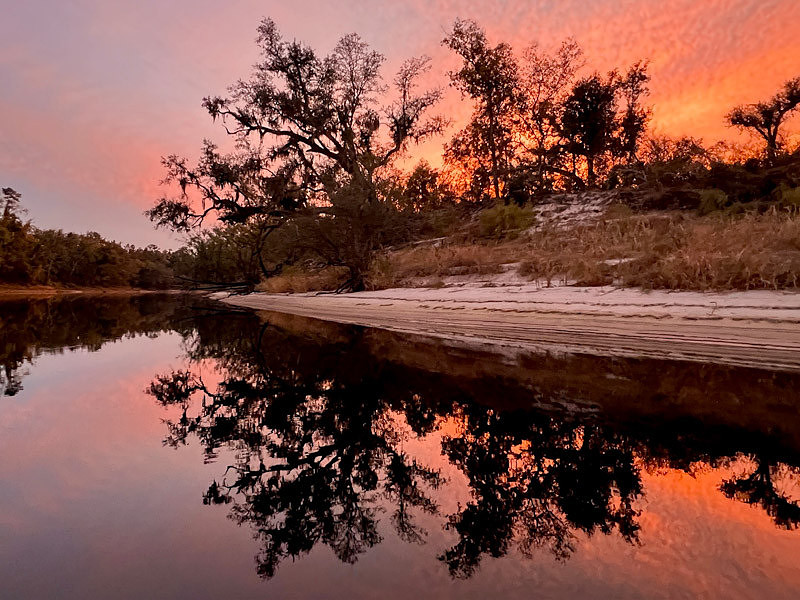
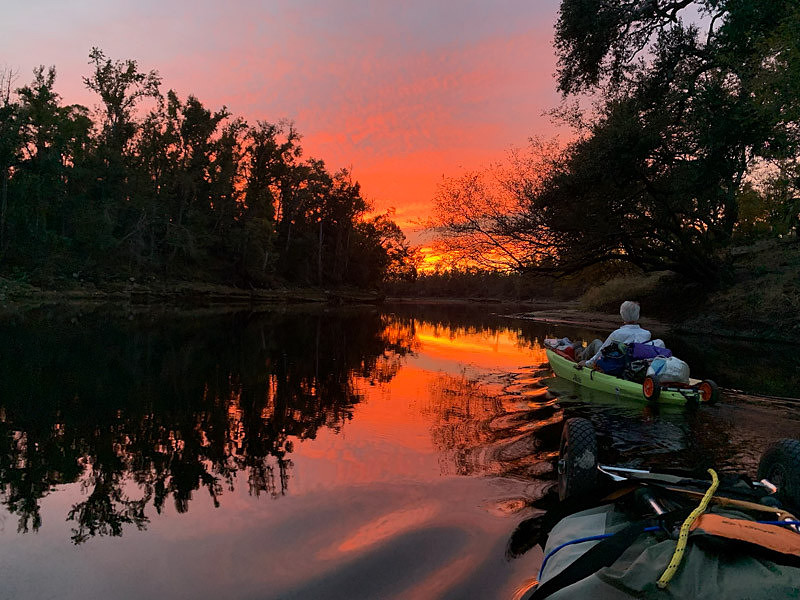
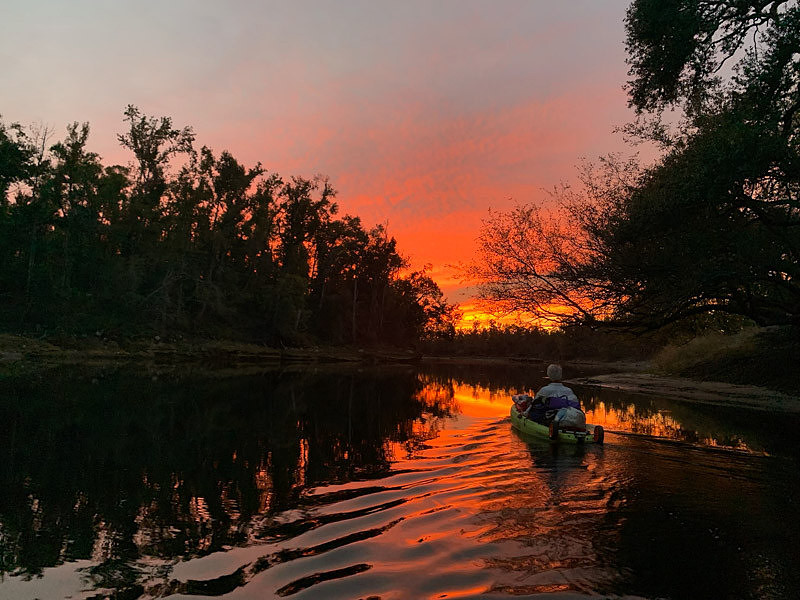
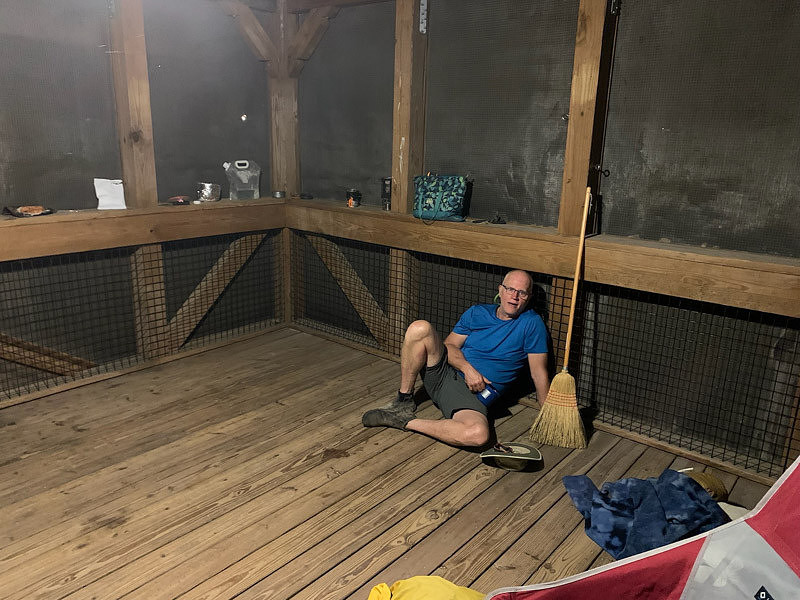
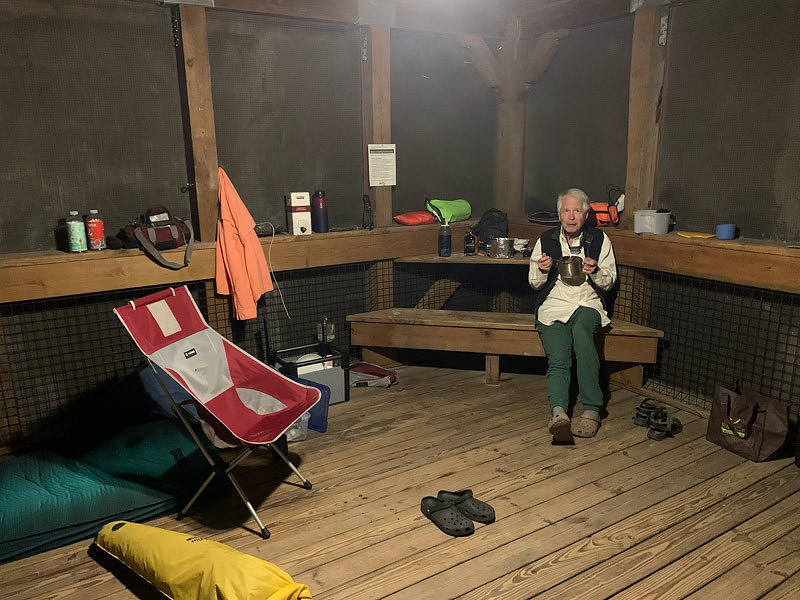
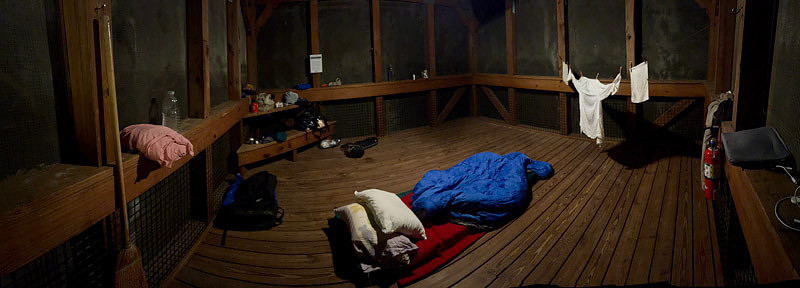
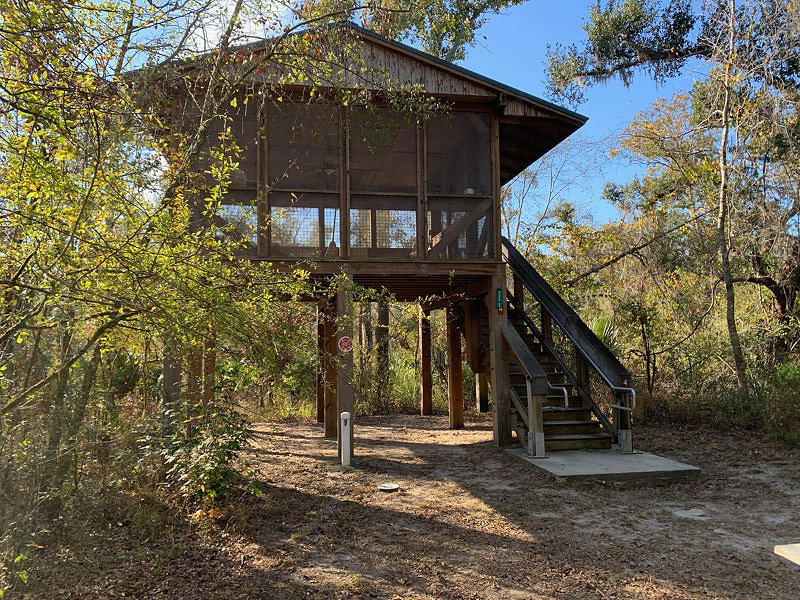
Our first River Camp experience. Nice big beach landing. We had to carry gear pretty far across soft sand to the end of the ramp. But then, when loaded it onto a big waiting wheelbarrow and up the trail to our elevated screen houses with lights and shelves - we each took one. Hot showers with on-demand water heaters in a heated bathroom. Flush toilets. Outlet to recharge devices. Free firewood, already split. Good water. Wow. We couldn't have imagined such luxury a couple hours earlier. Jody was host - young easygoing solitary guy with 2 dogs, living in a trailer on site.
Friday 11/7/25. 11 miles to Lafayette Blue Springs State Park.
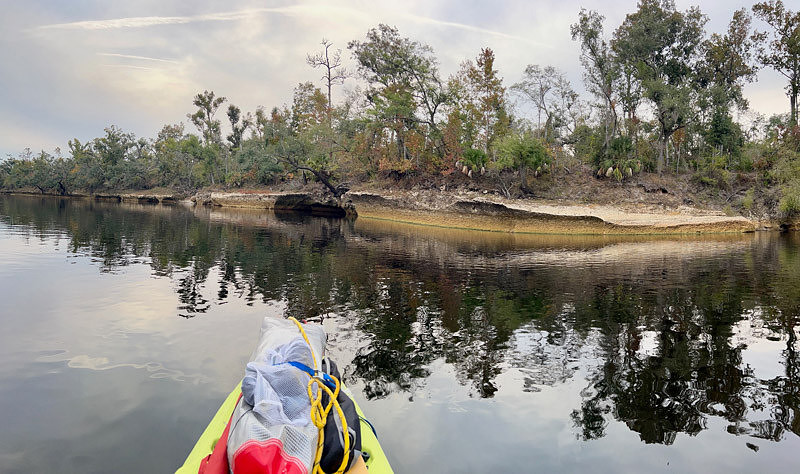
The ever-changing art of the rock walls along the river.
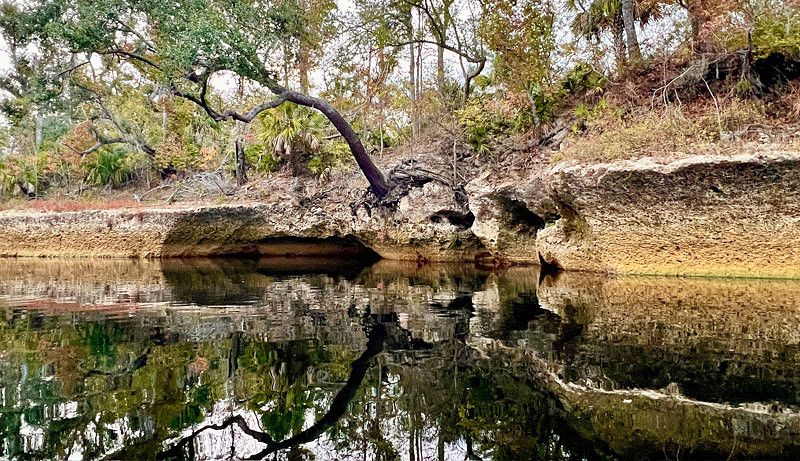
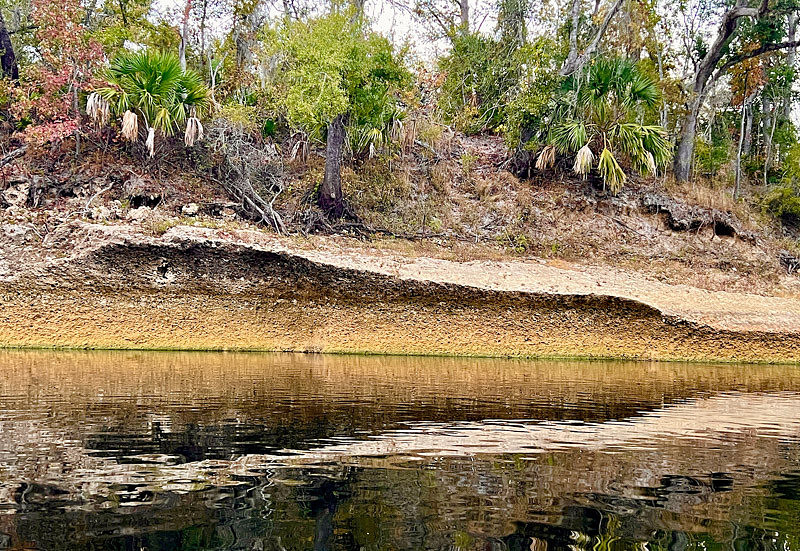
We had a relaxing start after yesterday's harrowing events. On river by 11:30 after making sure our gear was well-secured against prospective shoals. Lucky for us, the shoals were all minimal. In fact, there were no more significant shoals the rest of the trip. Today was the first day with a headwind from the south. Sunny and warm, so the wind was at least cooling. We took a break at Charles Spring, which had stopped flowing due to the low water. The underwater passage was above water.
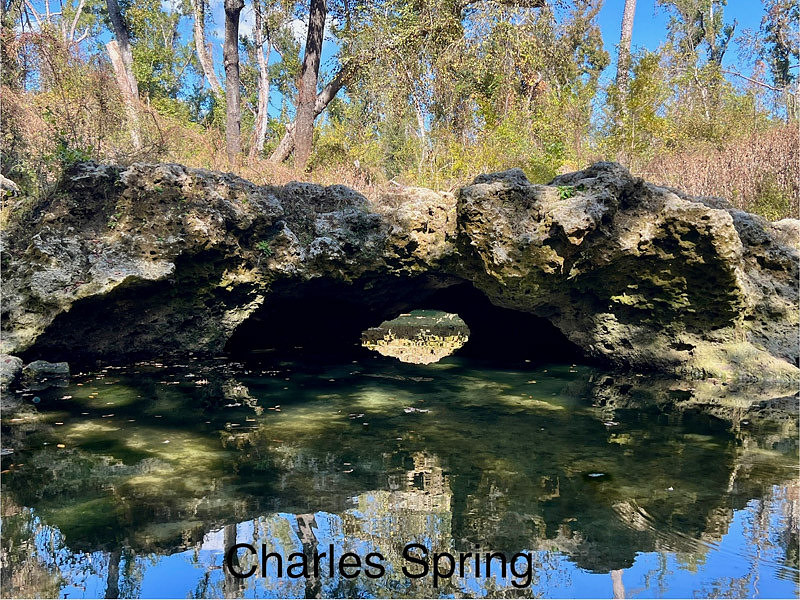
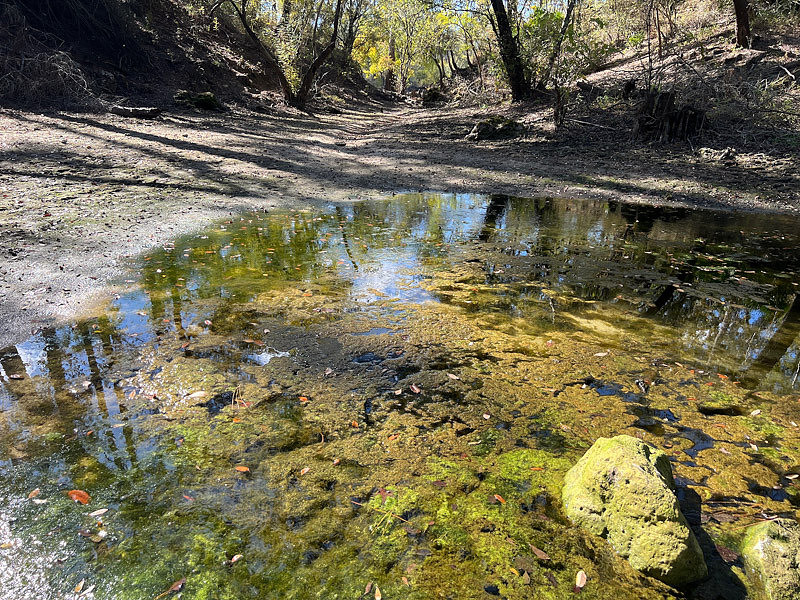
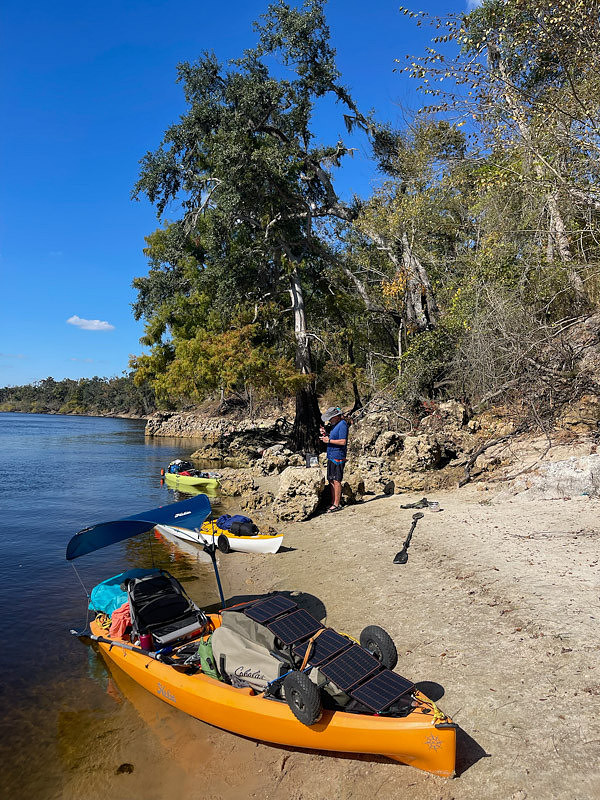
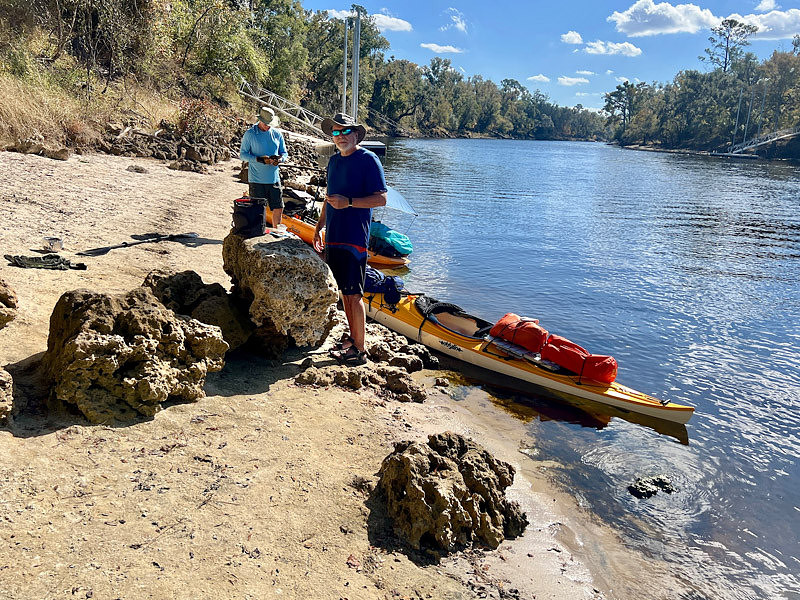
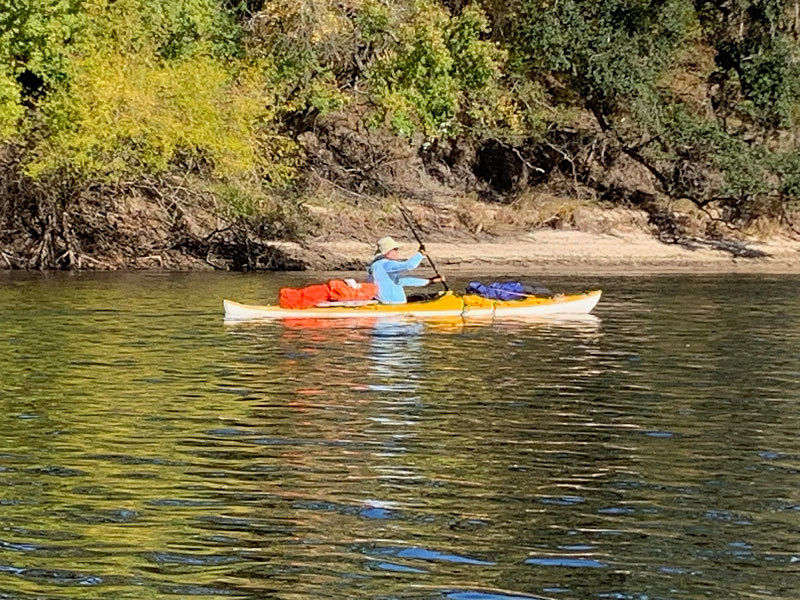
We swam in the river there and had lunch. Arrived at Lafayette Blue Spring about 3 pm. Pulled up on a beach by the spring where there were steps. We were meeting Bram and Mark Canter here, who were going to paddle with us for a couple days. No sign of them yet. We swam in spring. The rather private area at top of steps, complete with picnic tables, looked ideal for a camp, and close to our boats.
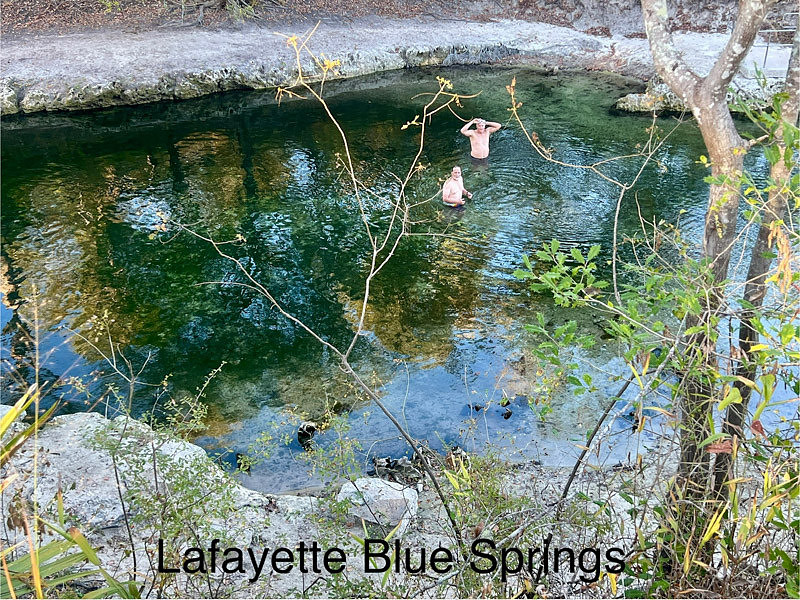
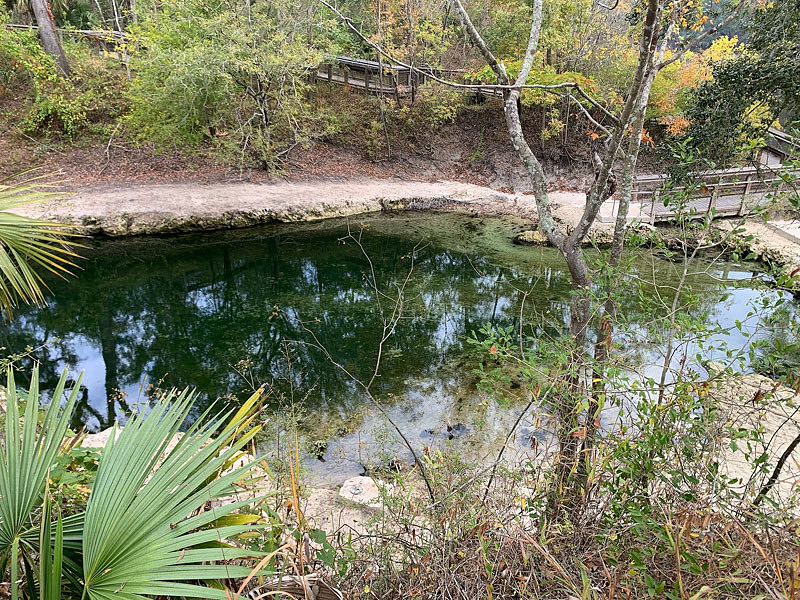
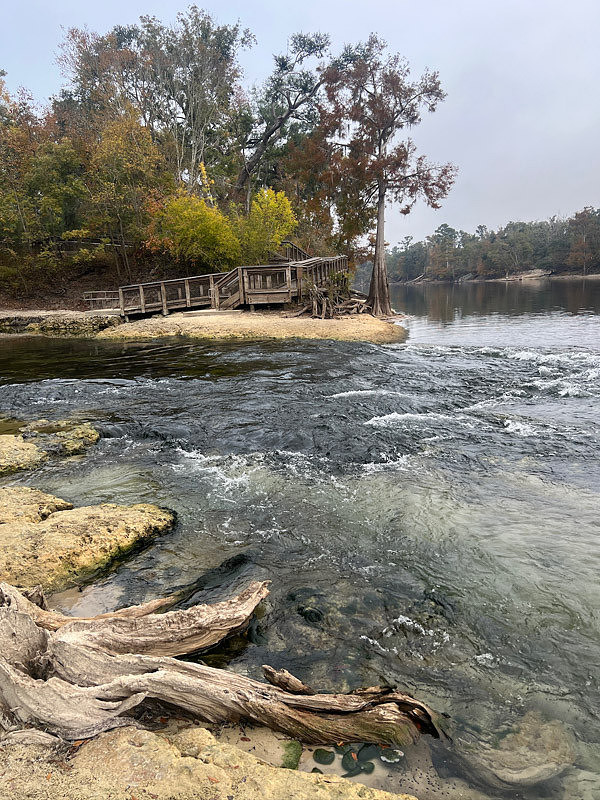
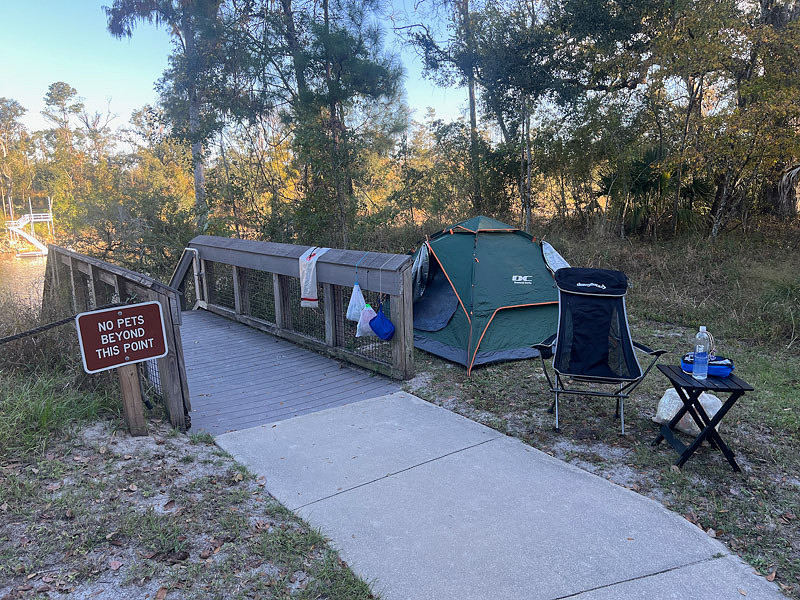
Steve knew Larraine (host) from previous camping, so he went to talk with her. He came back with her approval to camp there, so we set up. Awhile later, we found Bram and Mark who'd been there for a few hours waiting at the river by the boat ramp. They'd also talked with Larraine (before Steve) and gotten permission to camp at top of boat ramp (100 yds away from our camp). Comparing conversations, Steve realized that Larraine thought she was allowing us to camp at same place she'd told the Canters. So we moved our camp over there all except my tent and bedding which was tucked away inconspicuously. I promised to be packed up by daybreak (and was). We had a nice dinner and story telling ("the Day") sitting by our "fire" - Mark's DuraFlame log in a grill box (actually quite nice). Too warm night again. BUT, with below-freezing nights coming the next day, Mark lent me his wool winter hat. And shared some of Margaret's good homecooking.
Saturday 11/8/25. 12 miles to Peacock Slough River Camp.
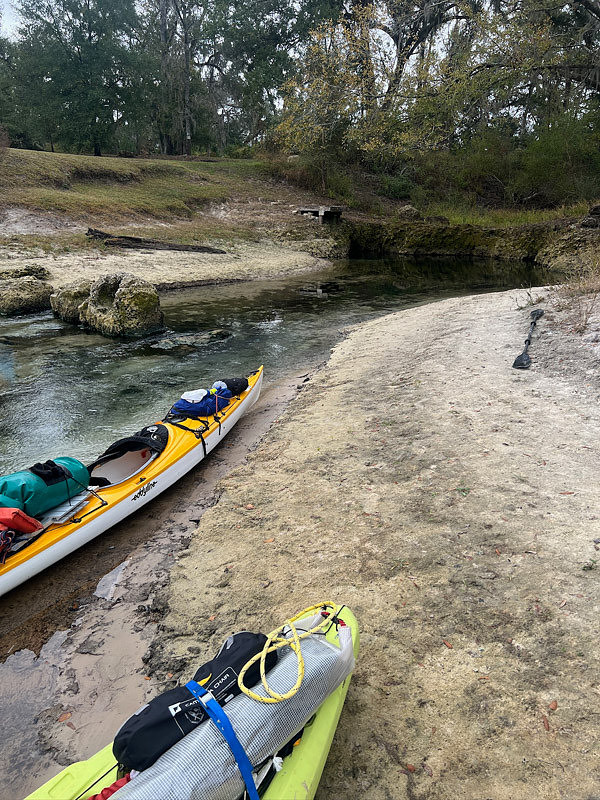
Perry Springs
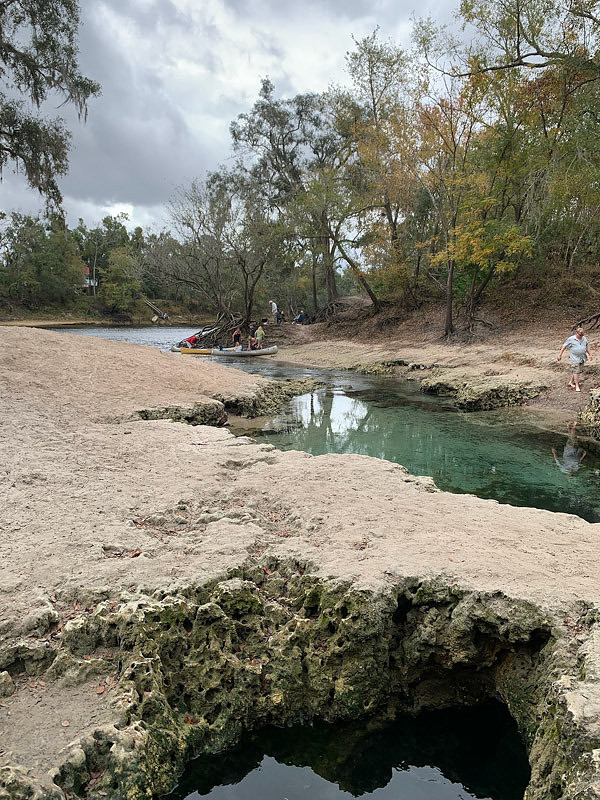
Telford Springs
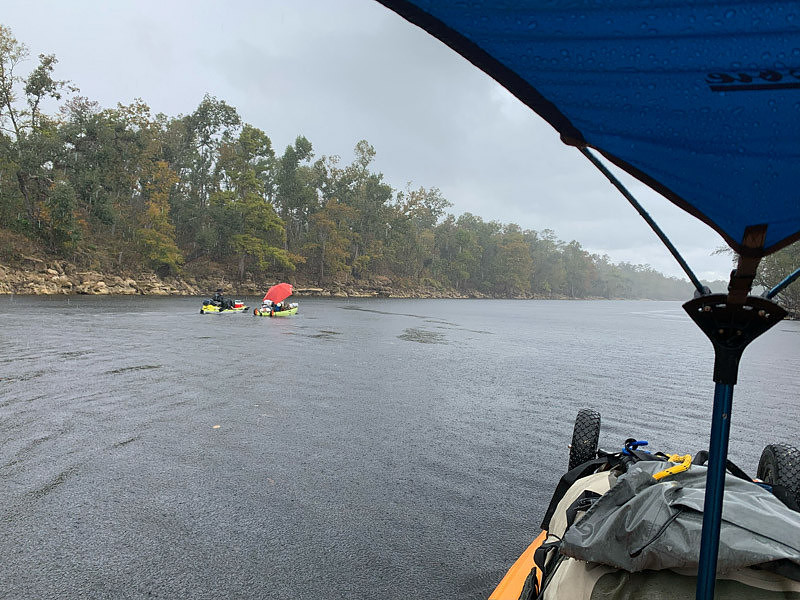
Rainy Day
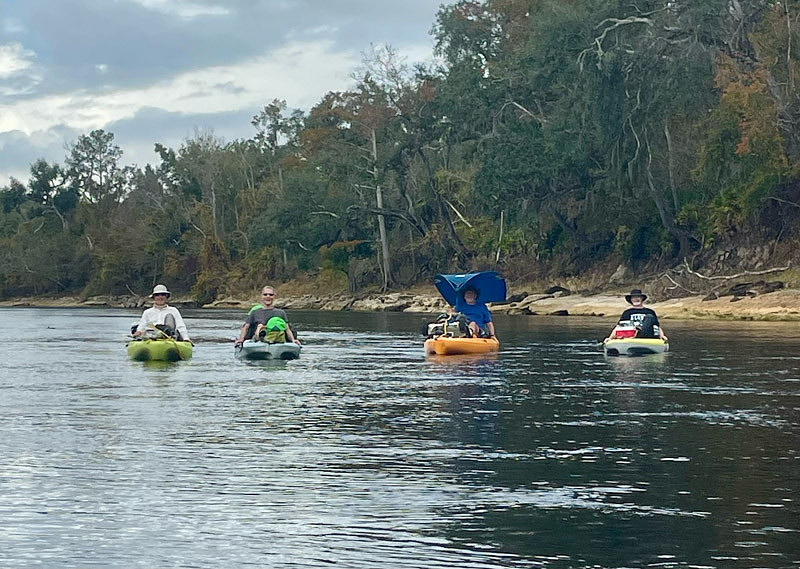
Bram and Mark Canter join us for two nights - Four pedaling Hobies.
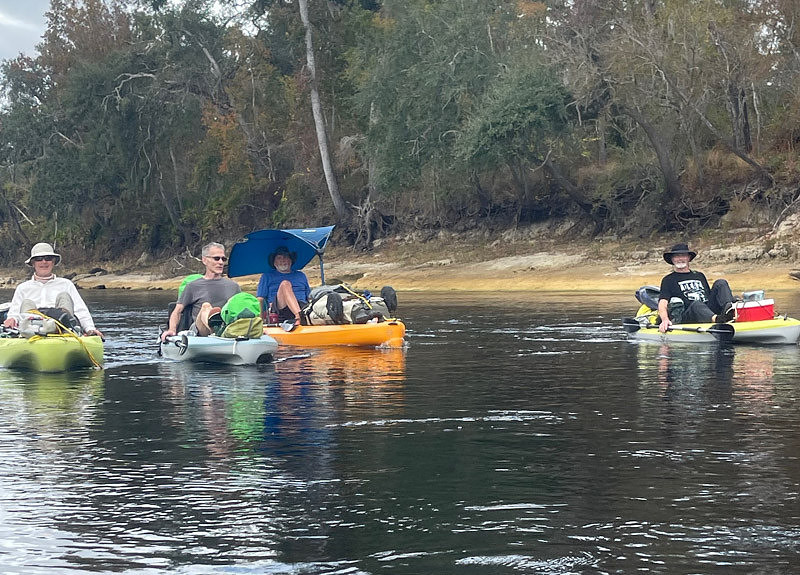
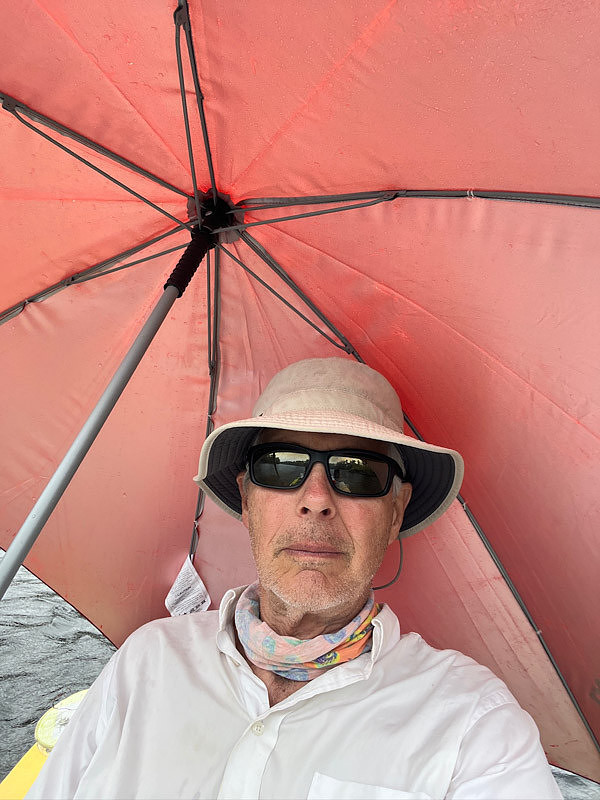
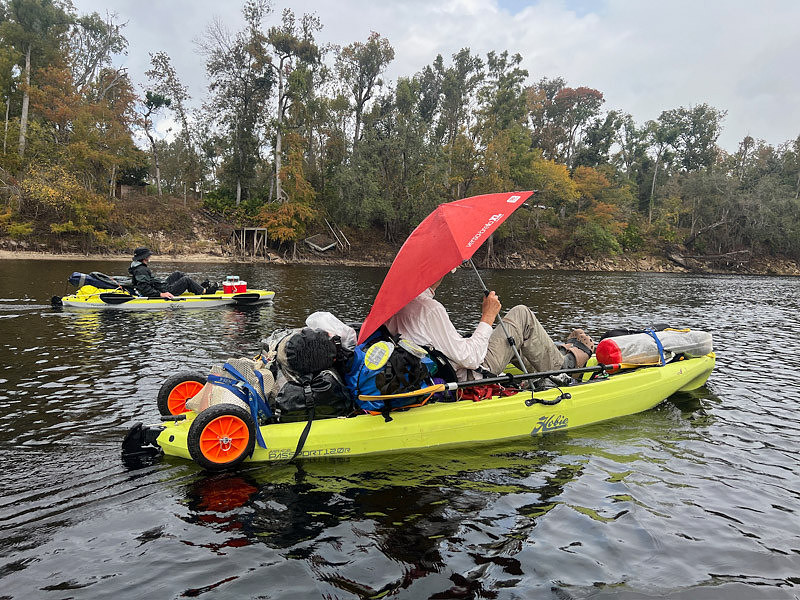
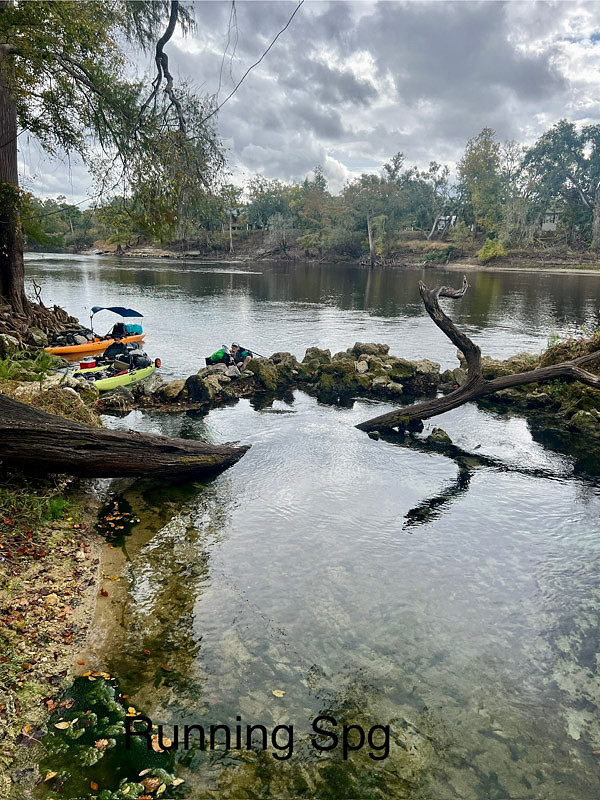
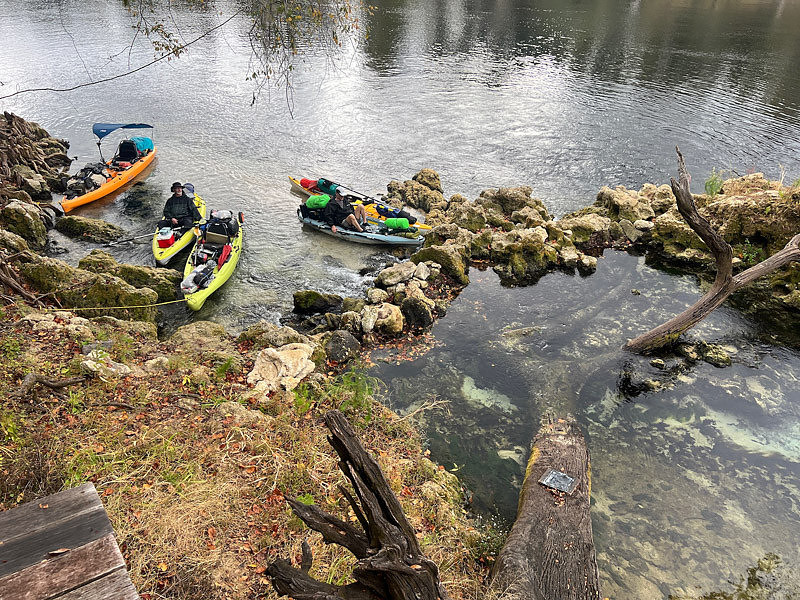
Cloudy and rainy parts of day. But we stopped at Perry Spring where Steve jumped in; and at Telford for a swim. I had arranged permission to camp at Running Springs via John Moran. It was about 10 miles, but when we got there, the river was so low that we found a very uninviting jagged rock wall four feet straight up the bank at Ambling Spring, and an almost equally difficult access at Running. A party of other people were there swimming and playing a boom box. We looked at the campsite and I found it very sad. Last year's hurricane had destroyed many trees and the sweet canopy. The weeds were grown up and springs sadly low. Most of us didn't think it worth camping there. We decided to paddle back upstream 2 miles to Peacock Slough River Camp. When we arrived, all the screen cabins appeared to be reserved! A surprise. (Though it turned out only 3 of 6 had campers show up. Steve and Mark ended up using two - moving in at bedtime.) The rest of us pitched our tents along the river in primitive sites. No host ever showed up. We had another nice evening of fire (a real one) and stories. Having had the "sold out" cabin experience at Peacock, we took the time there to make reservations for Adams Tract the next night - each of the three of us reserving a screen cabin online at floridastateparks.org. $6 each.
Sunday 11/9/25. 10 miles to Adam Tract River Camp.
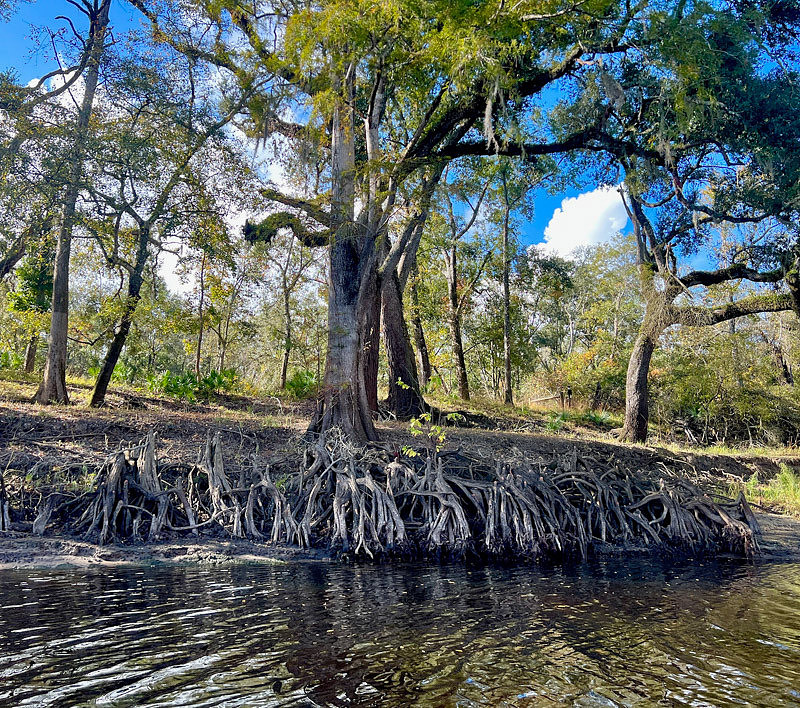
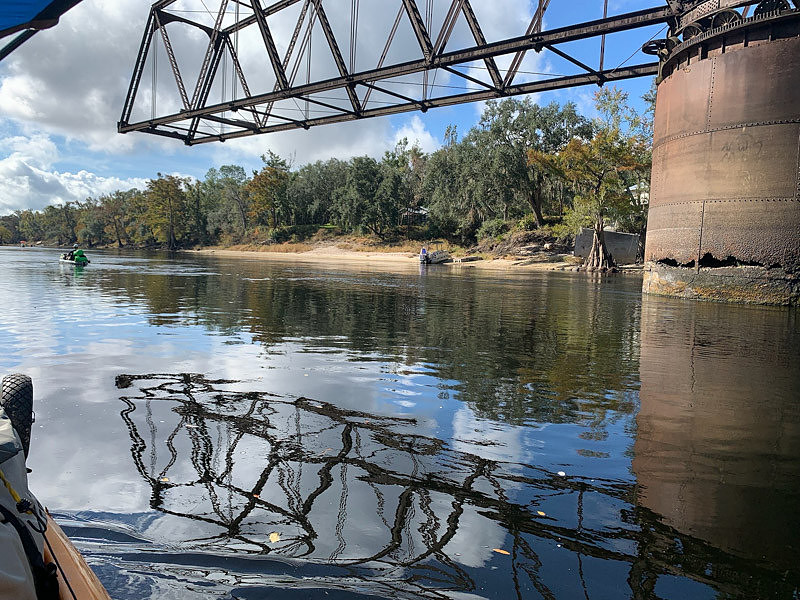
A short day. We passed Bathtub, Convict, and then made a longish stop at Royal Springs for a swim, lunch, and to say goodbye to the Canters (whose car was there). The spring water (in all the springs) was noticeably warmer than the river water, though both felt great throughout the trip on warm days. We paddled on to Adams Tract River Camp arriving about 2:30 PM. With the river so low, finding places among the rocks for our boats was tough enough, but then we had to carry all our gear 10 - 20 precarious yards up the rocky ledge and to the stairs. Lanice, the host, greeted us from the landing above and brought us her oversized wheelbarrow. So once we got our stuff up the stairs, we had an easy trip to the screen cabins. Luxury again! And we had much of the afternoon to enjoy it. Plus we had a big covered pavilion nearby where we spread out all our food and tried to reorganize, trade, and give away excess. We had a big fire ring. Steve bought firewood from Lanice (though we found plenty more wild wood). BTW we started with 3 saws, which quickly dwindled to one. Steve lost his at Camp 1. Jacques lost (or took) his. So all we had was Dave's. Next time, I will bring one too. The fire felt great. It was a colder night, but not freezing.
My plan had been to have much more time and energy for meal fixing, so I'd brought separate bags of veggies, dried tofu, dried grains, bean packs, and lots of spices to make up meals along the way. Even with all that dried food, I started with 60 lbs! All of it packed inside my hull. And although organized in net bags on labeled strings, it was a pain to pull out 4 or 5 bags every day and haul them to camp. Breakfast bag with oats, trimmings and coffee; Grain bag, Bean (etc) bag, Spices bag... Next time, premade (even if homemade) meals, where a day's worth of breakfast (incl coffee), lunch, and dinner can be moved to my topside "picnic bag" (a large insulated closed-top bag modeled after the one Dave lent me). I kept a supply of snacks handy in the bucket just inside the hatch at my feet - that worked fine, but needed more variety - salty, sweet, fruity, chocolate, protein. Steve turned me onto Costco Sweet & Spicy Snack Mix combined with unsalted mixed nuts. Addictive. Jacques brought yummy (and hardy, crumble-proof) Lemon and Ginger Snaps. Dave had a variety of protein bars that were really good, as well as biscotti for coffeetime. (Not to mention, Dave brought gourmet coffee beans, a grinder, and a French press. Steve had a pourover rig. Me, I had instant... which by the way, was delicious.) I also want to try some commercial vegan freeze-dried meals next time? Dave also gave me single portion chicken packs (I had brought some salmon packs) and lunch became much easier - a wrap (I had some - wraps made good bread alt.), mayo pack, meat, plus apple, satsuma, and peanuts+M&Ms. I quickly realized I had to be much looser about my vegan diet on the trip. Even though heavy, I wish I'd brought more apples and oranges. Dave shared his large pack of yummy golden kiwis too.
Monday 11/10/25. 12 miles to sand bar (MP 73.5) 2 miles past Branford.
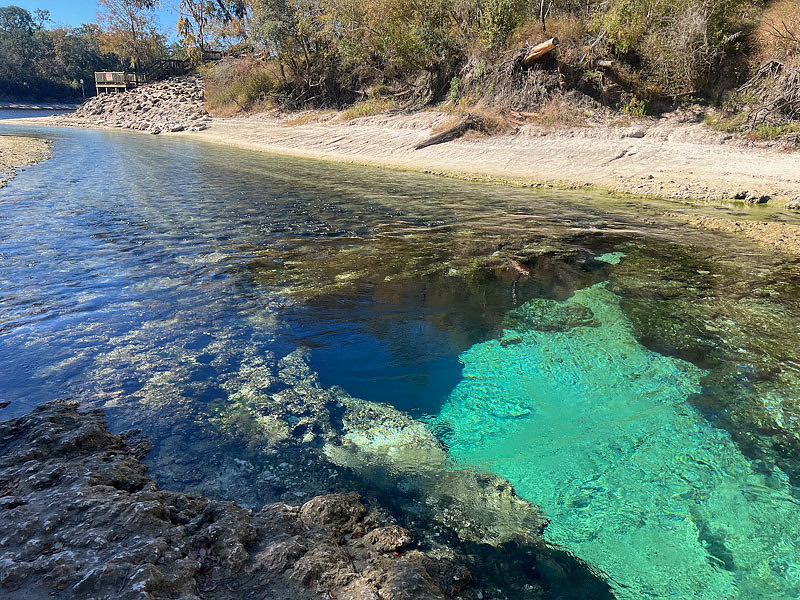
Little River Springs
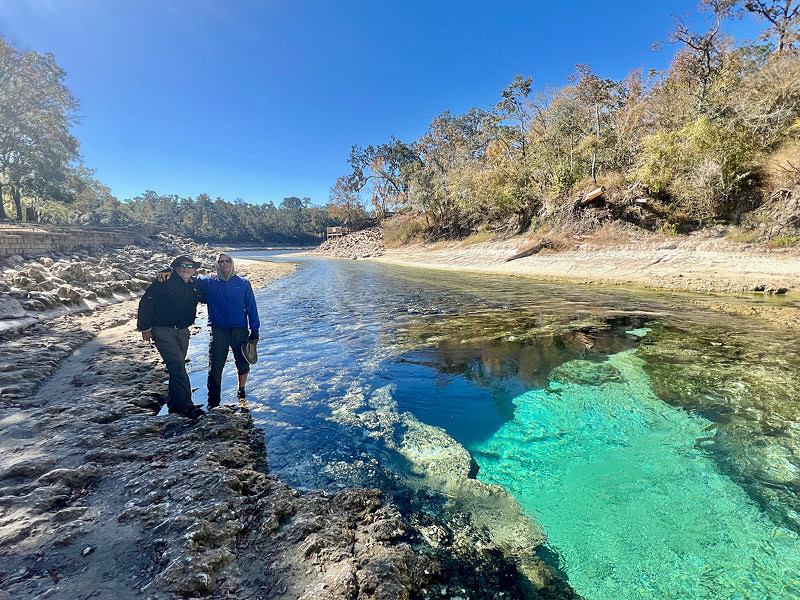
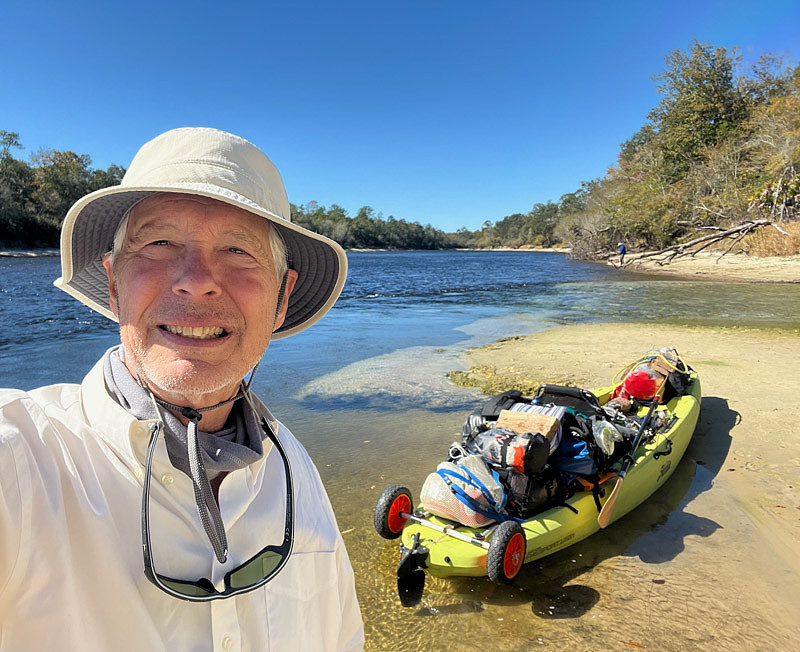
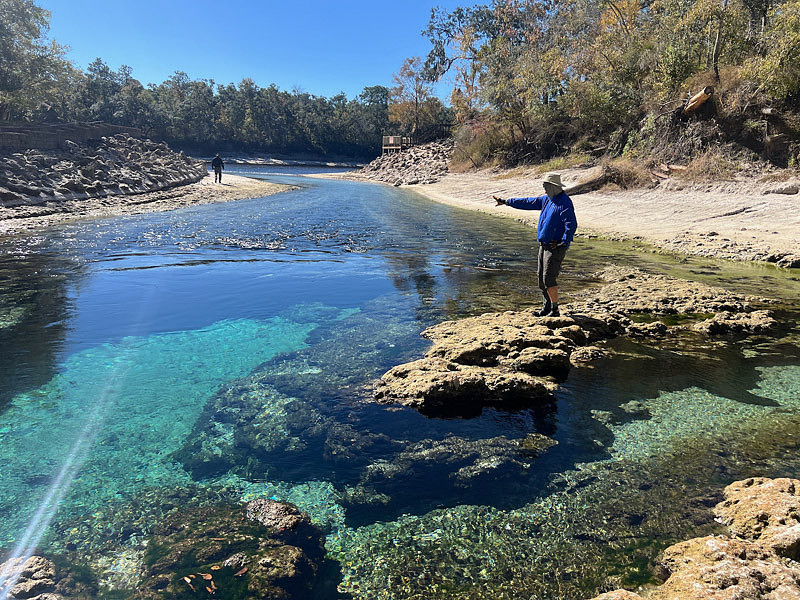
This distance (12 mi) is starting to feel like average and pretty easy. We are now moving at closer to 3.5 mph, even with the river at 1 mph, though it may have picked up a bit with added flow from the Withlacoochee. Muscles adapting. Big job getting all our stuff back down the rocks to our boats and repacking (after all the extensive unloading and organizing). Steve stopped at Troy Spring and told us we'd missed a beaut. We all stopped a bit later at Little River Spring. Also very nice.
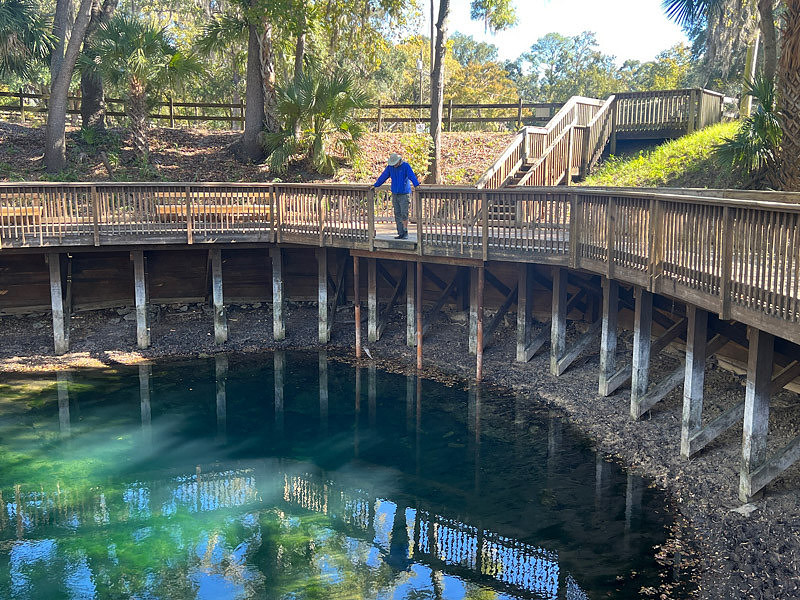
Branford Spring
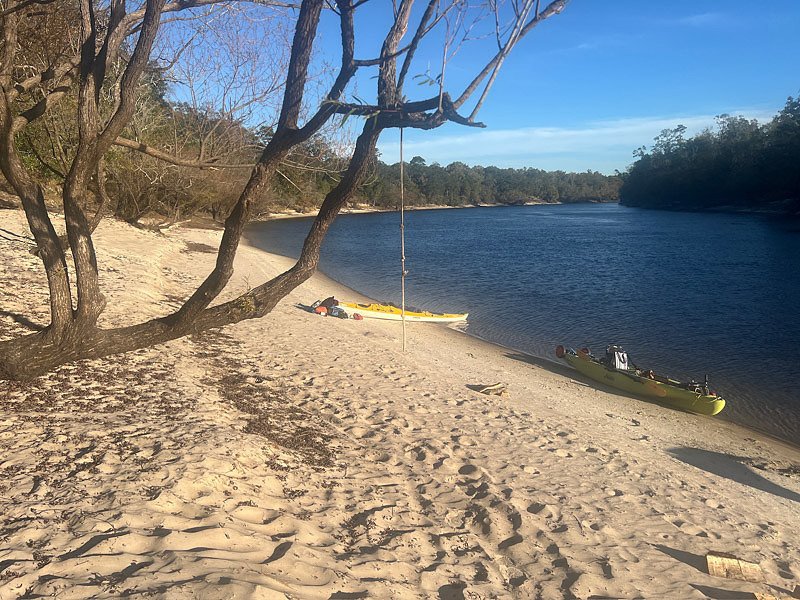
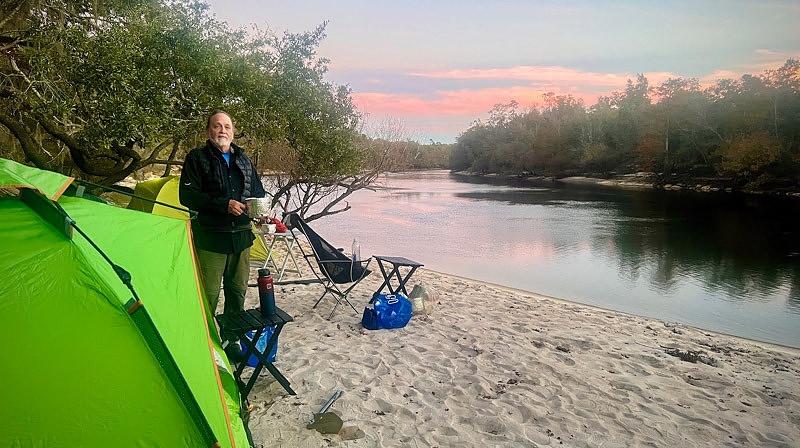
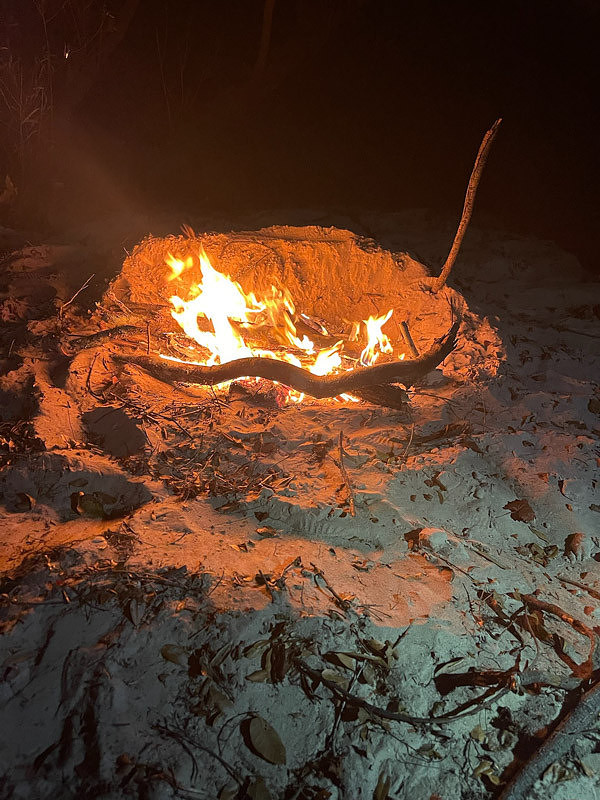
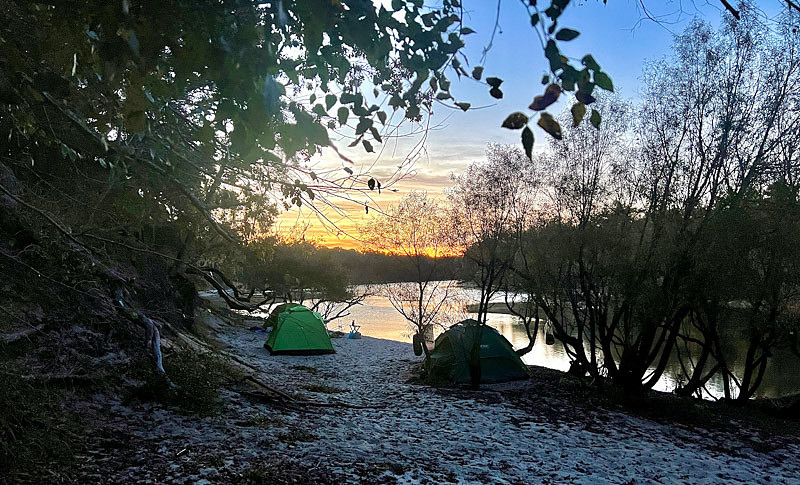
And then on to the town of Branford at Hwy 27. There's actually a pretty spring there too, Branford Spring. We left the boats for a short while and shopped at the nearby convenience store (Neosporin, etc) and a mom & pop hamburger joint - I ate a cheeseburger!!! (It had been MANY years). Steve and Dave went down the road to a Family Dollar, returning with beer and wine. Resupplied and bellies full, we paddled on a few more miles to a "rest stop" (in the paddling guide), which turned out to be a (rare, down here) gorgeous sandbar. We stopped for the night, christening it Taj 2. The day was cold and windy (wind from N, good sailing), with temps dropping all day. The night was cold and windy, 30 degrees. But we were all cozy in our tents (me with Mark's hat, and Steve with the down bag the Canters brought him.) We dug a pit for the fire because of the wind. Plenty of firewood, and the Power of Lint.
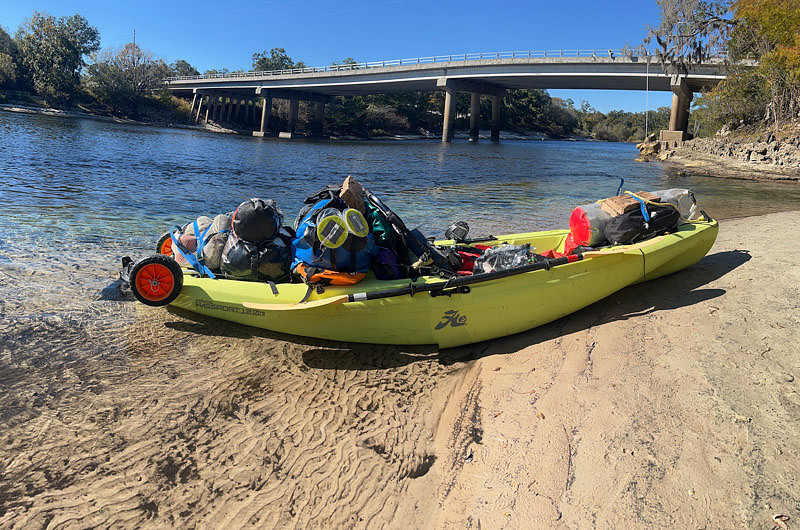
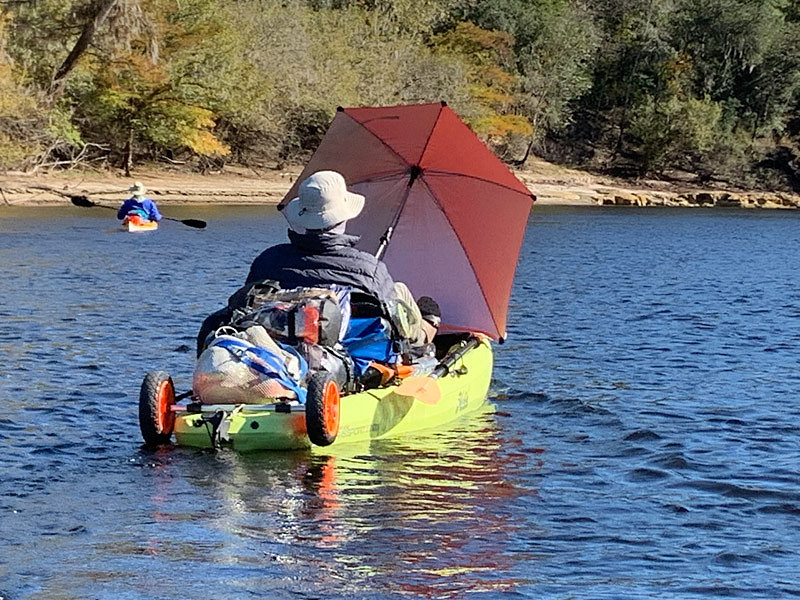
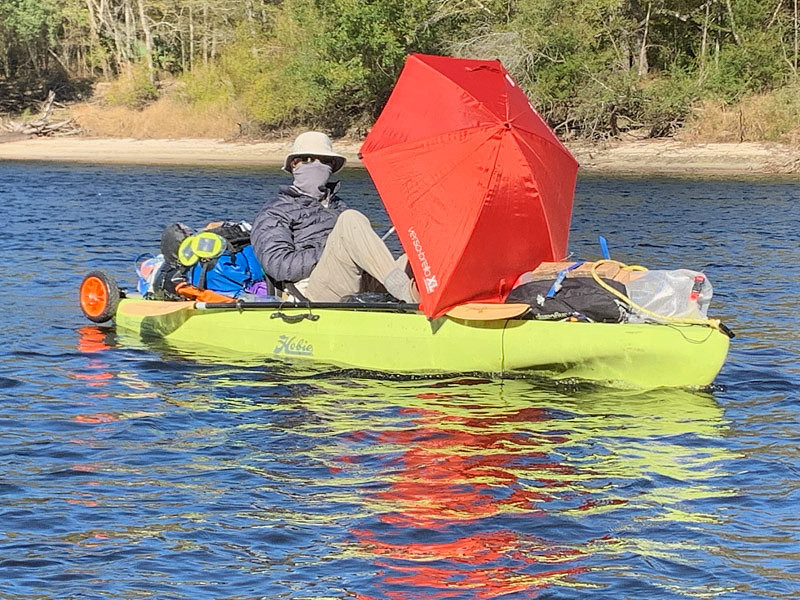
Great tailwind for sailing
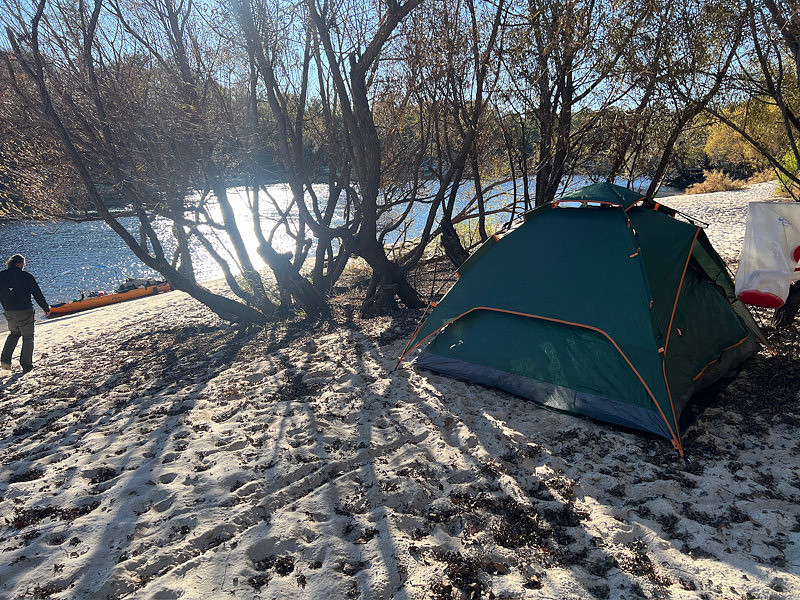
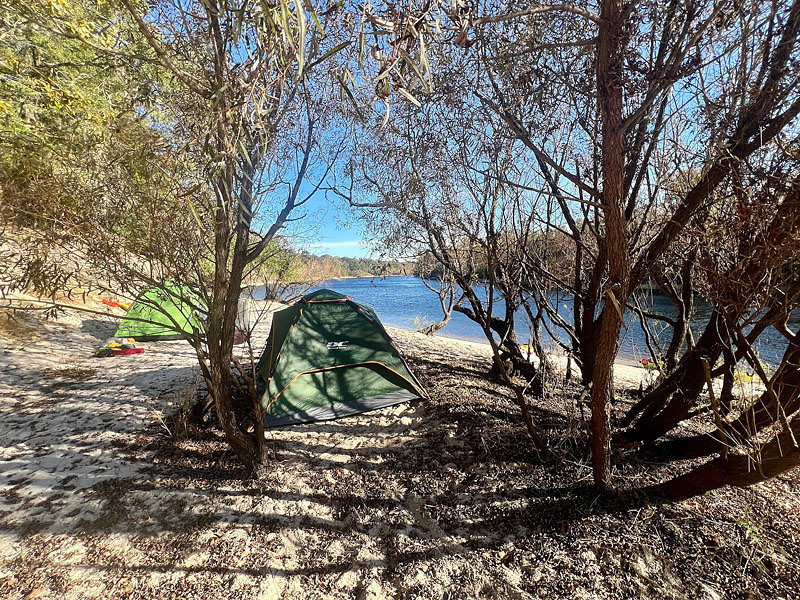
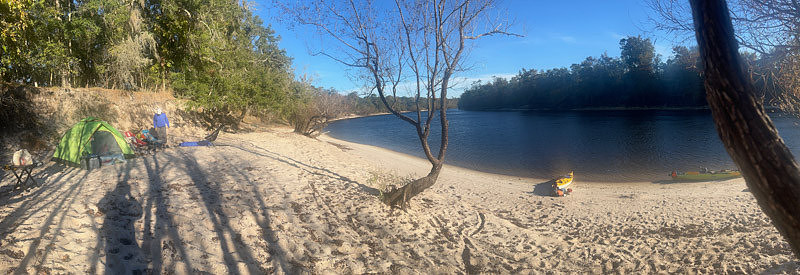
Taj 2
Click here for Part 2. Branford Sandbar to the Gulf of Mexico
]]>

St Marks Lighthouse
Some say that the Christmas Star followed by the Wise Men was actually the Conjunction of Saturn and Jupiter. This year on the Solstice, December 21, a Great Conjunction occurred again - meaning the two planets were closer to each other in the (observable) night sky than any time during the past 791 years! But what intrigued me as much was that one was supposed to be able to see moons of Jupiter and the rings of Saturn through BINOCULARS (or in my case, a telephoto lens on my camera). No telescope needed!

Lighthouse Pond Ducks Aplenty
So Crystal and I rigged up our binoculars on a tripod (to keep them very still) and headed down to St Marks National Wildlife Refuge a few days ahead to test it out. We had a delightful evening show - the ducks and wading birds in the late-day light, the sunset, the crescent moon, and finally the almost-Conjunction - as we ate our picnic dinner along the shore. When the final curtain dropped (clouds moved in), we headed home, full of awe, wonder, and anticipation of the preeminent performance on the Solstice.


On the Solstice, we returned for the Grand Finale, with another more ambitious picnic and a couple friends. We were careful with social distancing (and well away from the parking area), but also marveled at the >100+ others who showed up to watch the Great Conjunction. The evening's performances that night were every bit as brilliant as the dress rehearsal. (While intently focused on nature photo ops, I neglected to take a single shot of the people scene, even of our own picnic gathering. "In the zone"... my excuse... sorry)

The Wide Angle Sunset

The Telephoto Sunset

Quarter Moon in 3D

The Great Conjunction
Lo and behold, THERE in our lenses, we could indeed see four of Jupiter’s moons and the rings encircling Saturn... they were tiny, but visible. A thrill to see. Somewhat underwhelming as little photos on a computer screen, especially compared to the experience in the BIG SKY theater. I highly recommend getting out there somewhere where you can see the sun set, dusk settle, and the moon and stars appear. You'll be glad you did.
Thanks for your visit. I really enjoy all comments you leave below. And feel free to share the link with family and friends.
]]>

Merritt's Mill Pond, Before the Drawdown

Gator Hole Spring, Before the Drawdown
Merritts Mill Pond, a spring-fed dammed lake near Marianna FL, was "drawn down" for maintenance and repair at the headspring, Jackson Blue. This only happens once every 50 years or so. The Pond water level was lowered 6 feet or more -- quite an opportunity "to see what's underwater" without actually diving. One of the springs, Gator Hole, had become a large partially-out-of-water cave into which adventurous folks could actually paddle part way. And from there, one could wade in the crystal clear knee-deep waters and explore the many nooks, crannies, and side tunnels. After seeing some photos on FB (Thanks Giedra Mazelyte and Guy Bryant), we were intrigued, and then hearing the Pond would be refilled very soon, Crystal and I decided to try to see it. We got there just in time - they began refilling it a couple days later.

Scruff is keeping a close eye on Crystal as she fades into the whiteout. Meanwhile, we're struggling in the 1 1/2 inch deep water.
As a safeguard during the pandemic, we decided to be there at dawn on a weekday in hopes of having the caves to ourselves for a couple hours. We didn't anticipate the entire area (and Pond) being socked in by dense fog... and, as a result, never saw another soul on the entire Pond all morning. We launched before sunrise, wading through some mud, and then struggling to get our kayaks into deep enough water to float, but soon enough we were afloat and shrouded in beauty. Our scout, Scruff, was on high alert in the front of my boat.

Hmmm... which way do we go?


Friend, John Moran, had given us some landmarks for finding the cave entrance. Oops, the landmarks were lost in the fog. But we had a good general idea of where it was, and my GPS, which didn't mind the fog one bit, soon had the cave pinpointed.

Entering the Secret Passage

Fog swirled around us as we floated into the tunnel. Fifty feet in, we secured our boats and proceeded into the alluring dark stony holes by flashlight. We set Scruff atop a large flat stalagmite as sentinel. (Honestly, he would have had to swim in many spots and soon we'd have a miserable shivering doggie on our hands. He sensed that his post was the safest place to keep his eye/ear on us and remained relatively content for a couple hours.)

We were out to have fun more than to make photos, so without much gear to lug around, we spent most of our time just exploring. I had brought several waterproof inflatable solar LED lamps which we placed strategically in holes in the rock walls to guide us as we ventured into the various passageways.

In Earth's Heart
But there was so much mystery in the dark recesses, the dimly lit swiss-cheese-limestone walls, and clear blue water swirling at our knees, that I made a few stabs at trying to capture the drama of it.

Spring Caving

Inner Springs
One small side tunnel led us to the deep hole from which the Aquifer gushed, and into which divers go way beyond our reach.

Gator Hole

Gator Hole Denizens (No gators to be seen!)
Upon return to our boats, the sun was beaming into the entry tunnel.

The Spelunkers
We had to back out as the channel was too narrow to turn around.

Backing Out
One last look at the entrance to Gator Hole, before turning out into low-water Merritts Mill Pond and its eerie skeletal tree stumps stabbing at the sky.

At the Mouth of Gator Hole

Cypress Bones

We paddled back to our launch site, gleeful in our success and giddy from the adventure. And headed home.
I hope you enjoyed the trip into a spring cave. Please feel free to share this link. And leave a comment below - I love to read your impressions. And may we all journey safely to the end of this pandemic... the light (vaccine) at the end of the tunnel is getting closer.
]]>
Last Wednesday, Mike and I launched our kayaks in a gentle breeze from Wakulla Beach, intent on our missions:
1. To find his lost gear and 2. To find Gander Spring.

My neighbor, Mike, had been pretty animated when he came over earlier in the morning asking to borrow a kayak... he'd "lost" his kayak the previous day! He had been making solo kayak trips into the coastal creeks and sloughs during the pandemic. Mike became particularly intent on finding Gander Spring, rumored to be a beautiful clear spring deep in the coastal swamp/forest. There are no trails to it, only a very obstructed shallow spring run that spills into the saltmarsh and bay not far from where we live. So, Mike had made a few exploratory trips part way up Gander Creek, turning back each time due to inaccessibility, time constraints, or conditions. He made it furthest up the run the day before, and thinking he must be close, tied off his kayak and struck out on foot. With a bit of searching, sure enough he came upon the spring. After making his way partially around it, he headed back, thinking he was retracing his steps, but actually heading in the wrong direction. The edges of the spring are ill-defined, and there are several "channels" going in different directions. Mike's only compass (his phone) was in his boat, along with his lunch and water. Unfortunately, it was a hot humid overcast day. So no sun to gauge direction. Once he realized he'd lost his way, all efforts to reorient to his original path, or even the spring, failed. Soon he was doing his best to keep heading in the same direction (which was hard, given the swampy conditions, dense vegetation, and deeper sloughs that had to be circumnavigated). SEVEN HOURS LATER, parched and worried as darkness approached, he spotted a power line through the forest and came out on a dirt road. Whew. I can only imagine his relief. I know Mike to be level-headed, stoic, and in great physical shape, but spending the night in that swamp would rattle anyone. To his credit, he never panicked (which is KEY) and stuck with the best plan given his circumstances. Other than the dehydration, the spiderwebs (complete with the spiders) encasing him and the many ticks needing to be picked off, he made it home that night in one piece. A blessing. We both learned some important lessons (me - the easy way) from Mike's misadventure, and he agreed to let me share it for other adventurers to consider and possibly learn from.

The two of us had been talking for a month or two about taking on Gander Creek together one day soon. So, the moment was ripe with motivation, and the conditions seemed ideal. We paddled a short distance along the Gulf Coast, then turned north into Goose Bay. It was a good hour or more of paddling over oyster beds and winding through the marsh, past alligator roosts, and wading birds. Eventually, the channel narrowed to a creek as we approached a stand of mostly dead cypress trees - victims of sea level rise.

Great Blue Portrait

Basking Gator

Cypress Skeletons, Victims of Sea Level Rise

Swamp Gate
From there we quickly entered an enchanted forest and the challenging obstacle course/maze. Between the drag-over shallows, the soft creek bottom, the multiple large logs requiring portage, the false-creek side channels, and the mosquitoes, it was slow going. But oh-so-beautiful. I expected this so I had packed light, my only camera being my iphone. In the lower creek, each cypress knee had its own little population of crabs.


Crabby Knees
Spiders galore, but also spider lilies. And even a nice crop of my favorite-eating wild oyster mushrooms. After another hour, we spotted Mike's yellow kayak off on a side channel. Mission One, accomplished. We plowed ahead.

Spider Lilies

Oyster Mushrooms

Lost Boat Found
It can be tough knowing which way to go. There are often multiple obstructed channels in view, and the "easiest path through" isn't necessarily the right way. Once you realize that it may be the wrong way, you've committed considerable energy to get there and still aren't sure another better way exists. Once, when we realized we'd gone wrong, we explored a bit on foot and ended up dragging our boats across a short stretch of swamp to get back on track.


And then, there it was: Gander Spring. An oasis in the swamp. I had remembered to bring my mask and snorkel, so I took a quick swim around the main spring bowl, keeping an eye out for alligators. No gators in sight, but I saw plenty of beautiful garfish.


Garfish. (This older photo is from a different spring. I had no underwater camera here.)

We stopped for Mike's yellow boat on our way out. I thought it might be quite a challenge to extract it from the swamp, but being empty, it didn't drag Mike down too much. He towed it all the way back to our launch site without help.


And that's the story. Your comments below are much appreciated. And please share this link with anyone who might enjoy it.
]]>I've been publishing my monthly photoblog pretty consistently for 12 years now, but I'm ready to slow that pace as well.
Starting in 2020, I'll post at the blog randomly, maybe every 2 to 3 months. Those of you on my photoblog email list will still get notes (unless you instruct me otherwise). For anyone not on my list who'd like to get an email when I post a new entry (4-6 times per year via BCC. This e-address list is used for no other purpose), you can send me a note asking to be added: [email protected].
For my last formal monthly blog, I've decided to pick back through previous posts (only as far as 2013) and re-share some of my favorite photos along with the links to accompanying shots and the backstories....
In spring of 2013, we had a "bumper crop" of fireflies in our backyard. And I was "on fire" about lightpainting at night... put that together and here's the photo, and the story of its becoming:
Firefly Magic Round the Sinkhole (click this link).

Chassahowitzka - that's a mouthful of a name and an eyeful of a beautiful place. Have a look here for underwater caves, mermaids, manatees and springs hidden in swamps, and a dive with a sizable alligator:


Chassahowitzka River
One winter we had an unusual double freeze, during the infamous Polar Vortex. The ice formations in a nearby swamp were psychedelic and FULL of ART:
Polar Vortex Embraces Florida (link)


Snorkeling the springs of the Econfina Creek, Crystal and I came upon (and became enthralled by) the rise and fall of giant tadpoles. Here's the full story...
The Giant Tadpoles of Econfina Creek

John Moran and I began a series of nightscape-lightpainting collaborations in early 2009. Oasis in the Dark and Magical Moonlit Paddle, below, are two of more than a dozen (and counting). Here's a blogpost that includes more of our early projects along with some of my solo efforts.

Oasis in the Dark

Magical Moonlit Paddle
For many years, each January, a group of 8 guys make our traditional camping trip, usually on the wild parts of Florida rivers via kayaks and canoes. These good times often makes for good stories (and photos). Here's the link to our 2014 trip on the Suwannee River (you'll then see why it's called Fire):

Swapping a gallery of my best photos about a single subject in place of a tale of adventure has been another way I've blogged... such as this one on the weird and sculptural cypress knees I've seen over the years. Not to be missed and ...


Grazing Dragon
The first time I visited Merritts Mill Pond in Jackson County FL, I was blown away by its beauty. Here's that exploration through my lens - springs and caves and wildlife and people having fun.
Apple Snail Laying Eggs at Sunrise
The Realm of St. Marks National Wildlife Refuge is a collection of my photos that give a good overview of the majesty of this magical place we call our backyard. I have posted several photoblog entries about this Refuge.

Rarely have I posted photos from outside Florida, but here's one of those exceptions. As a boy, I was an avid saltwater aquarist and spent a LOT of time snorkeling and diving throughout the Caribbean, so when I had a chance to dive in Belize a few years ago with my brother Jay, I was happy to have my underwater camera rig with me. Many are the same creatures I grew up with in my South Florida homewaters.


Ginnie Springs in Central Florida is another jewel... actually, a whole necklace of jewels strung along the banks of the Santa Fe River! Devils Ear Spring (Into the Mystery, below) is one example. When the river level is just right, her tannic waters blend eerily with the crystalline waters boiling up from the deep spring. Here are more...
Ginnie and Her Santa Fe River Springs

Into the Mystery

Gin Clear
One summer, we set out into the Gulf from Steinhatchee in search of the scallop beds on a mission to make the Best Scallop Photos Ever. You decide... how'd we do? ... here they all are, at this link...

You might be noticing a recurring theme in these posts - - Florida Springs. Florida is blessed with so many of them, and they - our water supply - are under siege from run-off pollutants, development, and overpumping. So, yes, here are some more springs we need to protect and revere. Here's a sumptuous sample of springs around Florida. From wilderness to county parks, bountiful wildlife to joyful recreators, there is much beauty still. (I have not included photos of the many springs now choked with algae, dead muddy green, or flat out stopped flowing... there are too many of those as well.)


In addition to springs - the eyes to the underground aquifer - we have rivers that run along the surface, but periodically dive underground for a stretch. I know of none other that takes as many such dives as the Aucilla River here in North Florida. In some parts, the Aucilla just pops up as an oblong sinkhole before snaking down into the earth again. The Florida Trail travels these parts - the Aucilla Sinks Trail.

Aucilla River

Aucilla Sinks
...And then there are rare sinkholes that are also Eyes of the Aquifer, like THIS incredible place.

One Christmas, Crystal, Scruff, and I set out to explore the Econlockhatchee River, a little known river winding through pristine central Florida forest before opening into palm hammocks and the St. Johns River. We camped out of our jonboat, exploring the lower reaches.


Back to spring country, Moran and I had a great time making one of our nightscapes at Naked Springs in Gilchrist County. Naked was finely clothed by the floodplain forest and massive old cypress snag (since fallen) which made a statuesque subject to lightpaint, the stars (trails) swirling around Polaris in the northern night sky behind it. The now-state-park around Gilchrist Blue Spring (including Naked) is equally spectacular. The post includes a camping trip with Crystal, and several other explorations of the area.

Naked Under the Stars
One year, I made several trips to Nokuse Plantation in the Florida Panhandle to explore Seven Runs Creek, a wild and scenic creek being considered for protection by the Florida Forever Program. I was to make a calendar shot. Here's the back story. (The property has since been conserved.)
Seven Runs Creek - Florida Forever

I always thought one needed the dry clear mountain air to photograph the Milky Way, but in 2017, I tried making a photo at the nearby Wakulla River and was kind of amazed. That led to a series of Milky Way shots some of which found themselves in a blogpost...

River of Glory
In the spring of 2018, Crystal was watching the weather and her intuition said that we were going to find a bounty of migratory neo-tropical birds down at St George Island, so we dropped everything and went. Wow, so many birds we'd never seen!
Spring Migration at the Florida Gulf Coast

Blackburnian Warbler
Rock Springs Run rocks! As does the spring itself. Not far north of Orlando, clear springwater flows from a limestone cave into one of the prettiest natural swimming pools imaginable. The water continues a meandering course through swamp and forest, a summer dream for tubers and paddlers. Despite its popularity, this spring and run are magnificent.
Water from Stone - Rock Springs

Where the Ochlockonee River/Bay reaches the Gulf of Mexico, a small Wakulla County Park called Mashes Sands sits on the north side. I don't know the history of the name, but the Sands there are certainly a special feature. This is another place that feels like our backyard, a place I go for big sky, beach, and solitude.

Mashes Sands

Sand Ribs
The Super Blood Wolf Lunar Eclipse of 2019 had such a fancy name and hype that I got myself out of bed to make a photo... and I'm glad I did. Here is the link to all of my best moonshots...

Last January 2019, our men's group explored the tail end of the Suwannee River- the estuary where the mighty river spills into the Gulf of Mexico. It was beautiful, yes, but you'll also find tales of the harrowing adventure. Check it out if you missed it:


And I'll finish with Florida Swamps, a worthy gallery ranging from our Wakulla Swamps here in North Florida to the Everglades. Swamps are among the most amazing and beautiful places most people never get to see. Here's your chance...

Bladderwort

There you have it -- a wide ranging sample of my work and stories, enough to satiate even the hardest-core fan. Seriously, I invite you to return to this post and visit each of these places and photo collections. But beware, you might just find yourself infected by Florida wanderlust.
Thanks to all for your visits to my blog over the years. I wonder how many of you might remember back to the early posts in 2006 or 2007. Lots of great adventures. There will be more to come, just not as often.
Anyone who'd like quick access to the past 6 years, here is the index (including name, description and link): https://www.davidmoynahan.com/david-moynahan-photography-blog-index. Posts made before that (2006-2013) via Blogspot, not connected to my current website, are here: http://davidmoynahan.blogspot.com/
As always, your sharing this blog link with family and friends is what sends it on its wideflung journey through cyberspace - so, please do.
And leave a comment below, however brief.

Prehistoric Pottery Shard
On a recent visit to St. Vincent Island National Wildlife Refuge, Crystal, Sue, Jeff, and I discovered a spot where an ancient Indian midden (=prehistoric trash pile) was eroding into the Gulf. That is, the beach was loaded with old worm-riddled oyster shells and pottery shards. In short order, we found a few dozen “choice” pieces and I photographed them on site. It wasn’t the first time for such an adventure, nor is it likely our last, but it seems timely to present some of my artsy photos from years of exploring this island paradise with our friends.

Cabbage Top - a prominant palm grove on the island's bayside.

Tahiti Beach - the rarely visited jewel-of-a-beach at St. V's east end

St Vincent Sunrise - the dunes on the Gulf front.
There! Three images to establish that this is one beautiful island. In this post, I'm mostly going to zoom in to treasures and artsy jewels found in the course of our many explorations. Let's start with the sand beneath our feet.

Last Rays of Light

Sand Corrugation

Microbial Art I - The amazing palette of algae and micro-organisms

Snail-spun “Doughnuts” ...in Slow Motion

Sand Storm at Sunrise

Sand Decor

Microbial Art II

Sand Bands

Snakeskin Water. A small rivulet draining across the beach.

Sand Castles

Living Beach Sand. Coquinas in the surf wash on the Gulf beach.

Shells Abound
Then there are the living creatures of St. Vincent -- the birds, crabs, fish, even jellyfish -- who sometimes find themselves the subject of artsy photos.

Black Skimmer Sunrise

Blue Crab Art

Feeding on Light

Pygmy Rattlesnake.
Why do these deadly little masters of camouflage seem to always like trails? I've very nearly stepped on three of them in my Crocs or flip flops.

Heron Silhouette

Praising the Sea

Sting Ray Art

Skimmers in Light

Gar Scales

Cannonball Jellyfish -- with Pilotfish pal

Watery Sunbeam
Over many years, Crystal and I have shared adventures (and misadventures too - stories in themselves) with Susan Cerulean and Jeff Chanton at St. Vincent Island. We've seen the roaming wolves and soaring eagles, crossed paths with big alligators, watched the dolphins leap and the pelicans dive, and hiked the forests and beaches. Sue, a writer and biologist wrote a beautiful book, Coming to Pass -- about St Vincent and our stories, as well as other nearby barrier islands and their fragile ecology. She is currently the President of the Friends of St. Vincent National Wildlife Refuge, and the island's fiercest defender. Jeff is a renowned FSU oceanographer, and one of his research projects is measuring the impact of sea level rise on this barrier island.

Bookcover
So my photos made the cover and are scattered among the pages of this wonderful book. I encourage you to check it out. For a little taste, here is my blogpost about Coming to Pass (with several passages quoted from the book). And here are a few snapshots from our forays on the Island.

Sue and Jeff -- Exploring St. Vincent

Crystal Cools Off

Exploring St. Vincent


Sunrise Speedboat
Native Americans inhabited St. Vincent Island starting more than 2000 years ago. Fresh water, few predators, and all the oysters you can eat. They left some big trash heaps, er, middens, as record of their presence and food source. Now, the middens are receding heaps of treasure, slowly eroding as the island sinks into the rising sea. The oyster shells from these old middens are quite beautiful.


Eroding Midden


Oh, and a few other shells thrown in...

Shell Tool - I imagine a stick was driven through the holes.

Modern Moon Shell (not from a midden)

Seashell in Sunset Wash
Scattered amid the numerous midden shells are many fragments from old pots made by the ancient Native Americans. Most are just black and quite worn, but a few have patterns, colors, and rims. They're fun to find even though it's forbidden to take them away (except as photos).


Here are a few classics of the earth and sky that reflect the many moods of St. Vincent.

Stormy St. Vincent

Front Beach Sunrise

Flying in Glory

Morning Storm over the Island

Lying on the Beach Looking Up

Pelican Sunset
And finally, a few artsy images of St. V's flora.

Palmetto Fan (post-burn)

Nature-totemized Palm Trunk

Sand Spur - aplenty

Waves of Wood

Rattlebox

Pine Mosaic (post-burn)

Fallen Palm Patina
As usual, I could go on... and on. But I've given you a look at St. Vincent through my eye and lens. I encourage you to find a way into the wild places near you -- galleries of Nature's Art to delight your eye and soothe your soul. Your comments below are much appreciated, and please share this link generously.
]]>

Andros Sunrise
By now, we have all seen the newsreels and photos of the devastation wreaked upon the Bahamas by Hurricane Dorian last month... lives, livelihoods, homes, and loved ones lost. Communities wiped out. I wept. In my youth, I spent so many joyful months in the Bahamas, and came to know the out island Bahamians as a kind, gentle, and generous folk, living simple lives amidst tropical beauty. Not easy eking subsistence from rugged limerock isles, but generations of native wisdom passed down allowed a rhythm of life in nature. Hurricanes have always been part of that rhythm, but nothing like ferocious slow-moving Dorian.

Bahamian Flag
My time in the Bahamas was, of course, as a relatively well-off white man being an adventure tourist, so I make little claim to intimately know Bahamians or their culture, but the people and parts I've known, I love. This month I'd like to share a bit of my Bahama Time.

Leonard Moxey, with his Conch Hook
In this post, I'm sharing snapshots from a scant selection of faded images lifted from my old photo albums from the 1970s to add life and form to stories from one of the most wonderful times and places of my life. I've also interspersed some more recent (digital) shots from various equally great sailing, diving and fishing trips. (Full disclosure: some of the underwater photos are of common Bahamian critters, but I made them in other parts of the Caribbean, mostly on diving trips with my brother, Jay. I didn't have an underwater camera for most of my trips in the Bahamas.)

Gray Angelfish
In high school, I fell in love, not only with Antonia Marmesh, but also her whole family - Doc, Sarah, and brothers, Mike and Rob. They had recently bought a remote Bahamian property at the end of a narrow trail a quarter mile beyond the end of the road on a small island in Andros called Mangrove Cay. There was an old house with no electricity or plumbing. Only a hand-pump well. It fronted on Middle Bight, a channel through the islands that gave us boat access to the amazing beauty of reefs, lobstering grounds, blue holes, conching pastures, and adventures beyond our imaginations. There were a couple small villages and scattered residences along the few miles of road (including a widened stretch of road called the airport). The Marmeshs spent every August there - and me too, for many years.

Doc and Sarah

Waterbed Talk - Antonia, me, Sarah
Bahamians, Robert and Mamie Moxey, lived in a small neighboring house. Through our shared experiences with them, and many of the local islanders, I came to learn some bits of native wisdom and lore. (As well as some local cooking. Mamie's conch fritter recipe is still prized in "my cookbook".)

Robert and Mamie Moxey

Robert teaches us how Bahamians clean conchs.

Checking out a net fishing haul.

Bahamian Termite Nest
One day Robert was cooking some goo in an old soup can over a fire. He explained (as I recall) that it was a mixture of termite nest dust and termites (larvae and adults) that made a waterproof epoxy-like resin. He used it to patch cracks, holes and leaks in his skiff.

Reef Shark
Robert night-fished for sharks from right there at our Middle Bight shoreline. He taught us to fillet a shark, but also cautioned that once you eat flesh from a shark, you must never swim in the ocean because your scent will forever after attract other sharks to attack. I don't remember whether we ate some of Robert's shark. I suppose we did, because we had a couple of attacks in subsequent years. Luckily no one was injured, but spearfishing on the outer reef along the edge of the Tongue of the Ocean, in retrospect, seems pretty risky. Lots of big sharks cruise that reef. One shark stole Mike's grouper as we rode a breaker through a hole in the reef on our way back to the boat. I remember turning to see that we were clear and instead saw Mike going round and round with a big shark. It was all over quickly, but I felt shaken and can only imagine how Mike felt in that moment. Another time, a shark grabbed Doc's fin as he and Sarah were swimming along the outside of the reef. Thereafter, we spearfished on inner reefs.

Robert fillets a shark.

Robert thatches palm fronds for making floor mats
In the course of years at Mangrove Cay, the Marmeshes made some major improvements to the place. A new house with a "water tower" (that we hand-pumped full every morning) so the kitchen had running water. All the walls were only 4 ft high to allow full cross ventilation. We slept on cool bare waterbed mattresses on concrete floors - as good as air conditioning - with the luxury of mosquito net tents over each bed (since the eaves were not sealed)... That net backfired on me one night... I awoke with a start from what felt like a really bad dream - that a giant crab had crawled across my face. I laid there a minute and then heard a scratching beside my ear. In search of a flashlight across the room, I awoke the whole house. I was already known and teased for being somewhat crab-phobic. There, inside the net by my pillow was a huge land crab that apparently had tried to climb up the inside of the net and fell into my face. Never knew how it got there. A lot of teasing ensued, but I always checked for crabs in the bed after that.

Mike pumps while I shower. Pretty wonderfully basic.

Sally Lightfoot Crab. (Land Crabs are bigger and creepier.)

My brother, Steve, and I enjoy the comfort of a tented waterbed.

Middle Bight. Mangrove Cay, 1970. Doc, the Kid, and Robert Moxey

Mike Marmesh with his high school sweetheart, Nancy Spahn... (still together, 50 years later).
In 1974, the Marmeshes bought a new boat, a 21' open Boston Whaler with twin engines called The Outrage. Perhaps our plan seemed outrageous to some, but young Rob ("the Kid") was, by then, a master mechanic. Mike, Rob, and I set off one calm evening from Miami for a four day journey to Mangrove Cay. That first year, we stayed in little hotels in Bimini, Chub Cay, and Nicholl's Town (N. Andros), but by the next year, we were snorkeling and camping along our way. We camped on the old concrete ship wreck off Bimini at least once. I remember crossing the very deep Tongue of the Ocean between Chub and N. Andros one year -- as being pretty hairy -- when the waves towered over our little craft. And another time, an engine failed, but we made it on one, and Rob had the dead engine torn down, figured out, and new parts on the way (with family arriving by plane) in no time.

Me, Rob, and Mike, ready for first voyage of the Outrage

The Outrage
Back in those days, I was an avid saltwater aquarist... built my own aquariums, innovated filtration systems, and collected my own specimens. When fish didn't get along or outgrew the tank, I even returned some to the reef. Years later, I only captured my specimens with my camera.

Young Rock Hind

Queen Angelfish

Anemone Fingers

Fairy Basslets. Among the most challenging to catch.

Christmas Tree Worms

Reef Candy (to an aquarist’s eye)

Mermaids Bouquet
Among the many adventures we had on Mangrove Cay, a daily "task" was catching dinner. That usually meant spearfishing (snorkels only) on a reef for grouper or hogfish, or sometimes lobstering and conching in the Bight. We had delicious fresh seafood every day.

Hogfish

That’s me, back in the day, with a prize grouper.

My brother, Steve, spearfishing.

Lobster Crawl

Robert cleaning a Queen Triggerfish he caught.

Queen Triggerfish

Doc and Sarah during a Moxey granddaughter visit... so very SHY.

Visiting Samuel Rolle's farm... always fun, and bountiful.
Years (and many Bahama trips) later...
In 2008, with our friends Sue and Jeff, Crystal and I visited Forfar Field Station in North Andros, where friend Pete Davidson, artist and teacher, lived. Our daughter, Lumin, had been there many times, and encouraged us to see this beautiful remote spot in the Bahamas. Here are a few of my photos.


Red Mangrove Stilt with Barnacles


(Crystal, Sue, and...) Pete opening a coconut while Mullet keeps watch.

Sailing into Sunset
Over the years, we've made several sailing voyages to the Bahamas as well. Here are photos from a trip to the picturesque Abacos (hardest hit by Hurricane Dorian) with our family adventure travel pals, the Chancanteruleans.


Hopetown Lighthouse


David Canter and our daughter Marley dinghying to shore from our sailboat.

Dining on Conch Fritter Sandwiches...

Lumin cleaning and tenderizing conch astern

Queen Conch Shell...

... and me, with my "Queen", Crystal.

Sandy coves waiting to be explored...

... as well as sharp rock shorelines.


Nature's Bonsai

Sea Grape with a rainbow of leaves

Octopus peeks from its lair. Lumin is a master at finding octopi.
My younger brother, Steve, has been a lifelong adventure companion too. He often joined us in Mangrove Cay, and in fact, has been with me for most of my travels in the Bahamas - Andros, Abacos, Exumas, Berrys, and Bimini. We had some especially amazing times in Great Exuma... all pre-digital days and very few snapshots. Steve is a fisherman (and sailor) extraordinaire. A few years ago, he invited me to join him (and his buddy Rob) on his boat for a fishing trip from Miami to the Berry Islands in the Bahamas. Here are a few shots from that recent trip.

Brother Steve in his element

Yelloweye Snapper

Great Harbour Cay nightfall
So many more tales of yore I could tell. I look forward to more Bahama Time in years to come. But today, the Bahamas and Bahamians are suffering. Those of you so inclined, I encourage you to reach out and help in any way you can. A donation of money, goods, and/or time. Even a Bahamas Time visit to the islands -- many parts of the islands were not so hard-hit and are open for business. Tourism is still the economic lifeblood of these Caribbean jewels.

Child at Rolle Farm
Thank you for joining me all the way to the end of this marathon blog post. Hope you enjoyed it. Please share this link, and I love reading your comments below (no matter how brief).

Upper FEC near Venus, FL
Fleeting memories are all I have left of paddling on Fisheating Creek (FEC) with our dad when I was a boy, but, because of that experience, the Creek has always held a place for adventure and wildness in my imagination. I've since been back many times - camping, paddling, slogging, even working - and would like to share a few of my photos and stories.

Thlothlopopka-Hatchee is the Seminole name for the Creek, which translates to "the river where fish are eaten". The area has been inhabited by humans from as early as 1000 BC! Where is this place, you ask? Smack in the middle of the lower Florida peninsula, FEC flows directly into Lake Okeechobee. Wait!? Isn't Lake O is surrounded by a dike with carefully controlled-flow canals for inlets and outlets? Yes, but there is one break in that system - Fisheating Creek - which flows freely into the Lake from the swamps and marshes to the west.

Susan Cerulean on the upper FEC
When I was shooting photos for Florida Fish and Wildlife, Susan Cerulean and I spent nearly a week exploring the full length of FEC - the Creek and surrounding land having been acquired by the state and protected as a Wildlife Management Area. At the time, the water level was low. We spent a good many hours dragging our kayaks down a shallow trickle in parts of the swamp.

Fisheating Trickle


Phoebe

Kayak Walking
Fortunately, there were deep spots along the way where we could paddle, but also where the alligators accumulated. We came to one short stretch of deepwater - a gator hole - where we had to paddle a gauntlet of alligators. Many slid into the water ahead of us and disappeared into the dark tannic water, but this youngster swam right over to investigate me.

Young Denizen
Some adults held their ground.

More shots from along our journey...

Adrift on FEC

Touchdown. Swallow-tailed Kite

Air Plant Abloom

Black-crowned Night Heron

FEC Shallows

Vulture Pose
This Black Vulture was not far over my head as I paddled beneath. I felt like I was being sized up as potential soon-to-be carrion. What might the wild miles ahead have in store? You get the clear picture below -- the typical water level is at the line across these "trees in the swamp".

Waterline
After an arduous passage, we finally paddled the last leg through Cowbone Marsh, sighting a few limpkins along the way. The real treat, was the "welcoming committee" as we reached the Lake... a small flock of American White Pelicans flushed very near us as we came into view of Big O.

Limpkin

White Flight

Okeechobee at last!
There's a great campground near Palmdale right on Fisheating Creek. Once on a trip to the Everglades and Keys with John Moran, we stopped for a couple nights to explore parts of the Creek. Here I am with my all-purpose adventure boat that has a large shooting/camping deck, a kayak rack, bike rack, ample dry storage for cameras and camp gear, and even hardware to attach the johnny-pod (a 15 foot ladder tripod designed by Moran).


FEC from the campground

Memorial Tree
On another trip, Crystal and I camped along the Creek.

Picnicking after a swim

Creek Light

Crested Caracara

Glide of the Great Blue

Favorite Campsite along FEC (not Campground)

Pond Fracture (closeup of pollen and oils on pond in above photo)

Once, when I had lagged behind (to make a photo no doubt), by the time I caught up, Crystal asked, "did you see that fish on shore?". No, I hadn't. What fish? It looked alive? We turned around and paddled back to the spot. There, 20 feet from the water, in full sun, "stood" a fish! Literally standing. It looked and felt prehistoric... like we were witnessing evolution on fast forward. What the...?!

Dawn of the Dinosaur
Other than flinching a bit when I approached, the fish seemed perfectly content soaking up the rays. Its gills and mouth appeared to be "breathing" in the air". I later learned it is a sailfin catfish, one of the renowned "walking catfish", but I had no idea they could be this comfortable on land.

Walking Catfish
On another working trip, my daughter Marley came up from Immokalee and camped with me at Fisheating Creek. And so, we circle around. As my dad inspired me, paddling at Fisheating Creek when I was young, so was I able to inspire Marley. (She, of course, grew up camping, paddling, and exploring the Florida Wilds with me, so she already had the spirit of adventure in her by the time we made it to FEC. And lucky her, she lives nearby the Creek and lots of other protected Florida wilderness.)


Roots

Base Paint

Sunrise Meadow Knees

Belted Kingfisher

Iris Dew

Fisheating Creek Dawn

Lake Paradise Bromeliads. (a wide spot in FEC)

Moving In.

Floating Eyes
I've told the tale of these two alligator photos before... how I learned that imitating a small animal at water's edge could draw a gator to me like flies on... well, you know. Then standing tall stopped him dead in the water. Crouch-stand-crouch-stand, I felt like I had a remote control for that gator's motor.
There you have it - another place and reason to cherish and protect our wilds. May we all be good stewards of the remaining wild places and their flora and fauna, so that our children's children may look in awe and find solace in Nature as we do now.
Please share this link with your friends and families, and leave a brief note here at my blog - I appreciate it.
]]>

Maine really rocks... mainly because of its rocks. Well, not only the rocks, but I couldn't resist the pun. As a rare exception, this post leaves my beloved Florida for a jaunt to the Mid Coast of Maine. Crystal was itching to go (I was resistant)...and so she planned the whole trip, with or without me. When presented with the enticing details, my resistance melted away. She had us set up in a sweet little studio apartment along the upper Passagassawakeag River just outside Belfast. We explored the lovely coastal town (and others nearby), the beaches and trails, and the nearby state and national parks. While North Florida was steeping in tropical-storm-rains, heat, and humidity, Maine's cooler weather was a welcome reprieve.

So, this could be a travelogue... with a lot more snapshots of our daily adventures. But it isn't. Suffice it to say, we enjoyed ourselves and each other immensely, and will be going back. This blog is about Rocks. I've always been a rockhound, though my youthful days of hauling home embarrassingly heavy suitcases are long over. Instead, I've been "collecting" them with my camera for many years now.

And Maine is a goldmine. Have a look for yourselves. I've grouped these selected photos by location, named in the first photo of each collection. Take a moment to look at each composition individually, as you might a large abstract painting at the Museum of Modern Art.
I'll start at my favorite rock place, just outside Belfast - Moose Point State Park. The rocks ROCKED!

Moose Point State Park


An hour or so northeast was Acadia National Park. After our planned "one packed day for Acadia", we went back for an encore 2 days later.
Mid-summer and almost NO people on our hikes... how did we manage that? Hint: the sun rises at 5 AM.

Acadia National Park - Mount Desert Island - Ocean Path


Rounding the Loop in Acadia, we had a leisurely visit and hike at Jordan Pond. Seemed wherever you looked was a postcard.
 Jordan Pond, Acadia National Park

That's me. Photo by Crystal Wakoa


We were told that the summit of Cadillac Mountain was a must-see...

Cadillac Mountain, Acadia National Park


A ferry in Bar Harbor took us to the more remote part of Acadia, the Schoodic Peninsula, where we spent time at the Point.
 Schoodic Point


Despite these all being coastal Maine, each place we visited had uniquely different character clearly exhibited in its rocks. I was thrilled and enthralled. And next time Crystal says, let's go, I'll be all aboard.
Thanks for putting up with my rock passion, and getting all the way to the end (50 photos, yeow!) But if you made it this far, you must like rocks too, so please let me know... leave a comment below. Next month, back to Florida. Until then, stay cool.
]]>

Suwannee Springs
From the railing of the overlook, the view is grand: Suwannee Springs - once a healing-water-destination for the infirm, with its now-crumbling stone walls - directly below us; and beyond, the meandering Suwannee River; and peeking out of the distant forest, an arc of the old retired trestle, reminding us that this spot had its heyday. Might there still be magic here? Maybe under a star-filled sky? John Moran and I were sure of it. For more than a year, we have been planning a nightscape photo-collaboration at Suwannee Springs.


Old Retired Trestle - now for foot traffic and graffiti artists.

For those not familiar: for the past decade, John and I have joined our talents to make a series of elaborately-lit dramatic night scenes - from swamps in the Everglades to springs in the FL Panhandle. You may have seen some in previous blogs, museum exhibits, books, and other publications. (Here are 3 illustrative photoblog posts from my archives: Nightscape, Earthly Eyes Aglow, Eye of the Aquifer.)

That's me on the J-pod during setup. Photo by John Moran
Starting well before sunset, we precisely set up our two homemade tripod ladders (johnnypods) - one for the camera, the other for a photographer to operate the camera without touching the camera's support. With the composition agreed upon, we locked the lens rings with tape, tightened the ballhead, and strap-braced the pods. Shortly after sunset, we made a series of base shots from light to dark, and then began to "paint" with light. Typically we take turns at the camera and at the lighting gear. We create a series of several hundred photos of our scene, each with different lighting - using flashlights, strobes, and underwater lights.

John lights the Spring Vent
John invented the JohnnyPod, a nature photography tripod on steroids ... mine's a close copy. He also has an eye-popping assortment of lighting gear. We both love the challenge of "MacGyvering" solutions to the problems that always arise, and our MacGyver wavelengths are definitely synergistic. These projects and evenings are always exhilarating (if also exhausting). Once we can't think of any other ways to light the scene, and think we've covered all the elements, we consider it a wrap. That was about 3:15 AM for this one. (Strong) young Oscar Psychas, John's neighbor, helped on this project - carrying a ton of gear from our remote vehicles. (Thanks Oscar.) In return, he got to enjoy the moonlit river and watch our process, even taking a turn with some of the lighting gear. Memories in the making. Thanks also to Anthony Ackrill for logistical help during an earlier scouting trip.

Cool golden mineral water flows up from underground limerock caves... not a blue spring.

Weir from the River, looking in

Rocks & Clouds

Waves of Gold
We don't use all of the frames in the final image. For example, a series of about 60 long exposures to capture the sequence of stars moving through the window of sky in our photo (for making star trails) got jettisoned (see below). Serendipity (always welcome) offered a lingering red glow in the lower sky as the stars were coming out. Working that into the picture out-ranked the star trails.

Star Trail Composite - Rejected
One of my jobs is to layer the frames in the digital darkroom (Photoshop), masking out the unwanted parts and blending the useful parts of each frame into a cohesive whole picture. It is like painting with collections of sort-of-similar pixels. While tedious (23 hours over a week for this one), it's a labor of love and learning. As layered versions evolve, we share them over the internet (John lives 150 miles from me), pore over the details, and strategize for the next version. Gradually the composite image comes alive and, voila! a final version! John then optimizes it for printing, using his extensive printing experience and equipment. People sometimes ask us, "what do you mean, collaboration? It's a photo." No, it is truly a complex joint effort.
Here is a one minute scroll through 250 frames (approximately the whole series - those used as well as those rejected):
Timelapse of Suwannee Springs Lighting
Putting that all together, we present the finished art:

Timeless Waters - Suwannee Springs by David Moynahan and John Moran
Thanks for visiting my photoblog. Please SHARE this link with all whom you think would enjoy it. And leave a comment below - I really appreciate every note. Until next month, stay cool... (Swimming holes abound)!
]]>
Loch Tallee Monster?
Our kids grew up with the Tallahassee Museum nearly in their backyard... and they spent many joyful hours there. Any of you who knows this amazing place, also knows how lucky we were. So when Mike Jones and Suzie Buzzo called me a year ago to see if I'd be willing to donate some of my photos to use in creating a new (renovated) Snake Center, I was honored and said, "Of course!" But - of course - it wasn't that simple. The new habitats required images 108 inches wide by 20 inches high, meaning EXTREMELY WIDE panoramas. Nothing in my portfolio could be adapted. Plus, the photos needed to be of specific natural habitats for six species of snakes. So, I took it on as a challenging and fun year-long project: learning the right ecosystems, finding them nearby (with the help of my knowledgeable photo pal, Bob Thompson, a retired park ranger), composing attractive landscapes representing them and then making very w-i-d-e panoramas, typically 180 degrees or more, each composited from about 12 photos that I stitched together.
Spoiler alert: There ARE photos of snakes below toward the end... (I have had enough feedback over the years to know that snake pictures creep out some people.) But I've included other photos of the Tallahassee Museum to give you a broader sense of this cool place. And, for the snake lovers, I've included some extra snake photos from the Florida wilds.

Prayer Bear

Crystal having fun on the Zipline.
The Museum backs up to a gorgeous cypress wetland, Bradford Brook, and includes a nature trail that winds among fenced habitats housing local native wildlife. Plus there is an authentic (semi-functioning) old Florida cracker farm (which my kids LOVED). And more recently, a tree-to-tree zipline and adventures course. There is an art gallery and open air sculpture venue, a hands-on Science Center, a beloved playground and cafe, and other historic buildings, and more. If you haven't been here and get a chance to visit, it is a Must-See-Do.

Bradford Brook wetland

Grey Fox
The "zoo" part is not remotely your typical zoo. The fenced areas are large enough that, from the boardwalks and trails, you sometimes can't see any animals in the woodsy habitats. When you do, it might be after a careful search... like finding a camouflaged sleepy fox way up in a live oak tree... Or finding a Florida Panther lying regally beside a tupelo tree down by the creek.

Here are some more sights you might see along the nature trail and Museum grounds.

Red Wolf (Pups born here are used in a re-population effort in North Carolina. N. FL was historically part of their territory too.)

Stegosaur

Hawk (Many of the animals were found injured, rehabilitated, but are unable to be returned to the wild.)

Bobcat

The Farm House

Kid's Eye View of Turkey Face at the Farm (There are sheep, a cow, a pig, a mule, and other fowl.)

Sugar Cane Press... still used!

Snapper

(Tiny) Screech Owl

Marley participating in Science Center activities
And now, on to the newly renovated Chapin Snake Center. Note that this is much more than just "caged animals". These snakes are used both actively and passively to educate thousands of children and adults about the value and importance of snakes in our ecosystems, as well as a chance to see their beauty up-close, even to touch and hold these mostly gentle creatures... perhaps reducing that reflex fear and repulsion among the snake-phobics referred to in my "spoiler alert" above. Too many people will reflexly get the garden hoe if they see a snake in their yard. This Snake Center may diminish some of that reflex.
 Mike Jones and Suzie Buzzo, Animal Curators
While these snakes may also live along the Nature Trail, they tend to stay out of view of the visitors - a good thing I suppose. But at the Center, visitors can safely get a closeup view of six (or more) local snakes.
Six of the photos below -- those showing the wood-framed face of each cage -- were photographed after-hours-after-dusk (when reflected glare on the front glass was absent) by one of the Animal Keepers and generously offered for my use here -- thank you, Laura Augustine!
Let's start at the Diamondback Rattlesnake in a (simulated) upland meadow...


In this fisheye-like distortion, I attempt to show you how my "backdrop" photo wraps the back and both sides of the cage. (No, the snake is not there... it has access to a small side cage where it can go, especially when keepers need to tidy up the main cage.)
 Here's what it takes to wrap the whole cage - the full upland meadow panorama is 108" x 20" - a composite of 12 stitched together photos.

Eastern Diamondback in the wild (Despite its amazing camouflage, s/he was spotted by Bob Thompson on a hike together.)

Suspend your fear and see the beauty. The snake never moved or reacted despite our close proximity.
Next we'll visit the Cottonmouth aka Water Moccasin at the edge of a spring...

 Here's my spring/wetland habitat panorama for the Cottonmouth (that wraps the above cage).

Florida Cottonmouth in the wild (This one literally fell into my lap while kayaking. I made the photo a few minutes later.)
And the Banded Watersnake habitat... very similar to that of the Cottonmouth.

 My spring/wetland scene for the Banded Watersnake exhibit

Banded Watersnake in the wild

Slithering House - Watersnake convention at Wakulla Springs State Park
Two species of rat snakes share the next cage...

 For this one, Mike and Suzie wanted a man-made structure, like a shed, included (our woodshed?) - popular Rat Snake digs!
Yes... we have lots of (especially Gray) Rat Snakes around our yard...


Expert climbers, even without hands or feet.

Red Rat Snake aka Corn Snake, in the wild
 Backdoor view of the Rat Snake habitat. Me, looking in from the front window.
Next, the Eastern Indigo...


My panorama of Scrubby Flatwoods for the Eastern Indigo Snake habitat

Eastern Indigo Snake at the Museum

Scary? Nah. Harmless (and beneficial) Indigo Snake

Indigo Scales
Finally, we needed a scene of sandy flatwoods for the Pine Snake...

 My panorama of sandy flatwoods - Pine Snake habitat
 Sides are 30" wide and back is 48" - so for each, the wrapped image measured 108 inches wide by 20 inches high!
I've never seen pine snakes in the wild, much less photographed them. But I'm taking this photo op to throw in one of my favorite snakes from our yard - the Scarlet Kingsnake. (No, it is not a "red-on-yellow" Coral Snake.) This is a sweet secretive and beautiful creature.


Nose-to-nose. This one oughta make you smile!
There you have it... the Tallahassee Museum and it's new Chapin Snake Center. It is a wonderful (and super-kid-friendly) way to visit nature. Enjoy!

Thanks for visiting my photoblog. May you be inspired to find a way to get out into nature to play, view, hike, paddle, or simply sit and be. I promise it will be soul-restorative. Please share the link to this blog with friends and family who might enjoy it. And I always love your comments below.
]]>The lobby lightboxes are in pairs, an important consideration, so I am presenting the chosen photos here as they will be paired. The large Duratrans (transparencies) are being printed at this time and should be on display by mid to late June. Again, I am grateful for your help and kind words.


Angel Wings and Bird Paradise


Manatee Moment and Glass Bottom Boat (historic photo)


Morning Has Broken and Egret Intimacy


Mirrored Beauty and Wakulla Bathers (historic photo)
This has been a fun and challenging project. And like many of you, I'm looking forward to seeing it in person once completed. The spring water is running aqua blue and perfect for a swim these hot days, and it's rumored that there will even be an ice cream social/ unveiling of the new art sometime soon. Maybe see you there.
]]>

Have you ever been to Wakulla Springs State Park? There is a historic lodge there that has been renovated in recent years. At each end of the vast lobby are four large backlit frames that house photographs of the Springs. (Lightboxes built into the walls.) Late last year, I was asked to make photos for 6 of those frames, and to hand-color two historic photos from early days at the Springs for the remaining two. Each frame is 25" wide by 36" high. The photos will be printed on large transparent sheets (duratrans) and then sandwiched between two pieces of glass which fit into the internally-lit frames. Naturally, I was deeply honored by this request (and challenge) and have been working hard on this for the past 6 months.

Existing (damaged) hand-colored historic photo in one lightbox.
Wakulla Springs is only about 3 miles from my home, so I've been visiting the Springs often to capture "vertical" landscapes and wildlife images. (Typically, landscapes are in... well, "landscape" orientation, so "portrait mode" needed for these fixed lightboxes challenged my "eye for composition".
I have come up with 24 images to consider and now it's time to figure out which ones make the cut. That's where you come in. I'd love to know your favorites... which you think might look best at the Wakulla Springs Lodge. Please leave a comment below with your picks. I've included LETTERS with the titles - so it's ok to say, "my favorites are X, Y, and Z." And if you'd like to go a step further, rank your top three of the birds, and your top four of the landscapes. I'll be choosing in the next month or so. Thanks so much for your help.
Wakulla Springs State Park is famous for its wildlife - alligators, manatees, birds, and more. Many kinds of waterfowl and wading birds find refuge in the Park. Here are nine bird images. Probably we will use two of these images.
A Great Egret in flight...

A. Angel Wings
A Common Gallinule, with its iconic "jungle cry" at Wakulla, considers its own enormous feet...

B. Mirrored Beauty
A backlit Cattle Egret, strikes a pose...

C. Egret Intimacy
A Pied-billed Grebe scores a prize breakfast...

D. Grebe & Crayfish
A mated pair of Great Egrets welcomes the new day...

E. Sunrise Sentinels
Four gangly juvenile White Ibises, too young to be fully white...

F. Teen Ibis Team
You can count on seeing a Great Blue Heron on every river boat cruise...

G. Great Blue
A Double-crested Cormorant in breeding plumage...

H. Cormorant Pose
And finally, the Little Blue Heron, smaller, but no less lovely that its Great cousin...

I. Little Blue
Picking your favs was easy, wasn't it? Well, this next batch may be a bit more challenging. As you'll see, cypress trees dominate the Springs scenery. However, hopefully the expression, "If you've seen one, you've seen 'em all" does NOT apply here. When possible, I tried to include wildlife or special light to enhance the compositions. There are 15 images. Which are your favorite 4 or 5?
Early on a cold morning, the White Ibises were still roosting, but many of the Black Vultures had taken to the sky...

J. Bird Paradise
Another day, as the sun was about to rise, the Black Vultures dotting the treetops began moving toward the springbowl...

K. Dawn Vulture Flight
Further downriver, the sun blasted golden light across the misty scene...

L. Morning Has Broken
An anhinga took flight, mirrored in the placid River...

M. Flight Into Morning
Two Pied-billed Grebes were dwarfed by majestic moss-laden cypress backlit in sunrise light...

N. First Light
Early light caught the new coloring of early spring, including the winged seeds of the red maples...

O. First Light 3
Iconic old cypresses, with their knees and moss abounded...

P. First Light 5
Mid-river cypress stood in silhouette against a sun-drenched shoreline...

Q. Cypress Stand
Juicy light rose downriver of the big cypress...

R. Crack of Dawn
Polar smoke rising from the River, glowed in the sunrise...

S. Wakulla Winter Sunrise
On a cold blue-water morn, polar smoke billowed into the sky...

T. Wintery Wakulla
Mama and calf swam upriver on a gorgeous spring morning (next two photos)...

U. Manatee Moment

V. Manatee Moment 2
Another Mama comes up for a breath...

W. Manatee Moment 3
There are all my best shots. May the few chosen images shine well in the lobby of the Lodge.
 Lodge from the Waterfront
Here are the two historic black & white images we obtained from the State Archives of Florida in downtown Tallahassee. And my hand-colored renditions...


Wakulla Bathers


Glass Bottom Boat
Please let me know which photos you think would be best for this project. Wakulla Springs State Park, the Wakulla Springs Lodge, and I will all be grateful. Then come on down to the Park this summer for a swim, a boat ride, dinner, and to see the framed photos in person!
]]> Bladderwort Panorama
I'd seen Little Floating Bladderwort - Utricularia radiata - in bloom before, but never blanketing such large swaths of the swamp. The sun was setting behind the cypress as thousands of yellow blossoms hovered 8 inches above the blackwater, each standing atop a mast anchored by a radiating raft. The scene was magical.

Bladderwort
Florida is home to some amazing wetlands, so I thought I'd share some of my swampy shots (as well as a few denizens who call the swamp home).

There are often surprising hidden gems one might stumble upon while trudging through the swamp, such as an azure spring welling up in the middle of a vast muddy tract, like an oasis in the desert.

Here's one deep in the vast swamp of Chassahowitzka Wildlife Management Area... a trail-less slog through mud and mosquitoes.

Trying not to get lost

Bluestripe Ribbon Snake

Garfish
Leon County is home to some beautiful wetlands - both around Lake Bradford and Lake Lafayette - where I've loved paddling and exploring for more than 30 years.

Lily Among Cypress
Fall Cypress Panorama

Dead Dog Fennel

Standing in a canoe while concentrating on not tipping over AND getting the spider in focus was challenging. But here's what I got...

Swamp Web
Once after a drought - when the "swamp" had been a dry sandy hike - the flood plain filled quickly after a tropical storm. Crystal and I came upon an unusual sight... the colony of a flooded fire ant nest had clambered to "high ground" - a cypress knee - to survive.

Don't touch

Swarming Swamp Knee
We found another less fortunate, but more innovative fire ant colony that relied on collective buoyancy and created its own floating island.

Fire Ant Island

 Pollen Abstract

Cracked Cypress Oil (Actually, the natural source of the oil is controversial.)

Swamp Trail
Wakulla County, not to be outdone, has more than its share of swamps. St Marks National Wildlife Refuge manages multiple wetlands, each uniquely beautiful.

St Marks Fall Fog

Marsh Mallow. Native relative to the hibiscus
And if you look closely...

Mallow Frog

In the Limelight

Tupelo Light

Double Sun

Pearled Web

St Marks Swamp
Not far to the east, we have the Lower Wacissa River that flows into the dreaded Braided Swamp, which is actually really beautiful, even if it's easy to get lost in it.

Braided Swamp

Young Denizen 3

White Ibis Perch

Spider Lilies

Lower Wacissa - in Infrared

Angelic Little Devil

Lunch Stop. No dry picnic spots on the Lower Wacissa.
And further west in the Panhandle, you come to the floodplains and tributariess of the Apalachicola River...

Owl Creek Tunnel

Devon Creek

Devon Creek Tunnel

Twisted Cypress

Chipola Floodplain 2

Cypress & Tupelo

Deadfall Swamp. Chipola floodplain.

Swamp Unfurling

Chipola Floodplain 1
One cannot speak of Florida swamps without including The Swamp, itself - the Everglades. Here's a very small sampling of its vast beauty.

Guzmania Slough - Fakahatchee Strand

Cypress Dome Panorama - Everglades National Park

Butterfly Orchid - ENP

Roseate Flyover

Underwater in the Cypress Dome - ENP

Alligator Flag - Corkscrew Swamp Sanctuary

Swamp King - Fakahatchee Strand

Magical Moonlight Paddle - Turner River Mangrove Tunnel
That last one is a story unto itself, but I'll just say, making it was a late night harrowing adventure for two foolish photographers (collaboration with John Moran) deep in the Everglades. I expect you are waterlogged, or at least bleary-eyed by now, so I'll stop (having skipped way too many places and photos). Thanks for visiting. Please leave a quick comment below, and share the link widely.

Swampland
]]>
Flood stage! All the rivers in North Florida were too high, including the Upper Suwannee where we'd planned for this year's Mens Group Camping Trip (our 17th year). What to do? Going on tips from John and George, we ventured out on a Gulf exploration of the islands at the mouth of the Suwannee in search of a rumored secret beach. A few years ago, Crystal and I had camped and explored some islands between Cedar Key (southeast) and the Suwannee. This time, our group of 8 launched at Shired Island, a little northwest of the mouth of the Suwannee River... new territory for all of us.

We launched on a tranquil January morning at high tide, paddling over oyster beds, weaving through saltmarsh, and crossing creeks, all part of the Suwannee estuary. Soon enough we came to tropical-feeling islands with long sandy coves and spits, palms curving up from the beaches, just inviting exploration.


Finding gorgeous campsites was not hard. Harder was deciding where to stop - why not try the next spot? And so we spent the next couple nights, camping, hiking, sailing, paddling, and fishing in this idyllic setting... accounting for most of my photos. But that was not the whole story... the third night was a doozy. You'll find the rest of the tale below (near the end).


 Christmasberry... debateably edible.

Low tide Sunrise

A big old pine snag stood at the shoreline...

Polished and hued in fine detail by nature's paintbrushes and sculpting tools...

a resting spot for birds, crabs, and others...


awash in sunlight each day...

and moonlight by night.

View from my tent.

David Johnson ready to hook one in his namesake creek. Any luck, Dave?
\

Oh yeah!

Redfish


Oystermen find bounty in these creeks.


Beachcomber find.


Jacques's Camp
 Island Lake. Rain and over-wash from the Gulf storms make for variable salinity. These islands are "ever-changing"...

eroding away on one side (this destruction from Hurricane Hermine 2016)...

and building up on the other side. Here, sand washed completely across the low island.

Here we are, 17th year camping trip: Mark, David, Dave, Glen, Bram, Jacques, Steve, and Geoff.
 And now for the rest of the story... battening down the hatches.
The third day, the wind picked up. A storm front was predicted to blow in that night (our last) followed by a freeze the following night. But we (thought we) were prepared. We hoisted a 16'x32' tarp (above photo) into the trees to create a windbreak and rain shelter in our main camp area, pulled the boats high up to the edge of the trees well beyond the high tide line, and Jacques moved his tent from the unsheltered beach into the more protected woods. Dave and Bram, camping in rugged hammocks (more like suspended tents) in the palms along the upper edge of the beach, decided to stay put. This all worked well enough into the evening, and the rain even held off until bedtime.

Flying Tent
And then the Misadventure Began. You'll have to imagine the scene... because my cameras stayed locked in their Pelican case all night: The onshore wind continued to increase (way beyond what was forecast) – to gale force, 35 knots, gusting to 50 -- we later learned from the oystermen. The wind, combined with the pull of the full moon and midnight high tide, resulted in a massive storm surge. Bram awoke to waves crashing into the trees beneath his hammock. Looking out through the wind-driven rain, he could make out kayaks rolling in the surf. Imagine jumping out of bed into icy wind, rain, and roiling waters, knowing it was up to you to avert a pretty serious crisis. I cannot account for how it all unfolded in the chaos of it all.
Bram first enlisted Steve and Glen to help save boats. By the time I got there, all boats were accounted for. Just one more to pull to higher ground. Some gear had washed away from beneath the hammocks, a paddle was gone, and Dave's tent-hammock had lost an important fly stake, so his bedding got soaked. We got the fire stoked to warm up and dry stuff. Luckily the big tarp shelter held, affording us (and our fire) a respite from the fury. By the wee hours, the hammockers found shared tent space and some of us got a few hours sleep.

Tent Rescue. As we were breaking camp, one tent flew into the saltmarsh, like a tumbleweed across the desert.
By daybreak, the ordeal was -NOT- over, but at least the rain was. The wind was blowing like crazy and had clocked around to blow from the northwest – exactly the direction we needed to go to get back to Shired. The tide was still dropping, the water receding 50 yards out from the edge of the sandy beach, and only inches deep far beyond that. Not paddleable. I had pulled my little kayak up into camp the previous afternoon, hoping to load and launch it in the small tidal creek that ran through this island and past our site. Steve and I proceeded with that strategy, though by the time we were loaded, all we could do was drag our boats down the winding mostly-dry creek bed until it spilled out into the larger deep creek. The others had dragged their boats and hauled their gear along the beach to the same large deep creek. From there, all we had to do was paddle into the wind and waves about 100 yards to reach the saltmarsh on the other side. After that, if need be, we could wade and drag our boats about a mile further to reach the campground at Shired. Speaking for myself, it took all my might and will to get across that wide creek. And then, I immediately ran aground on clumps of oysters. It was too shallow and too windy to paddle, so it meant a long cold slog – my boat banging my legs with each wave – back to Shired camp. The only shoes I had were Crocs (dumb! - note to self), so I had to pick my path carefully (and mostly blindly), avoiding oysters and deep mud. A friendly fellow at the campground stood aghast in the wind as I dragged onto the shore. He invited me to defrost in his makeshift shelter wrapped with tarps where he had installed a small, divinely-warm woodstove.

Dragging home... one, two, three, four, and five - way in the distance. Two more not yet in sight.
Each of us had his own individual struggle. One by one I counted kayaks strung out across a mile. Finally a seventh one just appeared from the now distant cut in the marsh. No eighth boat followed! Turned out that the wind was just too much for the one canoe in our fleet, and Steve had to turn back. The bow of a canoe is like a small sail-rudder combo that will almost instantly catch a stiff headwind and turn dramatically off course in a flash. Steve figured on settling back by the fire with his book until conditions became more favorable, even if it meant another (this one, freezing) night... and sent us word via Geoff who'd been the last to leave him behind. This did not settle well with any of us, Geoff included, even though we all knew Steve to be tough and resourceful. Leaving a brother behind just wasn't right. Not that we had the capability of a rescue. But, luck was with us. Turns out, the oystermen, shore-bound by the weather, were congregated in the shelter around the hot little woodstove. After awhile hanging out with them, and telling them of the plight of our brother, one of them, Tick, volunteered that his son, Coon, might be willing to launch his skiff and go after Steve. We found Coon sitting in his red truck outside. He was willing, and within half an hour he was pounding across the waves toward the island.


By the time all eight of us were loaded, pretty beat, into our vehicles, we decided to debrief and refuel at Salt Creek Restaurant in the coastal town of Suwannee. I got home near dark that evening, still planning to photograph the lunar eclipse (photo here) that night about midnight. Rich tales of this camping adventure are sure to be revisited and embellished around future campfires.

Hope you enjoyed the tale and pictures. Your comments below are always appreciated. And please share this link with friends.
Super Blood Wolf Lunar Eclipse of 2019
Media hype for the "Super Blood Wolf Lunar Eclipse of 2019" conjured up enough momentum in me that, despite having had little sleep the nights before (kayak camping) and a commitment to take Crystal to to airport at 5 AM Monday morning, I was determined to drag myself out of bed at midnight that Sunday night to make a "quick photo". I admit I was a little skeptical about all the blood and wolf super-stuff. Boy was I wrong. Wow, what a heavenly show! After I made my photo (which proved more challenging than I anticipated), I joyfully continued to lay out in the cold on my gravel driveway and watch the unfolding drama.
This paragraph is the backstory, with a few technical details, for those interested (some have even asked): I used my Canon 6D with 500 mm prime lens plus 2x teleconverter, iso 2500, 1 second at f/8 (wide open with the teleconverter) on Gitzo tripod with gimbal head. I practiced on the (much brighter) full moon earlier in the evening (below shot) and thought I was ready. NOT. A little before midnight, the eclipsing moon was almost straight overhead. My tripod with the big heavy rig atop it was not stable when configured to point straight up. (Not to mention, hard to look through the viewfinder.) With that much zoom and long exposure, even the slightest vibration ruined the shot, so ultimately I resorted to shortening the tripod legs a lot and bracing the upward-pointing lens against the side of our deck as I wriggled on my back to get my head under it. I did have to get in and out of this restrictive position a couple times so I could get some chair cushions - the gravel was cold and bumpy. I manually focused and shot in LiveView so the mirror was locked up. And then, finally, I could get a sharp shot. I made about 10 bracketed shots over about 20 minutes before I was satisfied.

Practice Shot.
When you chance upon a view of the moon, especially low in the sky, are you awed by it? By its beauty? by its seeming impossibility? By the vast soft nightlight it reflects from the not-visible sun? This celestial orb has long captured my imagination and focus. Here are my favorites among the moonshots I've made over the years.

Super Moonrise 2018

New Moon Gradient
Here's the bigger picture, early morning over St. Vincent Island...

Sunrise Moonrise

Crescent Moon

Dead Lakes Moonrise
John and I scouted out this scene in the Dead Lakes, secured the boat (to be able to make longish exposures), poured a glass of wine, and waited for the moonrise, as this gorgeous sunset unfolded before us.

Big Moon Lighthouse
Big Moon Lighthouse is a photo of the 2011 super moon. This took a lot of scouting and planning (with a handheld compass guesstimation of exactly where the moon would come up). And actually, full disclosure, I missed by a few degrees, so this is a composite of two photos, where I slid the moon a little to the left so it would be behind the tiny distant lighthouse - but I did NOT change the zoom or size or position relative to either frame.
Below are a few shots made at St. Marks National Wildlife Refuge, my favorite Big Sky location.

Heron Moonrise

Super Moon Rising

The Grackle & the Moon
 Super Moon Panorama

Fiddler in the Moonlight
This fiddler crab is at St. Marks, but is NOT in moonlight - that's just the title (based on much lighting effort and crab cooperation)... which is the only justification for being in this post.

Moonset Over Marsh

Moon Halo

Moon-Light-House
When the moon rises over the sea...

Moon Over Craggy Peaks

Full Moon Rising over Gulf

Super Moon Rising

Sun & Moon Rise
Moon Rockers -below - is a portrait of a group of friends (including Crystal and I at the right end) enjoying a rising full moon after a fine dinner at a cabin in Apalachicola, Florida. The shadows cast are entirely from moonlight. Sublime evening.
 Moon Rockers
Here's a 2017 super moon from "Gator Country", Newnans Lake in Gainesville. Nice of that gator to show up for my photo...
 Super Moonrise & Gator
I'll end with a moon over our upper Suwannee River camping trip 2016. This year, my men's group camped a few nights at the Gulf-end of the Suwannee -- the trip mentioned in my opening sentence -- the day of the lunar eclipse - opening photo.

Well, enough mooning for all of us today. I hope you've enjoyed the show, and have a chance to watch the moon float up from the horizon one evening soon. Please leave a comment below, and share the link for this post with friends and family and social media.
]]>
Mashes Sands... I first heard this mysterious-sounding name many years ago - said to be a local beach at the mouth of Ochlockonee Bay. It took a few more years before I visited. Bob Thompson (above) invited me to meet him there for a sunrise low tide (..."and bring your wading boots.") We hadn't walked far before I was taken in by the magic in the sand and how it was shaped by the tides and currents and wind. We walked - and waded across Sand Creek - going a mile or so, around the point into Dickerson Bay. And then back again.

Less than a half hour from my home, Mashes Sands has become one of my favorite places on Florida's Gulf Coast. Let me show you why.
Sand Ribs

Sky Pond

Gulf Cloud Arc
I love the ever-changing patterns in the sand, the big sky, and the little surprises found on each and every visit.

Ghost Crab Reflection

Barnacle Adornment

Crab Trap Abstract

Sand Perspective

Dawn Sky Mashes Sands

Sunrise Snag

Beached Jelly

Gulf Oaks
Vulnerable acreage adjoining this county-owned beach was high on the list for acquisition by the Florida Forever Program. In 2011, I submitted the next three photos for consideration in the Florida Forever Calendar, an effort to raise awareness and to get the FL Legislature to re-fund the neglected Program.

Mashes Sands Hammock

Horseshoe Surfer

Florida Forever Cover
The third one was selected and ultimately made the cover. It was one of those serendipitous moments. I'd just set up to make a photo of this rather plain scene when suddenly a flock of Black Skimmers approached from beyond those trees, circled and landed right in front of me. Surprise!
There are freshwater and saltwater marshes between the beach and mainland - full of life and diversity...

Prints in the Sand

Blanket Flowers and Wood Storks
Gulf Dawn Panorama

Close Look

Molt
Nature the Artist creates (and destroys) amazing new sculptures at Mashes Sands each day...

Sandy Scallops

Ridges

Sand Creek Delta
And the Seep Trees always draw me in...


This is a popular place for folks to walk and dogs to romp... [but don't let 'em chase the shorebirds]

Scruffy... Full Tilt Boogie

Black Skimmers [NOT roused by Scruffy]
Mashes Sands commands a wondrous view of the Universe...

Still Standing 1

Still Standing 4
And magnificent vistas of fierce Gulf storms rolling in...

Ebbing Tide & Storm

Grass Spit

Imminence

Mashes Sands Sunrise Storm

What's Left
Mashes Sands and the surrounding area was hit hard by Hurricane Michael a few months ago. (What's Left was made shortly after the hurricane.) "Still Standing" is no longer. In fact, the topography is largely altered, but this natural shoreline is remarkably resilient. We're still wandering there, in awe of the surprises and life along the Gulf.
Now you know. If you are near Wakulla County, this unique wild Florida coastline is a place not-to-be-missed. Thanks for your visit. Please share this link widely. And please leave a comment here at the blog. I'd love to hear from you.
]]>

American Oystercatcher on the Gulf Coast
In the wake of Hurricane Michael and all its devastation, my heart goes out to all the people who lost so much. And to the creatures, trees, forests, and wildlife habitats. Godspeed to all in your recovery.

Chipola River Floodplain
Through the years, I spent many joyful hours exploring nature in this swath of the Florida Panhandle, and have captured many images of its beauty. Here, I've chosen some pre-storm photos from Michael's path and want to share them in honor of what was lost, what remains, and of the resilience of the folks whose lives have been disrupted, but are rebuilding anew.

Line of Dusk - Dune lake west of Mexico Beach
Hurricane Michael made landfall at Mexico Beach - not far from where so many of my Gulf Coast adventures date back to 1978.

Eroding Dune

Pink Sea Wash - Cape San Blas

Grayton Dunes

Gulf Abstract

New Day Dawns - Indian Pass

Dune Lake

Sea Shell in Sunset

The Gift -- Least Terns

Cutting Edge - St Vincent Island

Grayton Dune Lake

Last Rays

Shell Seeker
The storm roared north between Econfina Creek and the Apalachicola River basin -- two of my favorite wild places...

Springside Foxglove - Econfina Creek

Early Light on Econfina Limerock

Econfina Mountain Laurel

Cypress & Tupelo - Apalachicola River Basin

Dead Lakes Cypress

Prothonotary Mouthful

Owl Creek Light

Twisted Cypress - Apalachicola River Basin

Dead Lakes Moonrise

Dr. Seuss in the Florida Wilds

Apalachicola Oxbow Camp
...Maintaining Category 4 force winds all the way to Jackson County on the FL-GA line.

Misty Cypress Dawn - Merritts Mill Pond, Jackson County

Plunging in at Jackson Blue Spring

Spring on the Upper Chipola

Primordial Forest - Florida Caverns State Park

Luminous Underworld - Chipola River

Maund Spring - Chipola River

Silver Pond Cypress - Merritts Mill Pond

Chipola Dawn Fog

Troubadours of Tupelo - Chipola River

Chipola Ovens

Chipola Canopy

Blue Spring Bass

Florida Caverns

Indian Pinks - Florida Caverns State Park

Green Heron Breakfast - Jackson County

Florida Oasis - Chipola River

Standing in Honor at Grandmother's Grave - Florida Caverns State Park
The Storm whirled onward, wreaking havoc in Georgia and beyond. Climate change is here and now, fueling these epic storms and other extreme phemomena in our state, country, and across the planet. A sad new reality that might have been averted, and with some political will, might still be mitigated. There is much remaining natural beauty worth protecting. It/we are all interconnected -- a delicate balance -- and surprisingly fragile. May we humans have the wisdom to do what we can for the health of our Earth.
Thanks for visiting my blog. Your comments below are greatly appreciated.
]]>

Canopy Road V. 12x18
I just finished the very un-glamorous task of making an inventory of my "hard-copy"prints. As some of you know, I do sell prints of my work (as described here). Generally I have prints custom made per order by professional print labs and try to keep a very low volume of inventory in my studio. Over time, a random collection of prints has grown. And lately, whenever I've looked at the stack of plastic envelopes containing prints in my map chest, I've groaned. (Not infrequently, I have custom ordered a print, not knowing that I already have the exact print in my map chest!)
So, now I have an inventory - titles, sizes, (and even thumbnail images) that I hope to keep current.

Dr Seuss in the Florida Wilds. 20x30
A selection of some of these photos makes up my photoblog this month. This is about half of them. If you wish to see the whole list, it's here. You can see larger versions by entering the Title into the search box on my homepage.

Eye of the Aquifer. 12x18. Fine Art Paper (Backstory here.)
Given that the season of gift-giving is upon us, I'm discounting my whole print inventory -- "for sale, while supplies last" -- half off through December.

Emerald Cut. 12x18 (Backstory here.)
Typically, I have just one print of each. The prints are all on paper and signed, (not matted or framed). A few are on fine art paper, but most are on semigloss archival photo paper. The fine art paper prints are a little more, as noted on the inventory list, but generally the SALE PRICE will be 8x12=$16; 12x18=$25; 16x24=$32; 20x30=$45; 12x12=$20; 18x18=$$30; 10x20=$25. Other sizes listed are in line with these prices. Just ask me. (Plus sales tax for Floridians (7%) and $7 shipping.) The way to request a print is to email me directly: [email protected].

Baroque Bivalves. 18x24
Your gift to me would be Less Full Drawers in 2019, but please feel guilt-free to simply take a deep breath and smile while having a look at the photos here, (and perhaps share the link with others). Thanks for being here.

Lake Vista. 10x20

Beacon in the Cosmos. 12x18 (Backstory here.)

Bracket Fungi. 8x24

Florida Forever. 8x12, 16x20 (Backstory here.)

Barnacle Adornment. 12x12
 Earthly Eyes Aglow. 8x11, 12x18 (Backstory here.)

East River Myst. 24x36

Fleur de Lys Abstract. 12x18

Garfish. 8x8

Green Heron Breakfast. 10x20

Leaning Into Marsh. 12x18

Lily Among Cypress. 18x24

Live Oak Whorls. 12x12 (cropped)

Lookin Atcha. 16x20

Magical Moonlight Paddle. 8x12, 12x18 (Backstory here.)

Marsh & Sky. 8x10

Mating Dance. 12x18

Mother Nature's Paintbrush. 12x18

Naked Under the Stars - Naked Springs. 12x18, 16x24 (Backstory here.)

Osprey in Rain. 8x12

Night Bloomer. 16x20

Owl Creek Light. 8x12 (Backstory here.)

Oasis in the Dark. 12x18

Night Patrol. 12x18, 16x24

Pile Up. 8x12 (Backstory here.)

Pitcherful of Sky. 12x18

Reflections on the Suwannee. 16x24

Rising in the Mist. 8x10 (Backstory here.)

Ruffled Takeoff. 8x12

Runes of Nature II. 5x15

Scrub Jay Takeoff. 8x12

Spicebush Swallowtail. 15x22
 Star Struck. 12x18 Fine Art Paper

Still Standing. 12x18

Sunflower. 18x18

Swampland. 12x18 (Backstory here.)
 Totems to Picasso - Triptych. 10x15

Wacissa Light. 20x30

Water Color Abstract II. 12x18
 Water from Stone - Rock Springs. 10x20 Fine Art Paper (Backstory here.)

Wintery Wakulla. 8x12
There's a pretty eclectic collection for you! Hope you enjoyed the "Tour of Prints". Each image has a backstory (location, adventure, process) - some links to the backstory I included in the caption. Don't hesitate to ask if you'd like to know any particulars. Whether or not you're interested in prints, your comments HERE AT THE BLOG are much appreciated and help me reach a wider audience in cyberspace.
May your days be merry and bright.
]]>

In mid-September, I got an email from the Director of Editorial Services (and author of article referenced here), Steve Bornhoft, saying, "The Moynahan Edition of the Tallahassee Magazine has arrived..." Earlier in the summer he'd interviewed me for this article to feature my nature photography. Ultimately, it turned into a beautifully written cover story and 12 pages spotlighting my work.

Thanks Steve. And thanks to the many who've already seen the magazine and sent words of support, encouragement, and congratulations. (A copy is readily available from Roland Publishing on Miccosukee Road or at Books A Million in Tallahassee for $3.95.)

Floating Eyes

Lake Vista Panorama
This collection is assembled from five of my "top drawer" portfolios: Flora, Florida Landscape, Reptiles & Amphibians, Hand of Man, and Invertebrates. All the photos are from Florida. You will likely recognize some of these images from previous posts. Mr. Bornhoft started off the article with a spread from my FLORA portfolio.


Lily Among Cypress

New Day Dawns

Florida Mountain Laurel

Thistle Sunrise

Marsh Mallow
Turn the page and you find FLORIDA LANDSCAPE. These are from my website's largest portfolio. Tough choices!


Lucky Strike

Spring Run Light

East River Myst

Naked Under the Stars - Naked Springs
The next spread is from REPTILES & AMPHIBIANS (well, except for one Crustacean from the Invertebrates Portfolio).


Night Patrol

Rise & Fall of Tads

Fiddler in the Moonlight

Gopher Tortoise
When human impact is evident in the photo, I file my portfolio images in the HAND OF MAN gallery.


Canopy Road V

Fire Water

Fern Hammock Spring

Beacon in the Cosmos

White Dinghy
The last spread is of images chosen from my INVERTEBRATES portfolio (Wildlife Gallery).


Bay Scallop

Gabriel

Fire Ant Island (Survivalists from a flood.)

Dawn Layer
In case you're in the mood for more, there are plenty of cool shots in other portfolios at my website -- davidmoynahan.com -- such as Birds, Mammals, and Underwater (found in the Wildlife Galleries); or Animal, Vegetable, & Mineral (compositions from nature found in my Details Galleries); and mostly abstract compositions from nature in Photo Art. Please take a look sometime when you need a re-balancing visit to the great outdoors.
Thanks for your return visits to my blog posts, your encouragement and support of my work, and your caring and actions toward the stewardship of natural Mother Earth. Please leave a comment, however brief, below. And share this link wildly and widely.
]]>
 Carabelle Beach
Having long-admired Paul Marcellini's infrared photos as well as others, I've been tempted for years to try my hand at it. Then my friend, Mike Riffle, had a camera converted to IR and started making some very cool photos right here in Wakulla County. So earlier this year, I had one of my older DSLRs converted as well (which means having the sensor modified to read infrared light and reduced sensitivity to visible light).
Excitedly, I started testing the new rig. And... got lots of disappointing images. I quickly learned that I needed to start "seeing scenes in infrared". Just having a dramatic sky wasn't enough, nor was simply a pleasing landscape composition. Seeing in this new way is going to take experience... a lot more experience than I have by now. But I've had a few successful shots, and one panorama that I was particularly proud of. So, I thought I'd share those with my blog audience (while honestly admitting to trashing dozens of duds for each of these). Please let me know what you think, and maybe which you find most pleasing in the comments below. That will surely help my learning curve.

Palms of St Marks IR Pano

Lake Vista.
Lake Vista is my favorite IR shot so far. It was the "calm before the storm". We had to do some hard paddling to make it back to the safety of the car (moments) before the deluge and cracks of lightning, but I was pretty sure I had the makings of a portfolio shot. This is a "stitched panorama" made of a series of 7 shots, so it is a huge file (that makes amazing large prints).

Paddleboard Tour
I was surprised to find that humans appear pretty normal in the IR images. This is our granddaughter, Liv and her daddy, Hendrik in the Gulf.

Grand Wacissa

Lower Wacissa Paddling

Bradford Brook in the Rain
Color tints can be used, but generally I prefer to stick with straight black and white interpretations of the infrared image files.

St Marks Sky 5 (another of my favorites)
 Marsh Skyscape
 Half Mile Rise Panorama
 St Marks Sky Pano38

Fallen Palm

Into Light 2
 Salt Marsh Panorama IR31

St Marks Sky 3
There are my keepers so far. Let me know what you think below. Thanks, and happy wanderings.
]]> Fisheating Creek Gator
I remember being thrilled when I photographed my first wild alligator about 20 years ago. I was hiking by Fisheating Creek and came upon a sizable fellow sunning on the bank. I managed to squeeze off one quick shot before he exploded into the water and disappeared. That's what they usually do when surprised on land -- they're really dramatic, making a leaping plunge. It's always a momentary scare, then thrill. Maybe the same for the gator?
Anyway, I realized that, over the past couple decades, I've made a couple hundred photos of Florida alligators in all sorts of conditions -- on land, in the water, underwater, at night, babies and big'uns.

Young Denizen. This youngster swam out to my kayak from shore to investigate, while its seemingly-bored teenage babysitter (a 4 footer) sat nonchalantly on the bank.

I never feared gators as a boy tromping, swimming, or paddling in the Everglades. Naive boy. As an adult, I've come to respect these prehistoric top predators. They act on instinct...
so don't ever look like a smallish animal coming for a drink (by squatting and splashing at water's edge),
or harass babies or nest - Mama's nearby, or annoy a big male by getting too close,
or think it's cool to jump in to see one underwater,
or wade around in gator-waters at night.
I'm embarrassed to confess that I've done all of these things. I've been lucky, but I'm more cautious now. So, here is a selection of my favorites for "armchair viewing". Enjoy!

Menace. Just as we were passing, this big boy slipped quietly into the creek, just like in the Tarzan movies - before the attack.

Floating Eyes
Years ago, Crystal squatted in the shallows at the edge of Shepard Spring to wash her face after a hot hike. We were on a summer camp dayhike and our gaggle of middle-school-age campers had just seen the big resident gator explode into the water from that very perch and dive deep into the clear water. (I'd seen this gator on previous visits, so we had approached stealthily in hopes of spotting him before he split.) So now the coast was clear, right? Not. A minute later, our daughter Marley screamed a warning to Crystal ...and C scrambled up the bank to where we were. From the gator's perspective, a "small animal" was splashing at water's edge. We watched in horror as it came charging up fast through the water for its prey...right to the spot where Crystal had just been. Marley was a hero that day. Later, as I thought about it, this gator had, only moments earlier, been suddenly scared by the 20 humans arriving at its quiet forest spring. Then, instantly, when "food" appeared, the reptilian brain took charge and all wariness disappeared. Years later I tested this observation. At a remote "pond" along Fisheating Creek, I saw a large alligator about 25 yards out in the water. I squatted at the edge and splashed lightly. The gator immediately made a beeline toward me, coming fast. (The photo below.) But as soon as I became a tall human again (standing up), s/he instantly stopped (the photo above). I tested this repeatedly and it was like I was holding a remote control... small animal = attack. Scary human = stop and be wary. No seeming connection between the two versions of me. A little disconcerting.
 Moving In.

Alligator Hide. Beautiful, especially when worn by its source.

Happiness is a warm sunny log. Same big gator as the Hide photo above, deep in the Fakahatchee Strand.
What do you get when two (foolish?) photographers, determined to make one striking photograph, are willing to spend 6 hours after dark standing in chest-deep alligator-infested Everglades swamp? If they are lucky, you get the photo below. We were doing a lot of experimental lighting and trying to make our enormous alligator skull hover at the water's surface. We weren't so lucky... initially. So we spent the next day devising new strategies and tools and returned for a 2nd long evening in the same spot, still hoping alligators dislike wetsuits and lights. We passed quite a few gators on our paddle in and out, but fortunately didn't encounter any (live ones) in this mangrove tunnel. This was our first of many nightscape collaborations over the past decade -- with my good friend, John Moran.

Magical Moonlight Paddle.
Once when paddling the Braided Swamp (Lower Wacissa) with Sue, Jeff, and Crystal, we came upon a nest of youngsters. Mama was nowhere in sight, so I took the opportunity to make some portraits. Love the "halo" of light this first one was wearing.

Angelic Little Devil.

Another Youngster.
Visiting another beautiful remote spring -- this one deep in a coastal swamp of central Florida -- my family quickly slipped into the cool waters to escape the heat and mosquitoes, and wash off the mud. I was assembling my underwater camera rig onshore when someone yelled "Gator!" It was about a 6 footer in the shallows along the far bank. As they retreated, I scrambled to get in. I felt confident this gator would not aggress and was thrilled by the chance to photograph one in clear water. Sure enough, the gator wanted none of our mess. I had to follow it down, shooting away, until it found a shadowy crevice in which to wedge itself about 25 feet down - safe from the human invasion. By then, I'd run out of breath.

Denizen of the Deep.

Then there was this memorable day at Paynes Prairie where the BIG gators convened on a sunny bank... and babies convened on a sunny head.

Big Gator Panorama.

Isle of Safety. Mama's head!
And another time -- of drought. Alligators tend to gather at the water holes (where the fish have concentrated) in dry times. John and I lucked into such a moment. We set up our tripods in the shallows late in the day...

Stepping Stones
... As the daylight faded, the flashes on our cameras reflected a lakeful of gator Eyeshine!

Night Patrol.

Alligator Eyes.
Like turtles, alligators love to warm up on a nice sunny log...
 Wakulla River. You can tell this log gets napped on a lot.

Lazy Days. St Marks National Wildlife Refuge.

The Man Behind the Curtain. In the spotlight and framed in shrubbery along the Econlockhatchee River.
I've seen some real giants too... like this one. Peering over a small bridge along a trail at St Marks -- there just a few feet away, asleep in his enormity, was the bridge's sentry, submerged but for his eyes and nostrils.

Head On.
And this one... who looked like it just ate a horse.

Sated.
And one more. This "pet" goliath was a bit too friendly at Gatorama. As I was setting up low to the ground near the edge of his pond, he kept trying to climb out toward me and Allen had to keep urging him back into the water (and reassuring me). I had (and still have) faith in my Gator Whisperer... though I was prepared to run if told. It was impressive that this huge prehistoric reptile responded to Allen's sounds and commands.


 Super Moonrise.
There you have it. At the end of the day, the gator swims off into the sunset (and moonrise) at Newnan's Lake in Gainesville. Hope you've enjoyed my alligator tales and shots. Your comments here at the blog are much appreciated!
]]>
Rock Springs - Main eVent. Where the magic begins.
Tucked away in an off-the-beaten-trail corner of Orange County is a gorgeous Florida gem called Rock Springs. Not that it is a sleepy place... the locals know and love it well, with hundreds of tubers floating the run on any pretty weekend. The springhead lies in Kelly Park, a beautifully-kept county park with camping and many other amenities. A dramatic rock wall - pierced by two caves from which cool crystaline water gushes - stands at the heart of the Park. John Moran made a spectacular photo on Rock Springs Run last year, and raved about the beauty of the area. So I was inspired and psyched. He and I spent two lovely days here in May, intent on making one of our signature collaborative nightscapes. While at the Park we hiked the trails, swam in the springfed natural pools, and watched the wildlife. We spent most of one day paddling on Rock Springs Run downstream from the park, putting in at Kings Landing. The spring run meanders through lush classic Florida habitat, and eventually spills into the Wekiwa River. Words describing its beauty are inadequate, so let me entice you with a selection of juicy photos... ending with our nightscape, Water from Stone.

Rock Springs Panorama. A pretty spectacular spring bowl. (I used artistic license to digitally remove the red and white buoyed line from mid-frame.)

Summer Delight. Pretty beautiful way to stay cool!

Upper Rock Springs Run. Late afternoon, the last of the tubers has floated around the bend.

Upper Rock Springs Run 2. With early morning sunburst, a quiet peaceful scene.

Limpkin with Apple Snail. We sat quietly watching a nearby pair of limpkins rustling up their favorite escargot.

Rock Springs Bridge.

Down the Run. Yes, this is a real place.

John Moran, hard at work. (Best job ever!)

Paddlers on the Run. A steady stream of paddlers passed to and fro in the dappled light.

Palm Perch. Getting a little higher perspective.

Swallowtail Delight. We came upon a buttonbush in a cloud of flitting yellow (Eastern Swallowtail) butterflies drawn in by the sweet-nectared flowers.

Coral Bean Blossoms.

Creekside Nap. Hammocks make the perfect portable bed in Florida.

Drinking the Hemlock. Deadly to us, but I guess not to the honeybees.
 Shining a flashlight from beneath, the bee is brought into the limelight.
Emerald Cut. A pair of treed isles center stream...

... transform the run into a gentle obstacle course.

Eastern Swallowtail

Limpkin Portrait

Palm Fan. Art is all around us.
John and I spent a good part of one evening at the springhead. We had a long pole rigged to handle any of several different lighting attachments - video lights, flash, underwater lights - with which we lit the scene, making over 200 exposures of the exact same composition, but with different lighting in each. Then, with great patience and effort in the digital darkroom, the files were carefully layered and finessed into this final art piece...
 Water from Stone - Rock Springs
This was my first visit to Kelly Park's Rock Springs, despite having lived and traveled in Florida my whole life. What a treat! And so great to know that our state still holds hidden treasures and fountains of youth, even for old explorers like me. Hope you enjoyed the visit to Rock Springs as well. I'd love to hear your reactions in comments below, and please share the link widely.
]]>

Beach Sunflowers. Canaveral National Seashore.
Where I grew up in South Florida, you could literally stick a piece of "many-a-shrub" in the ground and it would grow. It was the land of tropical lushness and abundance - which flourished in my heart. Moving to North Florida (40 years ago) - where seasonal cycles dictate the growing patterns - took some getting used to, but I've come to love the rhythms of nature here as much.

Indian Pink. Native wildflower found abundantly in spring at Florida Caverns State Park (and now a modest patch in our yard.)
This month - celebrating spring kind of late - I've pulled together a small gallery of photos of flowers I've made over the years (and all over the state). Most are native, but with my S. Florida roots and having been an appreciative Master Gardener, I've included just a few shots of cultivars. Enjoy!

Thistle Sunrise. St. Marks National Wildlife Refuge.

Buttonbush. Wakulla River.

Floral Ether. Angel's Trumpet (Datura), non-native, swaying in the breeze during a long exposure in our former Tallahassee backyard.

Drinking the Hemlock. Bee on Water Hemlock at Rock Springs Run, Orange County

Goldenrod in Muhley Grass. St. George Island.

Lotus After the Rain. Lake Jackson, Leon County.

Ginger Blossoms. Butterfly Ginger in our yard in Wakulla County.

Blanket Flowers and Wood Storks. Mashes Sands, Wakulla County.

Sunflower. A cultivar grown by a friend - Judye, gardener extraordinaire - in Gadsden County

Peace Before Fury. Railroad Vine at Indian Pass, Gulf County.

Black-eyed Susans in the Flatwoods. Chassahowitzka Wildlife Management Area, Hernando County.

Fritillary and Plant Bug. Standoff on Thistle at St Marks, Wakulla County.

Lily Light. Tate's Hell State Forest, Franklin County.

Marsh Mallow. Swamp mallow along Florida Trail, Wakulla County

Mountain Laurel. Seven Runs Creek in Walton County.

Blissful Pollinator. Honey bee deep inside a Seminole Pumpkin flower, Wakulla County

Speculated Pine Lily. Native wetland wildflower, the Pine Lily, Wakulla County.

Rose Over Goldenrod. Pre-dawn at Hickory Mound Wildlife Management Area, Taylor County.

Swamp Aster Portrait. Silver River State Park, Marion County.

Swamp Aster In Situ. Silver River State Park, Marion County.

Wild Azaleas in Detail. Focus-stacked composite, Wakulla County.

Wild Blue Iris. St Marks National Wildlife Refuge, Wakulla County.

Magnolia grandiflora. Magnolias aplenty in our woods. Wakulla County.

Lady Lupine. L Kirk Edwards State Wildlife and Environmental Area, Leon County.

Springside Foxglove. False Foxglove at Emerald Spring, Bay County.

New Day Dawns. Railroad Vine buds. That's St. Vincent Island in the distance across Indian Pass, Gulf County.

Night Bloomer. Nightscape of a large water lily on the Turner River, Everglades, Collier County.

Morning Glory. Another showy wildflower at St Marks National Wildlife Refuge, Wakulla County.

Namaste. Water lily at dawn. Wakulla County.

Japanese Magnolia. Obviously non-native, but beloved in Tallahassee. (artsy rendition.)

Indian Pink. In all its glory at Florida Caverns State Park, Jackson County.

Wild Azalea. The short blooming season only makes wild azaleas all the more stunning in the woods. Walton County.

Pitcherful of Sky. Yellow Pitcherplants in Apalachicola National Forest, Liberty County.

Monarchs on Goldenrod. In golden afternoon light at St Marks, preparing for migration, Wakulla County.

Iris and Bokeh. Bokeh is the artsy background blur, (of a palmetto frond in this photo). Lake Winder, Brevard County.

Spider lilies. Bespeckled in dew, these wetland beauties were growing near Sumatra in Liberty County.
This is, of course, the tiniest fraction of the diversity and species of flowers growing in our fair state, but a good reminder to "stop and smell the roses"... and all their kin. Drink in their delicate floral beauty. Spend a moment and find how busy with buzzing visitors their short lives are. These jewels in the outdoors can be a balm to us all in these fast and furious times. Enjoy. And please share this link with anyone you think might enjoy it. Thanks for visiting.
]]>
Blackburnian Warbler
A big storm front was predicted to push through the Florida Panhandle in mid-April (a couple weeks ago), followed by the wind shifting to the northwest. Based on what Crystal understood from birder friends, that sounded like prime conditions for lots of weary neotropical migratory songbirds to drop to the first land they came to after crossing the Gulf of Mexico from the Yucatan. Our dear friend, Susan Cerulean (our primary birding mentor) had witnessed a "fall out" in similar conditions just the week before at St George Island and encouraged us to go for it. So, Crystal and I, and our dog Scruff, with minimal planning, left mid-storm on Sunday, headed for the state park on St George.

Cape May Warbler
As we arrived on the Island, the tail of the storm was breaking up, and sure enough, the brisk wind had shifted to WNW. There were so many birders there, we had trouble finding a place to park.... and we struck GOLD!

Black-throated Green Warbler
We stayed for two days and saw 52 species in an area not much bigger than our yard. Of those, 20 were warblers -- 12 of which we had never seen before! It was incredible and so lucky. To a large degree, our luckiest encounter was meeting Alan Ashley who was leading a small group from Albany (GA) Audubon Society. Other birders pointed out (and helped identify) many birds for us, but Alan was one of those teachers one dreams about. His birding experience stretched over 6 decades, his knowledge vast, and best of all, he loved sharing his enthusiasm and expertise. Alan's group had left Sunday afternoon (our first day), so we were surprised to see Alan and Peggy there Monday morning, but they'd decided to stay another day. And so all day Monday, Crystal and I were Alan's fledglings. If you happen to see this, Alan Ashley, thanks again for your kindness, humor, patience, and sharing.

Eastern Wood-Peewee
For many years now, I've been much more a FL landscape photographer (than wildlife). On top of that, I was recovering from surgery and had a weak left shoulder with limited range of motion - that's the arm I use to hold up my heavy telephoto lens. These birds, especially the warblers, are small (4-6"), and they seemed to move non-stop through the scrub oaks and pines. So, I was rusty and my subjects were challenging, but I was really psyched and determined... and somehow managed to get a good assortment of well-focused portraits (out of very many duds). Just for my own record, warblers we saw but I was unable to photograph: Yellow-throated, Yellow-rumped, Black and White, Tennessee, Blue-winged, Magnolia, Prairie, Palm, female Redstart, Wilson's, and Swainson's.

Prothonotary Warbler

Northern Parula

Cerulean Warbler

Blackburnian Warbler

Eastern Towhee

Brown-headed Nuthatch

Black-throated Green Warbler

Blue Grosbeak

Cape May Warbler

Scarlet Tanager
Later on Monday, we suddenly heard a cry of distress and looked up just after a falcon - a Merlin - had chased down and caught a male Scarlet Tanager. We stood aghast as it landed on a snag to finish killing its prey. I made a few photos, said a prayer for the dying bird, and felt sad, particularly thinking of the treacherous and exhausting flight the tanager had just successfully completed across the Gulf. Many of these migrants perish in the sea before reaching North America.

Merlin with Scarlet Tanager

Hermit Thrush

Immature Hooded Warbler

Hooded Warbler

Eastern Wood-Peewee. The one bird who'd sit still and pose.

American Redstart

Summer Tanager

Worm-eating Warbler
PS- For those of you who wondered, Scruffy got a few walks during birding breaks, but mostly he was happy to nap in his car-bed. He's become a great travel dog, adaptable, ready for new adventure, and always wanting to go along. What a great dog!

That's it for this month. Hope you enjoyed the birds. Please leave a word or two in the comments below, and share this link with anyone who might enjoy it. Thanks for visiting.
]]>
Mountain Laurel on Seven Runs Creek
In 2009, I was asked to make a photo at Seven Runs Creek in FL's western panhandle for the 2010 Florida Forever calendar. The calendar featured photographs made by "12 celebrated conservation photographers" of vulnerable properties in the queue for purchase by the Florida Forever Program. Having acquired and protected over 2 million acres over the previous 20 years, in 2009 -- for the first time since its inception -- the Florida legislature approved NO funding for this program!
So, as part of the effort to get this program back on track, I was honored to accept this volunteer assignment. Seven Runs Creek in Walton County is a 15,000 acre parcel adjoining already-protected Nokuse Preserve to the south and Eglin AFB to the west. I made 3 trips to the property that spring and marveled at new wonders on each visit.
This land acquisition was successfully completed in 2013 through a complex partnership between private and public entities.

John Moran. "We're sorta lost."
In February, John Moran and I explored the lowest section of the creek - as it loses its creekiness and turns into a braided cypress swamp that flows into the Choctawhatchee River. We started at a small roadside park (Hwy 81) where the shallow sand-bottom creek flows honey-colored through a lovely forest....misleading... Soon we felt like Hansel and Gretel, trying to figure out which watery trail to take and gawking at twisted gnarly cypress knees deep in the swamp.


As darkness approached, we wondered if we'd miscalculated. This was no place to spend the night: huge cypress trees in a deep swamp, owls calling... were we even following the right course? We paddled faster and faster. Finally arriving at Dead Lake Road, our aptly-named takeout, the sky had turned a deep purple. The familiar silhouette of a big split cypress stump standing near shore was a relief... and beckoned to be photographed. Then John took off on his bicycle in the dark to ride the long dirt road back to the truck while I waited with the boats. We were really bushed when our heads hit the pillows that night.

In March, I returned, this time in the company of 'Turtle Bob' Walker who is one of the biologists working at the Nokuse Preserve, the Seven Runs property, and teaching at the E.O. Wilson Biophilia Center. Bob hadn't had a chance to paddle much of the actual Creek that winds through the acreage, but was game for a thorough exploration. By now, the mountain laurel and wild azaleas were in full bloom in the bottom lands.


Bob gave me a tour of the property, stopping for "visits" with wildlife, like when we encountered a large diamondback rattlesnake who was friendly enough... and many of the resident gopher tortoises, who weren't so friendly... Mostly we caught glimpses of their tail-ends as they dived into their burrows. But we recorded locations of the most active burrows for a possible later photo.


We stopped on the Creek at Bad Bridge (burnt to ruins) and waded upstream. I got caught up in making a photo of the Creek with the mountain laurel as two hours floated by. When I noticed, dark was upon us. I was grateful for Bob's patience (he is the model of patience), for this beautiful setting in which I thought I had made the "calendar shot", and for Bob's knowledge of the property and how to get back to his cabin in the dark.

The next day, we arranged to drop a truck at Bad Bridge and some fellow workers drove us to a field in the middle of the property some miles away. We were sort of following a map. As we ran out of dirt road, we had to be careful to avoid the small recently hand-planted longleaf pines dotted across the field. This was formerly agricultural land, now being restored to longleaf forest. But the Creek ravine and its seven steephead runs have never been very accessible or useful and weave through this land, relatively untouched for many decades. We could see the dark lush treetops lining the waterway across the field and got as close as we could. As we watched our ride rumble off in a dustcloud, it felt strange standing in an open field with paddles, kayaks and camera gear.

We hiked down into the woods, dragging our boats, and we came upon as lovely a spot on the Creek as I could imagine. The early morning sunlight was bursting through the canopy. I was psyched. We had the whole day ahead to explore a creek that perhaps had never been paddled before. The water level had been bolstered by recent rains and appeared to be perfect.

Seven Runs Creek Put-in

Bob was in his element. He knows most every creature and plant in this part of Florida, has a delightful sense of wonder and enthusiasm, and loves adventure. So, in spite of all the logjams, rafts of debris, and snakes, we had a blast. In fact, because of those things we had a blast. Bob taught me to smell the snakes before we saw them. I'm not kidding. This is a really valuable trick on a wild creek like this.

A closely-encountered Cottonmouth
However, I was still a bit blown away when this cottonmouth fell from its perch above my kayak as I was bushwacking through debris and landed with a soft cool thud on my hand. Even before it visually registered, my gut said "NOT GOOD!". It slowly slid down onto my kayak and then into the water (as opposed to my lap). That was before I learned to smell them. Bob got a good laugh and feigned disappointment that I got off so easy. I did hop out of my boat anyway to get the photo above. After that, we smelled, then saw, many snakes that day... We both were sorry to see old Bad Bridge (our take-out), but made a pact on the spot to paddle another section of the creek in the near future.

Lots of smelly cottonmouths.

Following through on our pact, we explored the upper segment of the Creek in April.

This time our wives, Crystal and Leslie joined us... after hearing about all the snakes and stuff, they just couldn't resist. (Yes, I'm kidding.) So this time we put in at "Good Bridge". (You knew there had to be a Good Bridge if there was a Bad Bridge... such creative names too!) And yes, Good Bridge is still functional, although it has a locked cable across it. We left a vehicle in the same field of mini longleaf pines for our takeout. The creek was beautiful as ever, snaking through these bottom-lands with tributaries (the seven runs) pouring in from left or right along the way.

This trip the snake did fall into my lap. In the lead, moving with fast water around a turn, I saw it moments too late -- hanging on a low branch in a logjam. My kayak rammed the debris as I grabbed hold of the very limb on either side of the snake to keep from being dumped over. I was locked there by the strong current. There was the snake, fortunately this time, a banded water snake, inches from my face, right over my lap. Shocked from slumber by a human face, there was only one intuitive "escape": drop into the "water"... aka, my lap. Knowing that he was non-venomous didn't diminish the experience by much of having a flipped-out snake writhing frantically on my lap, while both my hands were keeping me from capsizing. By the time I got the boat out of there with Crystal's help and beached it, the snake was under my seat and not willing to come out.

In a few minutes, ol' Turtle Bob arrived, and with glee, reached into the dark crack under my kayak seat -- trusting me when I said "I think it's just a watersnake, Bob". He gently pulled the scared snake out and after showing it around and pointing out how non-aggressive it was, released it back to the Creek. We all got pretty good at smelling out the snakes before crashing into them after that. The cottonmouths outnumbered the water snakes from what we saw.
One last note about, oh yeah, the Florida Forever Calendar. Preserving the gopher tortoise, one of Nokuse's primary missions, is another story of its own. But here I'll just say, I couldn't have been with a better guide than Turtle Bob. I had a great opportunity to photograph one of the endangered gopher tortoises. And this is the photo that made the calendar.

Here's to Florida Forever!
Thanks for visiting my blog. Your comments here at the blog are much appreciated. And please share this link widely.
]]>

Ogeechees
If you've followed my blog for at least a year (this is my 12th year of near-monthly posts), you'll probably remember that my Men's Group enjoys a wilderness river camping trip every January. Last month we were back on my favorite North Florida river, the Suwannee, paddling a section we hadn't done before, from Roline Landing to Cone Bridge Road.

Creek at Roline Landing
Our 3 day trips are more about getting out into nature, hanging out together, and camping than covering long paddling distances. That also allows time for taking advantage of photo ops. This particular section is transitional - the tail end of the magnificent Ogeechee Tupelos upstream and the modest beginnings of the classic sculpted limerock banks more prominent downstream.

Ogeechee Tupelo

Suwannee Limerock
We had a chill time. And chilly too... with frost both nights.

Frosty Firewood


Moseying downstream in the midst of nature's beauty...


Dave and Jacques travelled in the comfort of hands-free foot-peddled boats with umbrella canopies.

From our Eightsome, this year we were missing Geoff.


Glen

Steve

Dave

Bram

Mark

Jacques

... and me.
Jacques and his bowsprit...


Campsite Sights...

Early Light on a Frosty Morning


Rainbow Water Color -- as the white sand dropped off in the red tannic water, then disappeared beneath the reflected sky.


Nature's calligraphy in the Shallows

Suwannee Star Trail. Tough to break away from the fire to make this shot with freezing fingers in the dark... but the stars were magnificent.

Suwannee Light
That's it for now. Thanks for visiting my blog. Please take a moment to leave a comment below. And feel free to share this link with anyone you think might enjoy a virtual paddle on the Suwannee River.
]]>

Sunrise on the Dead River
As 2017 ends, the news is filled with reflections on events of the tumultuous year gone by. As a break from that, I'd like to meditate on the calm and peace in the reflections of nature. Whenever the chaos, tragedy, or drama of the world starts to weigh too heavily, I find a good dose of nature provides a welcome antidote, or at least some balance and perspective. So I've selected a few favorites from my archives to share, hoping to give you a respite, and inspiration for a deep breath.

Bradford Creek - formerly in our backyard
Watching calm waters for abstract compositions is a sub-conscious habit for me. The soft blurs or wave-squiggled lines offer painterly interpretation of our so-called fixed terrestrial world.

Crooked Masts

Fleur-de-lys

Dock on the Bay

Fall Impression

Monet on Myakka

Sketchy Impression

Under the Rainbow. Refraction + Reflection

Water Colors

Rainbow Paddler. Reflections from a passing kayak.

Woven Light
As each day begins, whether we are out there or not, nature offers a wondrous show in its awakening.

Picnic Pond Sunrise

Bob


Placid Lucidity

Suwannee Panorama

St Marks Lighthouse
One day on the Chipola River... The surreal mirrored images from roots and leaves and carved limerock captivated my eye. Rotating them 90 degrees ... whoa!.

Rorschach Test

Arrow Head

Surreal & Sub-Lime-Rock
I sometimes envy the creatures, flora too, whose lives are so in tune with the rhythms of night and day, birth and death.

Zen Heron

Lazy Days

Reflecting Rose

Palmetto Light Reflected

Hood Spider & the Golden Egg

Lily Light Solo

Surreal Suspension. Crystal (and her shadows), lost in reverie, float through "Inner Space".
Often it's the edges in reflection -- whether marsh, river or lake -- where the composition happens or not.

Edge of Marsh

Devon Creek Tunnel

Turtle Rocks

Tree Burst

Misty Palm Pano

Econ Glory
Sunset into dusk is another time of magical light ...

Double Sun

Cattail Lightplay

Line of Dusk
Even at night, where there is light and water - human or starlight - there are reflections.

Night Lights

Polaris Vortex
May your days of 2018 be uplifted when you take a long moment to wonder at the marvels of nature. Thanks for your visit, your comments (below), and for sharing this link with all those who might enjoy it.
]]>
Marine Iguanas by Tidal Pool

Holly and Steve by grazing tortoise
I had the great fortune to be invited to the Galapagos Islands recently by my brother Steve and his daughter Holly. We lived aboard a small cruise ship and traveled what was called the "outer loop". Ecuador does an exemplary job of managing this vast national park. Despite its popularity, during our week in the Galapagos, we rarely saw visitors outside our group. Most of our landings (in small inflatable zodiac boats) were at natural shorelines -- often stepping off in the shallows along a beach or onto rough lava rock. Twice a day we hiked along rugged trails that minimally marred the landscape.

Marine Iguanas

Blue-footed Booby

Sea Lion

Galapagos Tortoise
As you probably know, the fauna of the Galapagos are mostly species unique to their island(s), and have no fear of humans. This makes photographing them a lot easier than bringing camera gear there (with the tight weight restrictions of the planes). Knowing we'd be hiking for 5 or more hours a day, I limited myself to one camera body with one telephoto lens and no tripod for the creatures. And for landscapes, I exclusively used my iphone in panorama mode.

Lava Cactus


As you can see, these are rugged volcanic islands, our trails often traversing old lava flows. But parts had also been coral reefs - evidenced by the sandy beaches and coral rocks - later pushed above water by the still active geothermic forces. It looks like a tough place to eke out a living, yet a diverse animal population managed to evolve and adapt to the unique habitats.

Once a coral reef.

Sally Lightfoot Crab

White-tipped Reef Shark


Marine Iguana sunning. Also seen in the landscape in photo above it.


Sally Lightfoot Crab
Darwin's Finches are perhaps the most iconic birds of the Islands, but there are plenty more colorful. Afterall, this is a place where flamingos and penguins cohabitate!

Darwin Finches

Greater Flamingo

Red-billed Tropicbird

Galapagos Flycatcher

Great Frigatebird


Galapagos Mockingbird

Yellow Warbler atop Galapagos Tortoise
Sea Lions were everywhere, and just plain fun. Especially underwater. If I did a somersault underwater, the sea lions went crazy-playful.


Sea Lions nap as hard as they play


Obedient pup, camouflaged in the rocks, awaits parents who are out fishing.

Snorkeling in that icy water was exhilarating to say the least (at least for this Florida boy). I wore two wetsuits, and still had blue lips and chattering teeth at the end of every dive. But every dive was fascinating, and kept me going back for more. We saw so many sea turtles, some sharks, sea lions, marine iguanas, the occasional penguin dart by, and Steve (an expert spotter) even found a sea snake and an octopus.

Iguanas, classic Galapagos critters, come in two unique forms. The Marine Iguana, who suns, sometimes in great numbers, on the shoreline lava rocks, swims out and dives to graze on the beds of algae covering the seascape offshore. And the Land Iguana, who reigns over the inland territories where succulent cactuses grow out of the rocky terrain.


Marine Iguana

Lava Lizard atop a Marine Iguana


"Say Cheese..."

The land of the Land Iguana

Land iguana

Mm Mm!...Juicy cactus, thorns and all.


The giant Galapagos Tortoises live where there is more lush vegetation, often in the misty fertile lands around the volcanic rims. We saw most in the highlands of Santa Cruz Island. Prehistoric in appearance, slow and deliberate in movement, these endangered creatures are protected and revered throughout the Islands.


In such a photogenic and exotic place, it's tough not to shoot a zillion photos. I admit I did. But then I agressively edited them down to just a hundred or so nature photo keepers, and limited this blog to 50, so as not to overwhelm you. And, here we are at the end of the journey. Hope you've enjoyed the exotic break. Back to my beloved Florida next month. Thanks for visiting. And please leave a comment below.

]]>

Palms of St Marks
The central core of the Milky Way is visible in our Florida night sky mainly in the summer. But it stretches into fall, so in September I made a trek to one of my favorite sites in St Marks (where, in the past, I made the photo above) for one more starry night sky. Oddly, I had a bit of trepidation going alone, perhaps because the location was somewhat remote. But I set out on my hike in plenty of daylight, with a flashlight in my pocket for the journey back. Walking the grassy trail in my trusty Crocs and loaded with gear, some spark of intuitive warning made me look down just as my foot was about to land squarely on a pygmy rattlesnake. In that fraction of a second, I managed to step a little longer, just missing the snake, startling it, and we both leapt to safety. Whew! Pretty rattled, I imagined the alternate-night in the emergency room sick with pain. I plodded on.
 g
After setting up at the edge of the marsh, I started to relax, until... a large curious alligator swam up pretty close and glared at me. What?! Was I in its night spot? S/he hung around the whole time, but backed off a little. As twilight dimmed, I shined my light across the water and counted 8 sets of eyes watching me, one from as close as 10 yards. Creepy. (I made the photo below in South FL years ago - but it gives you the idea, though the St. Marks gators weren't as tightly assembled.)

Far less shy, swarms of mosquitos, and worse -- no-see-ums -- ascended from the marsh, forcing me to poison myself with DEET. Ugh. (What we do to get the picture!) Here's a selfie making an early frame. (Looking closely, you can see the gator in the water.)

I made about 30 images of the exact same scene over a few hours. I brought a 2nd camera and even a 2nd tripod, knowing there would be periods of time between frames during some sweet light, though I didn't stray far. Didn't find anything too inspiring, especially with all the distractions, but here's a marsh shot of an old snag.

Why 30 "duplicate" images, you ask? And mostly before the stars even appeared? I put together some of the frames into this 45 second time lapse video so you can see what I was trying to do.
Putting it all together, here's what I got.

Galactic Vortex
From this St. Marks vantage, I could see the whirling disk of our galaxy wrapping from horizon to horizon across the sky above me. The "core" or center of the Milky Way, near the horizon in this photo, is more dense and colorful. Our sun is one of the tiny dots that comprise this vast awesome collection of stars, and our planet Earth, an invisible speck of dust. With such perspective, we humans are both miraculous and insignificant. I wish we could make fewer "mountains out of molehills" and get along better with each other and take better care of our fragile speck of dust.
Your comments here are most appreciated. And please share this link across the universe and cyberspace.
]]>
In deference to the mighty punch of this season's Atlantic hurricanes, I'm presenting a selection from my portfolio of storm photos. Mind you, these do not include any photos from the 2017 Hurricane Season. As Irma approached Florida, my focus and energy were on storm preparation and safeguarding my family. (Plus, I'm not a photojournalist.) We were fortunate to have this massive and destructive storm lose much of its strength before it reached our area and we came through it just fine. But I've included a few sobering shots (like above) that I made years ago after Hurricane Ivan so this post doesn't entirely gloss over the wrathful side with what otherwise might be a photo collection of beauty in nature's fury.

The Calm before the Fury . Indian Pass

Stormy Sunrise . Mashes Sands

Florida Mountains . St Marks

Frontal Assault . St Marks

Rainbow Palm . Cocoa Beach

Cotton Candy Panorama . Panacea

Ominous Sky . Apalachicola River

Total Loss . Dog Island

Tubing Wave . Ft Clinch

Sunset Storm . St Marks

Night Rage . Atlantic Ocean

Sitting Ducks . Indian Pass

Angry Sky . Panacea

Roaring Rollers . Cocoa Beach

Bay Storm . Apalachicola

Ebbing Tide Rising Storm . Mashes Sands

Hue of Storm . St Marks

Imminence . Panacea

Stormfront . Mashes Sands

Grass Spit . Mashes Sands

Ominous Dawn . St Vincent NWR

Promise . Panacea

Rainbow Sky & Lily Pool . St Marks

Sky Fury . St Marks

Storm Casualty . Dog Island

Stormy Bayou . St Marks

The Sky is Falling . St Marks

Starkness . Cape San Blas

Sand Storm . Cumberland Island

Lucky Strike . Panacea

Island of Storm . St Vincent NWR

Next in Line . Dog Island
My heart goes out to all who suffered from the mighty storms this fall, especially to those islanders in the Caribbean hammered repeatedly. May the rest of the season be calmer, and the storms to be remain asea. Thanks for visiting my blog. As always, I really appreciate your comments here, and encourage you to share this link with friends and family.
]]>
Playing with my Iphone - using my eclipse glasses as the solar filter.
On Saturday, Crystal and I embarked on our 2017 Solar Eclipse trip to Tennessee. We met our good friends, Chris and Susan Smith, who'd long ago reserved a campsite at Montgomery Bell State Park near Nashville and invited us to join them there. Knowing that we'd have only about 2 1/2 minutes of total eclipse, I had been torn about spending too much of that precious time fiddling with my camera trying to get my "best shot" (that would likely look like dozens of others shown on the Internet), and ultimately decided to spend the vast majority of those few awesome minutes taking in the whole experience with Crystal and our friends. I intentionally left behind my larger telephoto lenses so I couldn't be tempted "to get too serious".

Susan and Chris Smith, singing Let the Mystery Be at our campsite.
On Monday morning after a leisurely camp breakfast, we headed north to "the line" of peak totality. We chose the small town of Pleasant View, in part because of the apt name. The traffic jams were nonexistent on the lovely small country roads through the rolling hills and woods of Tennessee. The large community park in Pleasant View was prepared for a crowd, including food trucks and music. Having arrived plenty early, we opted for an area in the far back corner, away from the hub-bub, where we could set up our shade shelter directly by the truck. Chris and Susan had been camping cross-country for two months, and so were prepared with tarps, bamboo, stakes, and line for us to rig up a nice patch of shade on this blistering clear-sky day.

Pleasant View Community Park, Tennessee

Pinhole Viewer (and partial eclipse through a grommet hole in the shade-tarp)


I had studied online sources for information about shooting the eclipse, but still felt uncertain about settings and strategy. I had my camera pre-focused and the focus ring taped securely. I took my best guess at an exposure setting and then set the camera to auto-bracket a wide range of under- and over-exposures for a total of 7 shots. I was shooting at 105 mm (not much power) so it was quick and easy to get the sun in the frame as totality approached. The moment it arrived, all I needed to do was release the shutter one time and I'd be done with photography. That way, I could fully take in the awe of the moment. The moment arrived... click...There was the black sun, the glowing corona, the red sparkly threads along parts of the rim, the few stars as the light dimmed to twilight, the sudden coolness (dramatic on this hot day), the collective gasp, and then cheer of the crowd. A thrill shot through me, a fleeting feeling of some ancient connection to this phenomenon, and a connection with the millions of other Americans looking up in awe today. While I had a clear understanding of the physics of the eclipse, and had seen simulations and films from every imaginable angle, there was still a momentary primitive sense of fear and mystery that bubbled up.

Only after the moon's shadow continued its eastern journey and sunlight filled the field again did I venture a peek at what my camera had done. My widely bracketed shots went from too dark to all white frames, and there, near the darker end, was this momentary capture of Totality. It's just a souvenir shot showing only part of our eclipse experience, but I'm so pleased to have it.
You can see there is another star (beside our sun) in the frame as well. That feels like the cherry-on-top, for I'd imagined a starry sky during Totality. That star is Regulus (aka Alpha Leo), never seen from here at this time of year EXCEPT during a solar eclipse.
The sun and moon can make great photo subjects, even un-eclipsed. Taking artistic liberty, I've thrown in a few from my portfolio that might never otherwise find their way into the blog.

Eclipse... well, not quite. A nearly new moon rising in the east just ahead of sunrise over St Vincent Island and the Gulf of Mexico.

Cormorant Sunrise

Eclipsed by Clouds

A closer crop of my solar eclipse photo, in black & white.
Experiencing the total eclipse was truly amazing, and exceeded our expectations. For those who didn't, there's another one crossing our continent in just 7 years! Start planning now.

Thanks for joining in on our Great American Eclipse journey. I appreciate your comments here at my blog, and please share this link freely with your friends and family and social media sites.
]]>With the improved sensors in modern digital cameras, shooting at night has become much easier. As you know, I've been playing with light painting and nightscapes for some years. Equipment? Check. A little online research -- lots of info out there -- suggested the technique is fairly straightforward. That left timing. Sure enough, timing is critical. It so happened that I was in the midst of the right season, and even the right time of month to see the Milky Way in North Florida.
With that revelation, I grabbed my camera and went looking for a nearby view of a big southern sky to make a test shot. The conditions at the Wakulla River were far from ideal - cars whizzing by, light pollution from the town of St. Marks to the south - but, there it was. I could faintly see the Milky Way. And to my astonishment, my camera's sensor could see it far better than I could.
River of Glory
Whoa. Really?! I was pretty blown away. There were only a few MW-potential nights remaining in the moon cycle, and most of them were to be foiled by rain and overcast skies. But I determined to take every opportunity to make more trials.
I wouldn't normally present my "learning curve" work in this blog, nor do I like so much redundancy in photos presented in one post. But, I confess, I was thrilled with the results of my clumsy first efforts (and even more excited to learn that dramatic Milky Way shots are within my purview) so I'm throwing those rules out the window and showing you my first four successful attempts. Hopefully one day I'll have a more masterful piece to show you, and look back on this post and smile. But this is part of the journey, maybe even my favorite part.

Beacon in the Cosmos
This night's forecast and radar called for clouds and scattered storms, but I was out shooting and scouting at St Marks, and watched the southern sky gradually clear. Hermit crabs kept pinching my toes through my Crocs in the shallows where I had waded out to set up my tripod for the first St. Marks Lighthouse composition. My calculation was that, from where I stood, the MW would be just over the lighthouse and the softly lit Gulf waters would nicely frame my composition in about an hour. Then I waited for darkness. It came much later than I expected. Sometime after 10 PM, the sky finally darkened enough to see the core of our galaxy, but by then, it had moved too far south (right) for my composition. And the tide had fallen so my soft Gulf waters turned partly to dark muddy flats. Oops. I had to move and re-compose. Composing in the dark is not so easy.

Heaven and Earth
Since I had a clear night, I decided to try a second shot. From the viewing tower beside the lighthouse, I could frame both the MW and lighthouse but the platform roof kept slicing part of the sky from the frame. The viewfinder is essentially black after dark, so each move required a lot of trial and error. Mostly error. I didn't have the right tools to secure my tripod and nearly lost the whole rig over the side. Ultimately, I had to compromise my composition in order to be safe, but I did succeed in getting rid of that pesky ceiling in the shot.

Still Standing
On another iffy night, I headed to Mashes Sands with a beautiful dead tree in mind. When I arrived, an active thunderstorm raged out in the Gulf, distracting me for a half hour, but I just couldn't catch the lightning in my frame. When I finally got to my snag after sunset, I expected the low tide to be lower. Trying to set up in two feet of flowing water, I came to realize my composition was not going to work. Mike Riffle had driven down to meet me there. He had thought I meant a different dead tree and wondered where I was. So, once again, by the time we both arrived at the stilted pine snag he had chosen, it was nearly dark (except for distant flashes of lightning). We were making some test shots and playing with light painting the tree as a huge unanticipated storm hurled at us from the northeast. Nearly every long exposure was spoiled by a blast or two of lightning, and the storm quickly forced us to scramble out of there just before the deluge. I was amazed that I got one frame where enough elements came together for a presentable photo.
That's a lot more writing than I usually throw at you, but I wanted you to be able to get a taste of how it goes. I didn't mention the mosquitoes, or stubbing toes on roots and rocks, or nearly dropping my lens into the sand.... but you get the drift. We live in a glorious natural world, by day and night. Nature is the medicine we all need to help balance and lend perspective to the stress and grind and fear that seem to come at us each day. I encourage you to get out in it for plenty of first hand healing.
PLEASE leave a comment for me below, and share this link widely.
Addendum: Just got back some test prints and they look good, so prints can be made!
]]>These photos kind of picked themselves in that they have all been used to speak for the education and conservation of our remaining wild lands and creatures by a wide variety of organizations and institutions. (I've excluded most of my own direct conservation efforts to keep the length manageable.)

An early success, this photo was chosen as one of the winners in a National Wildlife Refuge Association contest in 2007...
Then I was contacted in 2010 by the US Dept. of Interior, after the Gulf Oil Spill, for permission to make silk prints of my photo for a special collectors cachet (envelope) for the new Duck Stamp. Needless to say, I was deeply honored. This effort raised money and awareness for the National Wildlife Refuges along the Gulf of Mexico.

Whoa! My efforts to expand my audience -- via my website (from 2005), monthly blog (2006), searchable keywording, and contest-entries -- were moving me into a bigger world of conservation photography. As if the Duck Stamp Cachet wasn't enough recognition in 2010...
 The Nature Conservancy Calendar contest - with tens of thousands of entries from around the world - chose two of my photos to represent April and July that year. Heady stuff, and earned me a lot of "street cred" in the alleys of conservation photography.
 I recently read a Time Magazine article called Wildlife Photography: Why It Matters in a Post-Truth Era. It was based on an interview with veteran National Geographic wildlife photographer Nick Nichols. He said that, because images hit you emotionally, they can still get through when science and facts can be ignored. I thought, yes, that old adage, "A picture is worth a thousand words" is more true than ever.
 Shot blind from my kayak in a small clearing of a cypress swamp where I had found this solo lily in the Apalachicola National Forest.
Over several years when the Florida Forever Program was being de-funded, I was invited to participate in creating a Florida Forever Calendar -- to be used for fundraising, awareness-raising, and lobbying. Each of 12 Florida conservation photographers was assigned a vulnerable property from the Program's priority list. In 2011, my shot made the cover.
 Early on, I had learned that donating my photos to non-profit organizations for use in conservation and education was a good way to help them juice up publications, websites, and statistics for their viewers... and keep me in the field instead of meetings. Requests have come in regularly over the years from a surprisingly wide variety of sources.
For example, 1000 Friends of Florida, ...


 ...and American Forests...


 American Museum of Natural History in New York asked to use one of my scallop photos for this exhibit in 2015-2016. The exhibit is now travelling through museums across Europe.


From local newsletters...


... ...to nationally distributed ones. Scholastic News has a young readership of 1.5 million.


Beginning in 2005, Florida Fish and Wildlife Conservation Commission (FWC) hired me part time to create photos at our managed properties across the state for use in Recreation Guides, on-site educational kiosks, webpages, and presentations. Most people don't realize that FWC manages thousands of acres in Florida, far more than even the relatively known Wildlife Management Areas. Traditionally hunters have used these lands, but our division, Office of Public Access and Wildlife Viewing Services, promoted our lands for other recreational uses like hiking, birdwatching, paddling, fishing, and bicycling.


 Florida Wildlife Magazine had access to my work in the FWC database, but the editor often called to see if I had photos in my personal database of a given animal or habitat for upcoming articles. Here are just a few examples of many.


Crystal and I were founding members of a local grassroots environmental advocacy group called Heart of the Earth. The Group organized educational and activist events, and published several books. One book was Unspoiled : Writers Speak for Florida's Coast, which coincidentally hit the stores immediately after the BP Gulf Oil Spill. This is a collection of stories by Florida writers with a theme of love for and stewardship of our coast, written when our legislature was leaning toward allowing offshore drilling. I did the artwork for the book, using my photos to create these stark black and white (oil-on-sand) images.


I am always deeply honored when asked by authors to use my photos for books they've spent years writing. Coming to Pass, by Susan Cerulean, published in 2015, is very special to me because Crystal and I shared many adventures with our good friends, Sue and Jeff, that Sue later described in the book. This is a beautifully written, engaging book -- part memoir, part natural history -- of the barrier islands along our Gulf coast. I highly recommend it if you haven't read it.

Recently I was contacted by Kevin Enge, one of the authors of a soon-to-be-released field guide, Amphibians and Reptiles of Florida. He had found my river swamp tadpole photos online.

 In 2009, Florida Natural Areas Inventory began creating a comprehensive atlas of Florida biodiversity. As photo editor, it was my job, not only to contribute some of the many photos, but to locate quality shots of species we didn't have in our databases. The book is now used for both education and lobbying for protection of our natural heritage.


 These are some highlights from my talk at St. Marks. May you be inspired to get out for a taste of nature and to make some contribution in your own way toward seeing that our wildlife and its habitats are safeguarded.
I appreciate all comments left here at the blog, and please feel free to share the link widely.
]]>

Broad white sandbars greeted us at most bends in the river. Those bars are like beacons for river campers, so when Steve saw them on Google Earth when scouting a new river for our men's group to paddle, he circled and starred it. In January, the month of our annual trip, with water levels just right, we headed to SE Georgia's Satilla River for a fine long weekend of camaraderie and wilderness camping. Ron Easton, who owns a nice spot on the river called Deep Bend Landing, was our "insider connection"- a veritable fountain of knowledge about this place where he'd spent his whole life, and he provided us with shuttle service from our take-out back to our vehicles at his place.

So here's your opportunity to take the trip, vicariously, through my snapshots along the way. But I'd recommend making your own journey too. It's a long scenic river with multiple paddling/camping options.

Tree Burst
Let's start out with my favorite shot. Jacques had wandered into this willow thicket across the river, entering through a small channel, just before we stopped to camp the first night. When he told me about it a little later, the sun was getting low with lovely light. I paddled over and was blown away by the fantastic vignettes I saw in every direction. Wow!


Willow Thicket, from Camp.
Our first day was calm, glassy calm... reflections galore!


We always leave plenty of room in the evening and morning for camp-time. Sandbar camping out of kayaks and canoes is a pretty luxurious affair. We eat, drink, lounge, and sleep in fine accomodations. Truly.

And while comfy, we have the backdrop of pure nature, away from the noise and light and hub-bub of human habitation. (A lofty notion, except that we campers bring some with us... I guess the wildlife there would take exception to this imagined "escape into pure wilderness".)


Moving on downstream...

Bram Canter

Geoff Brown

David Johnson

Glen Gifford

Jacques Depart

Steve Mills

There's me, through Geoff's lens.
Sadly, Mark Canter was unable to make the trip this year. Our eightsome has been gathering regularly and camping annually for 15 years. It's been a privilege to be a part and an honor to know these great guys.


We had a brief rain the middle of Day 2, which resulted in a lovely mist floating on the river for the remainder of the day... YES! Good for shooting photos.


The next afternoon, we set up camp at a mysterious underwater sand formation (well, not all that mysterious to anyone who knows the South. And knows that rivers rise and fall.)


Goodbye sweet Satilla for now.

Hope you've enjoyed the journey. If so, please share this link with anyone you think might enjoy it as well. And every comment you leave here helps others find their way to my blog... so, even if just a word, your comments are very welcome. Thanks. I'll be back with more in a month.
]]>
Econ Glory
The Econ, as locals know it, is a long & winding creek that feeds the mighty St. Johns River in Northeast Florida. Finding the nondescript mouth and picking a path in through the bars during low water were challenging for newbies like us. But Crystal and I had heard of this creek's great Florida iconic beauty for a long time, and had seen a slew of luring photos, so we were determined to spend a few days camping from our boat while exploring its serpentine passages.

Please join us as we celebrate our wedding anniversary camping on the Econlockhatchee River.

On the floodplain marsh near the mouth, cattle grazed the grasses, while a few chilled in the tannic river. Calves danced near the bank as we passed.

Palm Isle Moo

But the real draw for me, were the graceful clumps of palms, evoking strong affinity dating back to my childhood. Such grace and beauty. And one of my clear notions of the real Florida.


As evening approached the first day, we came upon a raised shelter overlooking a lovely bend in the river. Often used by hikers along the Florida Trail, but not another soul around on this day, we accepted the gift of a lofty perch.

Econ Camp Hut. Look closely, it's there.
 Location. Location. Location!

Fireside
In the morning, mist rose eerily from the river. Always a nice photo op!


And then the sun rose...


After a leisurely breakfast, we packed up and idled further upstream. No calves playing on the banks up here.

The Man Behind the Curtain

Big One. Incoming !

Stark Study


Coffee Time

Painterly Palms

Texture of Palm in Early Light
Gators were aplenty. We kept Scruff on the boat or on a short leash and kept a keen eye out.

It was an effective strategy. We left the Econ behind, safe, happy, and fulfilled for now. Hope you enjoyed the snapshot of a Florida river. May you be inspired to get out for a walk, paddle, hike, or ride in Nature's finest. And devote some time or energy toward helping to conserve what wild beauty we still have.
 Thanks for joining us. Your comments - no matter how brief - here at my photoblog are greatly appreciated! And please share the link with friends.

Blue Spring is a name given to many a Florida spring, but to me, Gilchrist Blue is the jewel of them all. And within the (Blue Springs) Park, there is another, much smaller and more intimate spring called Naked. This was the spring on which John Moran and I set our focus for our latest collaborative nightscape, creating a surreal image that swirls around Polaris, the North Star. You will find this "master piece" at the end of this blog, but don't cheat yourself out of the photos that precede it. This is a place of rare beauty.

Blues

A Night at the Main Vent

The Rainbow of Blue Spring Run
Having heard so much about these springs and the wonderful "mom & pop" family-run park and campground that envelops them, Crystal had been wanting to behold the crystalline waters and river floodplain for herself. So I've included some photos from our recent camping trip at Blue to help fill out the bigger picture of this Florida jewel-of-a-park.

Minimalist camp. But we have the essentials!

Watery Garden Way
Crystal and I arrived mid-week during off-season -- our favorite time to camp anywhere -- and practically had the place to ourselves... the big Blue Spring on whose beach we kept our kayaks, the boardwalk along the run to the Santa Fe River, a woodsy isolated campsite near Naked, the wonderful nature trail, and the star-filled night sky. My photos show only the natural part of the picture here. In season, Blue Spring Park is a popular swimming hole and camping getaway... the main spring teeming with "kids" of all ages having fun.

In the Races. Snorkeling down the run all the way to the river is exhilarating as you dodge logs and whip past turtles and fish.


Delta's Dawn. Early morn at the end of the spring run, where clear water meets the tannic waters of the Santa Fe.
 Paddling the Santa Fe

Battle-scarred Sentinels
We paddled in search of a nearby spot - Jonathan Spring - where I made the above photo years ago on my first trip to Blue with John, but Crystal and I never found it, or anyone who'd even heard of it. (I've since re-learned where it is.) Our paddling did take us to a number of other springs along the river... but none nicer than Blue.

Naked Spring
A stone's throw from our camp, the clear waters of Naked Spring bubble up into a veritable Garden of Eden. That night, inspired by this flowery scene, Crystal and I took turns lighting the trees and waters while the other ran the camera's shutter for the duplicate long exposures. Below is the result: Nightfall in Eden.

Nightfall in Eden
One morning we took the meandering nature trail through the floodplains and past other springs. It is a beautiful walk overlooked by too many visitors.

Aric the Giant, a champion tree

Johnson Spring Run

Trail to the Sun
Below is another oldie I made one night from the dive platform, using the eerie stray light from a nearby sodium vapor security lamp, a waterproof flashlight John dangled on a line, and freediver, Lesley Gamble, holding VERY still. (It was a fairly long exposure.)

Nocturnal Spring Light
And now for the finale, Naked Under the Stars (below). When first visiting Blue Springs Park 5 years ago, I fell in love with Naked Spring (and wanted to make a portfolio shot of it. My recent Nightfall in Eden, above, qualifies). After our last collaboration, Eye of the Aquifer, John suggested we light-paint big Blue. I agreed, but proposed we do a two-fer, and make a starry shot of Naked as well. John, a long admirer the old cypress snag by Naked, went to scout it out, and came back on fire. Yes! A project to be far more complex than Nightfall... or any of our previous projects.
Like our many collaborations over the years, John and I spent a full evening lighting up the spring and its surroundings (with canoe-control assistance from Anthony Ackrill and George Tortorelli). The challenging addition here is the star-trailed sky. Neither of us had much experience with star trail photography, but John duly noted that our angle was due North, toward Polaris, and we had a patch of clear sky in the composition... it only made sense to take advantage of the stars.
I spent many hours online researching star trail shooting and post-processing. During that time, I made multiple trial efforts (some of which "failed" in teachable errors). Finely ready, I made a checklist of steps and settings for both the shoot and the processing. So when we finished our light painting, we began the series of 120 long exposures, each of which captured a small movement of the stars circling around Polaris. When all those frames are stacked together (like a double-exposure but with 120 shots), the stars appear to streak across the sky. (Actually, the Earth's rotation accounts for the movement, not the stars.) Late into the night, the shoot was complete. (Well, almost... we left the camera set up all night so that we could rise early in the morning to see if we could get some shots of mist rising from the spring. There was indeed nice "polar smoke", adding some magic to our compilation.)
Over the past month, John (in Gainesville) and I (in Crawfordville) spent countless hours on the computer, phone, email, text, and sending prints via FedEx to finetune this image. Getting a composite nightscape to look great on a screen is far easier than getting it to look great as a fine art print. We tweaked and dinked until we felt it was there - the final (?) version just a few days ago. (Note: only my watermark signature is on this thumbnail, as will John's signature appear solo on the prints he sells at the art festival April 1-2 and beyond. But, like Eye of the Aquifer, this piece is a joint collaboration, and when feasible, we share joint credit.)
What do you think?
Naked Under the Stars
That wraps up Naked Under the Stars (and more) at Blue Springs Park on the Santa Fe River in Gilchrist County, Florida. Hope you enjoyed the tour. As always, I greatly value your comments left here at the blog. Please let me know what you think of Naked and the other shots. Share my blog wide and free. And happy (nature) trails!
Naked Under the Stars -- POSTSCRIPT
On June 12, 2017, just a few months after this photo was made, the old cypress snag central to this photo fell into the spring. What a grievous loss. And yet another reminder from the great circle of life. Here is an excerpt from a posting made by my dear friend John Moran yesterday:
Yes, it’s a picture of a beautiful spring, and there’s our awe-inspiring galaxy spinning through the night. But from the inception of our vision for the picture, we considered this bare cypress to be the photographic linchpin joining water to the sky. Accordingly, we honored the tree with a veritable golden shower of light. Talk about living life large, even in the afterlife. For many years, this fine old snag was as a stately conductor in the dark. Appearing nightly even as we slept, conjuring visions of Springs Eternal and Cosmos Everlasting.

This photo was made at Naked Springs by the owner of Blue Springs shortly after the fall.

 This was a rare year that we celebrated our family Christmas with kids and relatives early. That freed Crystal, Scruff, and I to have a Valentine-kind-of-Christmas - out in nature, "far from the madding crowd". And far away we were - the only humans (and dog) spending the night amidst the beautiful trees on Blue Cypress Lake. We trailered our jonboat down to the Lake (near Yeehaw Junction, FL) where a single small road that dead ends at a fish camp is the only lake access/development on the whole lake. The family-run spot was getting ready to close for the holiday, but said, "sure, you can leave your car and trailer overnight."

This was Scruff's first boat-camping experience, and in the back of my mind was this question: where we might stop for him to pee and poop? Luckily, he can really hold it, because it turns out, the lake is ringed with cypress swamp, and the folks told us the fish camp was the only lakeside land.

We tootled along taking in the gorgeous Christmas Eve afternoon until the sun was low. Then, to our amazement, we saw a small cabin standing on stilts back in the shadows of the cypress. It had a deck around it, a landing dock, steps down to the water at the back... and best of all, no signs forbidding a respectful stop. The cabin itself was securely locked up. It took a bit of coaxing and encouragement, but we got Scruff to make use of the back steps covered with cypress needles (easily rinsed off with a bucket of water.) Home free.

Typically we pitch our tent on the large custom foredeck of our boat (made for it); but here there was ample room on the deck beside the cabin - and under a roof so we could forgo the tent fly - to set up the tent with a wide open view. Thank you to the fisherman/family for such a lovely accommodation.

The lake is famous for fishing and also renowned for its gnarly short cypress trees adorned with giant osprey nests... some so low we could stand on the boat deck and peer down into them!


 And osprey by the dozens...


Our lake and view from the cabin deck was to the southeast - Vero Beach glowing over the horizon, but the stars still put on a show.

And as morning stirred, the birds moved from their roosts to their day's feeding grounds.

We had a beautiful Christmas Day deep in nature, and returned to the boat ramp in the late afternoon rejuvenated and joyful. Here are a few more of my photos from the day.


A lovely Florida jewel, Blue Cypress Lake was the perfect Christmas-Valentine getaway... and we had more adventures in store before heading home... but that's another story.
Your comments here at the blog are much appreciated! Thanks for visiting, and please share this link widely.
]]>
OUR JAWS DROPPED as we came around a stony outcropping at the end of the obscure trail. A sunbeam poured through the oculus into water almost too blue to believe. Actually, the whole scene was a bit hard to believe... a karst window sinkhole beneath a dome of limerock with a 30 foot oculus high on the wall through which the sun and moon and stars can keep an eye on our Aquifer.
John Moran's new friend, a young ardent springs advocate, had visited this place a few times as a guest of the owner and knew that an amazing photograph might be made here. He knew of Moran's photography and springs advocacy work. And so, after obtaining special permission from the owner for a photo to be made here, he contacted John. One look and John recognized the unique potential for a killer addition to our collaborative nightscape series. He sent me a note with a teaser photo. Months later, here we were ready to make it happen.

That's Crystal in the ocular sunbeam.
On that initial scouting trip, our host led John, Lesley Gamble (who along with John is co-director of the Springs Eternal Project), Crystal, and I to the sinkhole so we could meet the owner, figure out a strategy for our night shot... and take a dip.

On the night of the shoot, we fine-tuned the above composition for our nightscape. That's my little kayak in the left corner. We'd spent an hour cleaning the surface of leaves and pollen. Lesley, George Tortorelli and Anthony Ackrill, as well as our host spent the full 7 hours there serving as models, light bearers, and general assistants.
We made more than 300 frames of the identical scene (each lit differently) from which about 30 were chosen to layer into the final composition. Here's a quick timelapse video of the whole series.
In talking with John about how I'd present our finished photo in my blog, he had these words:
"The Floridan Aquifer -- source of our springs and our drinking water -- is closer than we think. Like a great hidden sponge, that mass of wet rock beneath our feet is the very foundation of Florida's ecological and economic well-being. Out of sight, it delivers its bounty too often out of mind. Simply put, the Floridan Aquifer is the everyday miracle we value too lightly. The point of this picture is not only to amaze, it's to inspire. It's all connected. Those are words to live by, Florida. What we put in our water, we put in ourselves."
Please take in these words carefully as you now view our latest collaboration, Eye of the Aquifer.
This is a sacred place in Florida, privately held and protected, its location intentionally not divulged. We were humbly honored to be given a chance to record and celebrate this karst window and are pleased to be allowed to share it with you. I hope you feel some of the awe and joy we had in the making of this photo, and are inspired to be good stewards and ambassadors in your own ways for our springs and watersheds.
Please share this link widely, and I'd love to hear your thoughts and responses to this photo and story below.
]]>
Aucilla - since the meaning of this river's Indian name has been lost, I'll venture a guess as to its meaning: Peek-A-Boo River or Now-You-See-Me-Now-You-Don't... you get the drift. The Aucilla River has the unusual feature of disappearing into underground caves again and again during the course of its run. There is a great stretch of the Florida Trail that meanders along the course of the underground sections of the river and its sinkholes or "windows" into it. I recently hiked the Aucilla Sinks Trail with Paul Marcellini. So this month, I'm featuring my photos from this walk, as well as shots I've made of other parts of the Aucilla River on past hikes and paddles.

Tea-colored water typically fills the sinks.

In early December, we were nearly at the peak of our modest fall color.
 There are nice paddle runs on long stretches of the river as well. (This shot was made during a severe drought, a rare time when the water was clear.)

Late Light on Half Mile Rise

Water levels vary dramatically. The more typical level is the line on this tree.

Several rocky rapids make paddling exciting at the right water levels. (This is high water just below the main rapids - a long exposure.)
Starting early is always a bonus for me and my work.

Aucilla River Sinks Autumn

Bedrock. A former path of the river, now dry, exposes the underlying karst topography.

Flow.

Floating Rock

Big Sky over Half Mile Rise

Sinks Trail.

Conjoined Roots

Water Colors (An artsy rendition of reflections in a sink.)
Sinks in Autumn

Red-tailed Hawk. On one trip in very low water, Susan Cerulean and I found and rescued this hooked hawk who'd been caught in a trot line.

Merging Waters. The clear-watered Wacissa ultimately drains into the tannic Aucilla. The confluence is a magical place.

The Long Arm of Live Oak.

Our recent hike was blessedly cloudy (for less contrast), but the sun popped out late, back-lighting the fall colors.

Not a lot of wading birds here, but this ibis was happy to pose.

Corkscrew. The tree appears to be screaming from the giant vine's stranglehold.

The End of the River.
Seemed appropriate to end with a shot from the mouth of the Aucilla at the Gulf of Mexico, a place of beauty all its own. Hope you enjoyed this virtual tour, and that the New Year provides you ample opportunities to get out into the wilds.
Please share this link with your social media and email friends and family. And leave a comment here if so moved -- I love reading them and am told they help get this post to new viewers.
]]>

November... that's a pretty thin theme to hold together this random-seeming collection of mostly not-fall-like photos - all shot in November. I suppose that is my point though: wherever I go in our beautiful state, my eye feasts on photo compositions in the flora and fauna, the panorama and close-up. For that, I am deeply grateful. So from me to you this Thanksgiving month, a taste of November photos, many of which may never have otherwise found a spot at this blog. (Ironically, the one non-November image is the Tom Turkey above - I threw him in simply as iconic Thanksgiving eye-candy.) All shots were made in Florida - from the Keys to the Panhandle.

Alligator Hide. A marvel of nature. A good size fellow, and perhaps I'm closer than I should be? (Not. I'm careful and respectful.)

Alum Bluff Sunset. The mighty Apalachicola River. After sunset, it was a very dark hike out through the ravines of the Garden of Eden Trail, but so worth it.

Asteroid Landing. Actually, I'm gliding in my kayak on the black waters of the Suwannee River toward one of its spectacular limerock walls.

Battle-scarred Sentinel. In the realm of the gnomes and goblins. Light-painting from Jonathan Spring on the Santa Fe River.

Salute to the Sunrise. An oldie-goldie from St. Marks National Wildlife Refuge.

Dark Scare...er, Stare. A most startling thing to find in one's weak flashlight beam on a sleepy-headed late-foggy-night camping pee break. That's the nightmare conjured up for me by this photo. But actually, it's an-accidentally-under-exposed shot of a Florida Panther at Gatorama in midday.

Dead Lakes Moonrise. Afloat in his boat just after sunset, John and I took in the grand beauty of this magical place and the rising moon.

Eel Grass Abstract. The red tannic waters flowing over shallow white sand of the Aucilla River with the vibrant tendrils of eel grass flattened by the current, blend with the blue-sky reflections on the deeper water's surface... or... simply, an abstract of nature.

Floral Ether. An Angel's Trumpet in our backyard gently swaying in the breeze during a long exposure.

Foam Feather. I looked down from a culvert at St Marks to see the roiling waters squeezing into the pipe, leaving this lovely trail of foam.

Green Heron Strike. Clever opportunist, the small heron uses a low-hanging dock line to fish for the unsuspecting minnows around the shrimp boat (reflected).

Head On. What a surprise to look over a small footbridge on a St Marks trail and see this sleeping giant a few feet beneath me.

Life Anew. Fakahatchee Strand hides some marvelous Guzmania swamps. Slogging through the knee-deep water, photo ops beckoned everywhere. Here, a deadfall becomes a perch for the abundant bromeliads.

Magical Moonlight Paddle. As the ghost of a big ol' gator rises out of the mangrove tunnel on the Turner River (Everglades) at midnight, my paddle became a jet as I skedaddled, leaving only a trail of light. Well, something like that. John and I did spend 6 hours late at night in chest-deep alligator-infested waters to make this light-painted photo. Actually, it took two nights. (First try was a failure.)

Mystic Spring Dawn. Another light-painted all-night collaboration John and I made at a lovely little spring on the Chipola River. No alligators here, but that little fish in the small lit window was a lucky cherry-on-top.

Palm Leaf Study. From a majestic South Florida exotic called a Silver Palm.

Pines in the Mist Inversion. Early morning mist lends a painterly filter for landscapes, especially reflected ones.

Reddish Egret. This handsome bird showed off its graceful fishing dance for me and my lens before flying up to a nearby perch to pose for its portrait. That was a lucky day at St. Marks.

Reflections on the Suwannee - Panorama. Here's the big picture view of one of those gorgeous Suwannee limerock banks (seen close-up in Asteroid Landing above).

Solo Mangrove. Waded in treacherously deep mud from my jonboat near sunset to this unusual isolated flat-topped mangrove in the Florida Keys. We hurried back at the boat ramp but arrived too late... it had been locked up minutes before. A long story I won't go into here, but all worth the photo.

Twisted Cypress. Kayaking along a tributary of the Apalachicola River one fall evening, I found rich beauty in the color-changing cypress trees.

Under the Rainbow Eye. Reflection, refraction, and intense back-lighting created magic in a small sinkhole in Apalachicola National Forest. Here, a swamped lilypad cups a smear of cypress oil rainbow.

Z Tree. This dwarf cypress is an icon in Everglades National Park. But finding it in the pre-dawn darkness took the intimate knowledge of local master nature photographer Paul Marcellini. As the light came up on the soft river of grass, I found a small slot of water where the Z was mirrored.
For those of you who don't already know, you can follow me (or friend me) at Facebook where I publish several of my nature photos each week (and steer clear of politics). And recently I have opened an Instagram account and am posting photos there as well. Hope you have/had a Thanksgiving filled with family/friends, gratitude, and an open heart - and a refreshing reprieve from the troubled world.
]]>
Many of my photos look pretty good online, but I'm looking forward to seeing 10 of them as large framed canvases in an upcoming show in West Palm Beach, FL early next month. A show called Wild Florida will feature the work of some of Florida's finest nature photographers - Marina Scarr, Carlton Ward, Jr., Mac Stone, David Moynahan, Greg Matthews, Paul Marcellini, Chris Gilette, Raymond Gehman, as well as the outstanding pieces by contest winners as picked by judge, Clyde Butcher. The work will be on exhibit from November 5th through December 17th in THE GALLERY at Center for Creative Education. There will be a gala Opening Reception from 6ish to 9ish on Saturday evening November 5th for those of you in the vicinity. (There is a $10 donation, 100% of which will go to a Florida environmental charity). Here are the pieces I'll be showing.
 Bay Scallop

Gin Clear

Plumage
 Lily Light

Into the Mystery
 Pines in Mist
 Night Patrol
 Polyps
 St. Vincent Sunrise
 Star Struck
The virtual show here is one thing... but I'm holding out for the real thing. Maybe I'll see some of you in Palm Beach.
Please share this link. Oh, and I greatly appreciate your comments below.
]]>

From high in a tree, our very own Crystal Sink
Nothing is more refreshing than to jump into the cold clear water of a Florida spring in the balmy heat of a summer day. September is upon us but little reprieve from the heat, and Hurricane Hermine just passed right over us leaving a soggy mess in her wake... a hot, sticky, mosquito-laden mess. So I'm all for revisiting some of Florida's greatest swimming holes and shivering at the thought of diving in. Ahhhh.....
I have to start with Crystal Sink (above). It is a karst window sinkhole, not a spring, but its fed from the same caves as Wakulla Springs and I am so grateful to be able to cool off in it every day when the need arises... like when a hurricane has killed the electricity (and A/C), or when the sweat from doing yardwork is dripping into my eyes, and especially when its time for relaxing. Instantly rejuvenated, I think of Ponce de Leon's search for the Fountain, and know that this is it.
Here is a selection of a few of my springs favorites, starting at nearby Wakulla. You may have seen some of these before - or been there in person. Maybe you have a favorite too.

Many swimmers enjoy Wakulla Springs...

And some even find it to be a great place for breakfast.

In the depths of St. Marks National Wildlife Refuge one can glimpse the Flying Fish of Shepard Spring.
To the west in the panhandle, on the Chipola River many springs beckon. Mystic Spring (3 photos) ...


Mystic at dawn. A collaboration with John Moran.

Not far downstream, Maund Spring. The spring is visible (upper left) flowing down the arc of its run to the Chipola (mid-right). A wide angle lens captured the entire "smile".

Almost a caricature of a Florida oasis, one of the Baltzell Group on the upper Chipola.

And another gem from the Baltzell Group.

Jackson Blue Spring, the biggest of the Chipola River system, is spectacular, and a popular swimming hole. In early morning by boat, I had the place to myself... well, me and this bass.

Looking out from Jackson Blue's cavern... there's a diving board just overhead...


Cypress Spring's old maple tree in fall. It's a short paddle on Holmes Creek (FL Panhandle) - - so worth it.

Cypress Spring Run

Surreal Suspension. Crystal in the clear waters of Cypress Spring Run.

And where Cypress's waters meet those of a small tannic creek. Some invisible barrier slows the blending of the waters.

Gainer Springs on Econfina Creek (also in the Panhandle) -- a series of crystalline spring vents and surprising wildlife...


The giant tadpoles of the River Swamp Frog. (I've only seen them there once in these large numbers.)

One of the many Suwannee River springs... by day...

And by night. This one, Oasis in the Dark , was a collaborative project with John Moran. Swimming it at night (to operate the underwater lights) was a chilling experience.

Speaking of the dude... there he is, John Moran in his element.

And John's not the only one in its element in Suwannee's springs. Convict Spring.

The entire run of Ichetucknee River is like a giant spring, full of clearwater-revelers afloat in tubes all summer. I had to wait awhile to get this break in the tube traffic.

Near Williston, Devil's Den is deep inside an above-water cave The cave roof has a natural skylight, dripping with curtains of vines and soft light. The underwater caves accessed from here are popular with divers.

In the wild springs of the Chassahowitzka Wildlife Management Area, I found myself sharing my swim with an undesirable denizen ... not the best of swimming buddies.

Not far away, the young punk gar hangout was a cool spot. Fearless of the old gators.

Volusia Blue Spring, a flower of limerock layers and light. The hard-to-see-diver about halfway up gives you some perspective. It's deep.

Pals enjoying Gilchrist Blue Spring. (Every county should have its own "Blue Spring" and many seem to.) Gilchrist Blue is another wildly popular swimming hole for the locals.

In Ocala National Forest, springs abound, from this small un-named one on Juniper Creek...

To the most famous, Silver Spring. The spring run is the beautiful Silver River.

Another of my favorites in the Ocala Forest is Fern Hammock Spring, with its beautiful arched foot bridge and stretching live oaks.
And here the day (and blog) ends... way back upon the Suwannee River.
May your eyes (and to the depths of your souls) have been cooled and refreshed.
Please share this link freely... and I love your comments here at the blog.
]]>
Every summer, our Big Bend sea grass beds become home to thousands of delectable bay scallops. The "hot spots" become packed with boatfuls of snorkelers in search of the crusty shells hidden like easter eggs in and around the eel grass. You can't look too closely into the (many) lovely blue eyes of these delicate creatures or you might find it hard to kill and eat them. But year after year, many of us have joyfully filled our bags, shucked out the sweet white muscles, and enjoyed every finger-licking morsel... and year after year, the maturing scallops return, often bountifully.


But after the Gulf Oil Spill in 2010 -- realizing that our scallop populations might be doomed -- John Moran, Eric Zamora, and I set out to photograph these beautiful bivalves. Until then, for all the years I'd been scalloping, I didn't have a single snapshot, much less an artful rendition of the bay scallop. We spent a full day working on this project, and while at the end of the day, we harvested a good dinner's worth, we made sure that our primary "models" went free. Most of the photos here are the ones I made that day, but a few I made in subsequent seasons.


Bivalve from Outerspace.
This was a "failed" test shot as far as ambient light settings - the sea grass was supposed to show in the background. But the underexposure combined with bright flash (in a bag underwater) and the flecks of silt that we had stirred up came together to make this extraterrestrial delight. Nothing was altered here (except the viewer's perception).
The oil spill pollutants didn't make it to our local waters and the scallops remained plentiful, but now there is a new threat: the wastewater of the Georgia-Pacific Foley Cellulose (formerly Buckeye) Pulp Mill in Perry, Florida. For decades, the Mill has discharged its nasty effluent into the once pristine Fenholloway River, turning it into Florida's only Class 5 industrial waterway, a black-sludged riverbed full of toxic chemicals. Foley now has a "plan to clean up" the Fenholloway by building a pipeline all the way to the Gulf -- so instead of flowing down the 24 miles of river to the Gulf, the wastewater will be discharged directly into the coastal Gulf waters, about 20 miles from the scallop beds off St. Marks. Part of the plan is to improve the quality of the effluent before discharging it, but given that our state politicians and their gutted "regulating" agencies have just weakened the standards for toxin discharge concentrations into Florida waters, a healthy level of skepticism seems in order. If the Gulf grass beds that used to be at the mouth of the Fenholloway -- now a dead zone --are any indication, we may be in for severe degradation of our scallop grounds, and the safety of eating the meat of these filter-feeding shellfish, those that dare to venture into the area, may become dubious.

I rarely use this blog as a political soapbox, prefering to entice my readers to visit our wild places and inspire them to find their own voices for stewardship. But what has happened and continues to happen to our state's public lands and waters at the hands of our current short-sighted greedy governor and legislators is just too extreme... and extremely sad. So I am imploring you to get involved, to learn about the issues, and to vote your conscience. You, YOUR VOTE, can make a difference. Here are a couple resources (of many) that can help keep you informed about what is going on: Springs Eternal Project and Florida Clean Water Network. Staying informed and VOTING in every election is a great way to make our marks. (The officials we elect in local and state elections impact our daily lives and environs far more than the big national ones... though this year's presidential race might be an exception.) Thanks for visiting, caring, and sharing! Please leave a comment too!
]]>

Sand Peaks in Sunrise Light.
Summer in Florida calls for the beach, the sun, the cool ocean waves, and a gentle breeze. While I'm all about being immersed in our Florida waters, when at the beach my eye is often drawn to patterns in the sand. All the elements - earth (sand), air (wind), water (waves and tides), and fire (sun) collaborate to create incredibly diverse, elegant, and creative art in the grand shoreline etch-a-sketch. And like the Zen rock/sand gardens and Buddhist sand mandalas, this carefully crafted beauty is swept away by the same rhythms that drive its creation, only to be replaced by a new masterpiece. No two are ever alike. As I study these and the many gifts of nature, I am profoundly moved. And my faith is somewhat restored, that there is indeed underlying method to the madness of the world. Earth will survive despite us (and whether we do or not).
So in honor of Summer and Sand, and the Knife and Brush of Mother Artist, here are some of the moments I've captured of her work.

Fractaline Ridge.

Sand Ribs.

Sandhill Illusion.

Calligraphy of the Elements.

Closer view.

And closer still.

Overflow. Tannic water escapes a brimming dune lake as it snakes a channel across the beach.

Corrugations. How does this happen?!

Three Stones. Dry sand, blowing from higher on the beach, is caught by these tiny blockades.

Textures. Wet sand at Indian Pass was whipped into a decorative stucco by stiff winds.

A Web of Beach Sands. Black minerals come to the surface in some of the tiny pools, now dry.

More black minerals and a "looser brush".

Blackwater Sand. Here, the black minerals are brought to the surface after a heavy rain on a white-sand beach of the Blackwater River.

Oysters of Sand.

Seep Trees. As the tide ebbs, water caught in the higher sands gathers into small drainage "creeks".

Juicy and sparkling. As the gentle waves recede with the tide, they leave these amazing echos in the sand.

Edges and Ridges. A whole ecosystem of lifeforms thrives here.

Sand Castles. Dried algae and other sticky organics can glue surface sand into a crust as it dries. Where the crust is toughest, castles can rise, here in the early morning light, when the looser grains tumble away in the wind.

Stormy Sand. For my sand-art photos, low raking light often plays an important role in bringing out the relief and detail.

Stone Face. OK, a little abstract, but it's there. Forces of nature and time can turn sand to sandstone. Then the erosive forces get a whole new medium to work with.

Sandstone Vortex.

Scalloped Edge. Light plays across the ridges and gullys left by receding waters.

Mashes Sands. Here's another scalloped edge.

Misty Mountains in the Sand. This composition of sands reminded me of pictures I've seen of the mountains in Zhangjiajie, China.

Star Dust. Life finds refuge and sustenance in the sea's edges.

Wildlife Collaboration. The food chain starts with the microbial life, lending color to this image. Then the small critters crawl in to feast and draw their trails. And finally the finger-painting birds arrive to partake of the snails and crustaceans. And the masterpiece is complete.

Sand Mandala... Er, SANDmanDOLLAR?

Sand Dollar Swoosh. Here's the living version, sifting through the sand for food.

Blue Crab Art. Tucking into the sand bed in defense, soon all that will show are its stalked eyeballs.

Living Sand. Walking the Gulf beaches, look closely as the wave recedes... the sand comes alive with coquinas.

Sanderblur. Sanderlings skitter along the leading edge of the beachwash, snatching up morsels that live there. I tried to capture their speed and synchronicity and how they merge with the visuals and rhythms of the waves.

Pre-Sand. While our white (and black) beach sands come from stony mountains washed down rivers, some of Florida's shores make their sands by tumbling seashells in the shorewash.
I hope you have enjoyed my romp through one of my more abstract portfolios, that you might share the wonder and curiosity about these artsy forms in nature with me... and perhaps you too are reassured by their orderly-yet-random beauty, and how that may translate to the bigger picture.
I am always grateful for your comments here at my blog, and for your spreading the word (link) far and wide. Enjoy your summer and dip your toes in the sea, river or lake. You might see something cool at water's edge too.
]]>

As an avid saltwater aquarist, I spent countless hours snorkeling the saltwater coasts of South Florida and the Bahamas as a boy, and immensely enjoyed studying the behaviors and personalities of the many inhabitants. There was no place that brought me greater inner peace than the quiet but lively seascapes rocking to the rhythms of the waves and currents. Oh, the stories I could tell... octopus eggs, sharks, eels, tiny lobsters...
Gray Angel Mates
I learned to scuba dive at 14, even though I continued to prefer snorkeling. However, the deeper reefs of the Caribbean were/are still spectacular - and sometimes call like the Sirens to me - and there is no way to experience them without carrying "one's breath upon his/her back". (Or hold one's breath for a very long time, like this Hawksbill sea turtle grazing on the reef.)
Several years ago, my brother, Jay, invited me to join him for an excursion on a "live-aboard" dive boat in Belize. It was an amazing trip, so when he asked again for an April 2016 trip, I jumped at the chance. And the diving was no less thrilling and the reefs there (to my amazement) appeared every bit as healthy and full of life... the corals, sponges, fish - from tiny jewels to huge denizens - and myriad other creatures doing all the things I'd watched them do in my youth.

While figuring out how to convey the feeling of floating amidst the other-worldly reef habitats sixty feet below the sea's surface leaves me stumped, I did capture a variety of "snapshots" that offer a salty taste of my experience. Here's a sampling for your delight.

To see the flourishing staghorn coral... ahhh... like it used to be in Florida.

Faces of Tarpon. Like passing submarines, these sleek "pelagics" cruised by, ignoring me.

Reefscape

Painted Tunicates. Tiny delicate animals hidden amidst the corals.

Black Durgon. A triggerfish all gussied up with eye shadow, rouge, and a fishnet bodystocking!

Six Gun Cannon. (At least I call them cannon sponges.) And black coral, on a deep wall.

Jay

Me... oh, I mean Moray. Hmmm... maybe I'm too close.

That's me. The bifocal mask is new - wow, what a difference for operating a camera!

Lettuce Coral.

Invasive Lionfish. There seemed fewer than 3 years ago. The groupers and morays are learning how to eat them without getting stung.

Black Grouper. This big dude could eat a lot of lionfish.

Gorgonian Polyps. Each tiny "anemone" is a single animal living cooperatively in a beautifully sculpted condo.

Black Coral. These are the creatures from which the jewelry is crafted. Fine craftsmen they are as well.

Queen Angelfish. Holding very still - not for me, but - for the small Spanish hogfish (near her chin) that was cleaning her.

Deep Dive. Dropping into Blue Hole.

Tube Worm Bouquet

Loggerhead Elder. And his remora pal.

Brain Maze.

Jacks in Art School. Or maybe an artsy school of jacks... and a few chubs.

Reefscape

Mutton Snapper

Reef Shark. Carrying a radio tag on her dorsal fin.

Sea Fan Study

Reefscape

Hope you enjoyed the dive.
I love reading your comments here at the blog. And please share the link freely with friends and on social media. Thanks for visiting.
]]>
Recently reflecting on the intriguing cypress knee, I searched my archives and found I had many photos of them that I really like. You might like them as well, so I'm devoting this month's post to the Knees. Cypress flourish in wetlands throughout Florida. These trees don't all have knees coming up from their root system, and not all knees are the classic spires (as you'll see). No one is certain of the function of cypress knees, but I am certain that they are a distinctively beautiful part of our wild Earth's majesty. Here's a sampling of knees I've photographed. (Wavy Knees, above, is a dramatic example of how crazy these cypress can get. Sopchoppy River.)

Fire Water. As this double-knee spires out of the tannic-red depths, it's growing crown (near the water's surface) glows like a red-hot poker in the sunshine. The "smoke" from this "submerged ember", is merely the dark water's surface reflecting the wispy clouds overhead.

Picasso-esque. This torso protrudes from the deep swamps of the Choctawhatchee River.

Three Knees. Everglades National Park.

Holey Knee. Clinging to another knee with my left hand, trying to steady my kayak in the swift Sopchoppy current, it took multiple attempts to get a sharp shot and great effort to stay afloat.
Grazing Dragon. I was stunned by the intricacy of this fancy face on a knee. Sculpting at its finest. Lost Creek.

On Knees of the Sage. The wizened old knees appear to have been embraced by the wavy youngster.

Sopchoppy Knees. When the water is low, it is forced into swirls and braids by the obstacle course of knees.

Sunrise Meadow Knees. Although this is a wet prairie, these knees stand in the midst of meadow wildflowers. Fisheating Creek.

Reaching for the Sun. These unusually tall slender knees grew well over my head. Big Gully Creek.

Manatee Springs. Cypress love all freshwater wetlands, from mucky swamps to pristine springs, flowing rivers to still ponds.

Hobgoblin. Sopchoppy River, where spirits seem loosely entombed in the wildest cypress trees and knees I've seen.

Cathedral of Knees. The light was beaming onto these steeples as I came around the bend in my kayak.

Wakulla Family. With the early fog floating across the springbowl providing a clean backdrop, this quirky family of knees stood at water's edge. Wakulla Springs.

Inside the Sanctuary. Squeezing through a small opening in the side of a giant cypress, I found myself amidst these silent worshippers in the cavernous sacred tree. Choctawhatchee River. Photo by John Moran.

The Knees Within. Here's my photo looking through the portal into the giant cypress in the last photo. The tree was hollow all the way up, letting a 60 foot shaft of light drop to the floor.

Anatomy of a Cypress. In low water, you can see how complex the knee-system can be. And how massive! The paddler is dwarfed!

Classical Knees. Why would this single horizontal cypress root send up all these knobby knees?

Making a Stand in the Strand. This triple-knee (cypress) popped up in between two tupelo trees, each adorned with a guzmania bromeliad. Fakahatchee Strand.

Deadfall. As if revering their fallen great-grandmother, the knees gather round her still-grand carcass. Florida Caverns State Park.

Napping in the Knees. This green treefrog has found refuge along the Sopchoppy River.

Canopy Light. Here's the "bigger picture" of the numerous potential photo-ops that line the banks of the Sopchoppy River.

Light Wave. Suwannee River

Ribbon Knee. Sopchoppy.

Knee'ling in Grass. Fisheating Creek.

Ramshead. Then there is the fun with reflections... Lost Creek.


Eye of Knee. Sopchoppy.

Quadruple-knee. Fakahatchee Strand.

Creature from the Black Lagoon. Sopchoppy.

Panoramic Knees.
Photos from plenty of adventures around Florida. Ahhh, the stories I might one day tell my grandkids sitting on a knee. Hope you enjoyed! I love reading your comments below. Thanks for visiting.
]]>
 Last month, I got a call from the local Tailwinds Concessions manager to see if I'd like to exhibit my work at Tallahassee International Airport. Intriguing for sure. Pat manages all the cafes and gift shops at the newly renovated airport and had recently heard of my work. He was wanting to offer a taste of the natural beauty of North Florida to the flow of travellers passing through TLH. In addition, the largest cafe, Live Oak Grille, could benefit from attractive local art on its walls, and he figured I might like a new local venue to show and sell my artwork. Win-win-win for his company, Tallahassee's visitors, and my small business. Smaller matted prints will also be sold at the gift shops soon.

So on Friday, Crystal and I met our good friend Chris Smith at Tallahassee International Airport with tools and art in hand. We installed 16 new metal prints ranging from 12x12 inch square wildlife portraits to 20x40 inch panoramas in the Live Oak. We were all pleased with how it turned out, as were the customers who commented during installation. Afterward, lunch at the Grille was the "cherry-on-top". The delicious well-prepared food, was way beyond the usual airport fare. Next time you're flying to or from TLH, have a look and a bite.

This long term exhibit will provide me with a new and broader audience, and may also generate sales. The pieces are actually available for purchase right there at the cafe. And I am committing 10% of the proceeds to the Florida Wildlife Corridor, a brilliant and worthy endeavor for Florida wildlife's future.
But best of all, I love that many of our visitors from far and wide will get a real taste of the North Florida wilds and beauty as they arrive in our neck of the woods. So few get to see it in person and have no idea what they're missing. Here are the 16 photos. Hope you get a chance to see them sometime... or better, get a chance to see where they were made.

Paddle Trail. 11x17. This photo was made less than a mile from where it hangs in the airport.

East River Myst. 20x30. An early morning at St. Marks National Wildlife Refuge.

Garfish. 12x12. Our springs, while struggling to remain healthy against man's heavy footprint, still house some pretty cool wildlife.

Gulf Mist. 16x24. Front Beach at St. Vincent Island National Wildlife Refuge.

Sopchoppy Sentinel. 20x30. A paddling trail of wildly sculpted cypress and knees.

Jazz Riff of Liquid Light. 16x24. One of Crystal's favorites and the name is borrowed from her writings.

Bay Scallop. 16x24. Bountiful in our Gulf coastal waters each summer, their beauty supercedes their delectability.

Plumage. 12x12. The showy Great Egret during mating season.

Secret Beach. 11x17. Most of our sugar-sand beaches, unlike this remote one at Cape San Blas, are prized by tourists.

Wacissa Light. 16x24. Our springfed rivers are a paddler's delight.

Night Patrol. 11x17. Standing in knee-deep water in the dark beside my tripod, I felt quite vulnerable as my flash lit these gator eyes.
 Realm of St. Marks. 20x40. What more need I say about this magnificent place?

Japanese Magnolia. 11x14. Okay, so not native, these lovely early-spring blossoms bountifully adorn our Tallahassee neighborhoods.

Pelican Dive. 12x12. Here entering the plunge toward an unsuspecting fish, this beloved seabird is a Florida icon.

Young Denizen. 16x24. Alligators, another of Florida's icons, are found in wild (and not-so-wild) waterways throughout our state.

Swallowtail. 12x12. Our spring wildflowers are closely followed by a myriad of butterflies in North Florida.
That's the show. The pieces may change from time to time. Thanks for your visit. Oh, and please leave a comment here at the blog. I love hearing from you.
]]>

I found far more pertinent images than I expected (60+)... and quit searching before I was done since I can't use that many anyway. Who'd-a-thunk I was such a voyeur of romance? With little further flourish, here is some Love - from my heart and our beautiful world - to yours.

Besides eating, "loving each other up" seems to be a main activity for manatees

Barred Paired

Grackle Courtship

Suwannee Limerock embraced in the arms (legs?) of a tupelo

Great Blue Love

Sensuality of the Sea

Hugs, way down deep.

Calling for her, while strutting his stuff

Wood Ducks... well, you know.

Inter-species Intimacy

The Grace of Courtship

Christmas Tree Worms share a coralline home.

Black-necked Stilt Lovers

Luna Lovemaking


Valentine Breeding Plumage

Oystercatchers dressed and made-up for a date

Enfolded Menage a Trois

Black Skimmer Pair Reflecting

Young Tom strutting his stuff

Florida Lobster Crawl

Lovers' Quarrel? Not.

Happy Valentines Day

Reflecting Ibis Pair

Fire Within

"Water Angel" by a Giant Strider

Great Egret Intimacy

Yellow-crowned Night Heron trying to impress her. I'm impressed.

Can't get enough petting

The Lift - A delicate dance move between Cypress and Tupelo

Gray Angel Mates

Broken Hearted

Cupid
May yours be a month, a year, a lifetime of love and growth, joy and awe, inspired by Mother Nature's bounty. Please leave a comment here at my blog, and share the link freely. I am grateful to you, my viewers, for all your support and encouragement.
]]>
 Persisting through decades of recurring floods raging out of the Okeefenokee Swamp, the tough old tupelos along the river banks and floodplains are the Upper Suwannee River's icons... its sentries... its survivors. Often losing most of their upper branches and more of their root-earth to the battering waters and flotsam that envelop them, the gnarly trunks hold fast and sprout anew.

Each January, our band of brothers-in-adventure take a camping trip somewhere in our environs, often a paddling journey on a stretch of river wilderness. This month we took in a section of the Upper Suwannee.

Jacques

Mark

Bram

Dave

Yours Truly. (We ate like kings. No freeze-dried fare for this merry band.)

Geoff

Glen

Steve

Embarking in Fargo, Georgia, not far below the Swamp-origins of the River, we launched on a rising river with more rain in the forecast.
 But camping sandbars were aplenty, including the one above, with a massive (photogenic) live oak. That first night we were serenaded by the yip-howl songs of coyote not far from camp. And graced by a clear starry sky. Conversation around the fire was easy, flowing through a wide range of topics, as it does with us. Magically, all the worries and stresses of daily life melted away.


And plenty of great paddling with fantastic vistas around nearly every bend.


We did get the predicted doozy-of-a-rainstorm on the night of my birthday. Camped on an island, we had spread out, each seeking strategic ground for tents and hammocks. We put up a giant tarp under which our kitchen, firewood, chairs, Steve's tent, and miscellaneous other stuff hoped to stay dry. Dave and I each added tarps over our sleeping spots in case we needed to pack up in the rain the next morning. Which we did.
The big downpour, announced by a peal of thunder, hit us in the wee hours. I was awakened, but warm and relaxed in my sleeping bag... that is, until my night time imagination got ahold of a worry. I saw those swollen swamp waters barreling down the River, carrying away not only tupelo branches, but our boats as well, most of which were just inches above water level on the low sand bar. It didn't take long for me to realize I wasn't going back to sleep until I made a foray into the dark deluge. After dragging the boats to higher ground (which turned out to be unnecessary), I made my way to the large tarp and was pleased to see our struggling fire still (barely) aflame and our tarp heroically holding fast in the wind and rain. When I crawled back in bed, my sleeping bag was still warm and, as the rain lulled me to sleep, I appreciated that I could be in such a wild beautiful place for my birthday.


Steve, in the thick of discussion. It gets pretty intense.

Dave (and Bram) opt for camping hammocks. Pretty nice. I'm tempted.

My rig.

Enjoying the morning's light rain from our island perch.

Green Glen had a cool new Christmas present - a solar-powered, waterproof, inflatable, multi-colored LED lantern.

The water did rise by nearly a foot, but slowly over the next day.

Marlin

Jacques atop old flotsam: a HUGE live oak trunk!

In between showers.

Fleetingly, the evening before, we had a pink-sky post-sunset that had me dancing around the island like a madman with a camera.


Mark's Point - at the rejoining river, downstream tip of the island.
Side creeks, bulging from the big rain, also contributed to the rising river.


As our journey was ending, we reminisced about our previous Suwannee adventures, and made a commitment to keep at it until we've paddled every part from Swamp to Gulf. May sound like pie-in-the-sky, but the 8 of us have been at these trips for 15 years (Suwannee on maybe a third of them). I'm willing to bet that one of these years we'll be paddling the last miles out the River's mouth into to open Gulf.
Thanks for joining me and my camera on this latest jaunt. Hope you enjoyed it. Please leave a comment here at the blog. They are much appreciated. And share the link freely.
]]>
I promised in my August 2015 blog - The Realm of St. Marks: An Introduction - I'd share more photos showing what a gem we have in Wakulla County's St. Marks National Wildlife Refuge. And while a multi-faceted photographic jewel - wildlife, historic lighthouse, birds, big-sky-sunrises and sunsets, flowers, and butterflies - I've focused here on some of its myriad landscapes. Enjoy! And please share this link with family and friends.

Palms of St. Marks

MoonLightHouse
Standing in the shallow Gulf waters, we hoped for the full moonrise just after sunset. But the predicted time came and went and the sky grew dark. A few of us persisted. Then, through a window in the eastern clouds... ahhh.

Transitions
In the late-day light, oak-palmetto hammock gives way to pine flatwoods, which transition to marsh and the mouth of the St. Marks River beyond.

Moonset Over Marsh
It can be tricky, but pre-sunrise light often casts a lovely glow on the west-setting full moon.

East River Sunset
On my birthday in 2011.

Lily Dotted Sky

Texture of Sunrise
The layers, hues, and textures of flora, subtly demarcated by the morning mist caught my eye as the sun rose.

Palmy Afterglow
Camera already safely put away, and heading home, there, through a break in the trees, I spy this scene, and marvel.

Double Sun
The swamp was unusually full from recent rains, and there, in just one clear slot through the maples and tupelo was a double sun.

Pre-dawn Lightplay.
Purple light in the wind-ripples dances with peachy reflections in the calm. The lucky earlybirds see the ever-changing show every morning.

East River Myst
One of my favorites. The painterly backdrop counterbalances the blast of early sunshine on the foreground grasses. Two coots bear witness. Well, three, if I count myself.

Stormy Bayou
The January front rolled across the big sky over a St. Marks' bayou while a large flock of Great Egrets fed and fussed in the marsh grass. Crystal, Sue, Jeff and I paused a long while on the dike to take in the unfolding dramas.

The Grackle & the Moon
It appeared that the grackle was awaiting the big moon to drop into the cupped arm of the old snag. Same as me.

Palm Point

Buttressed in Longshadow
The Refuge reaches well beyond the land at the end of Lighthouse Road. Here, not far from Otter Lake in Panacea, Bob Thompson leads me through a dry swamp.

Boneyard
On another walk with Bob, he leads me to this Live Oak boneyard, ancient fallen silvered limbs still hard as stone.
 Wakulla Beach Marsh Pano
This morning, still part of St. Marks, Bob wades into the Gulf to make a photo of the sunrise as I climb my J-pod* to get this panorama. Then I photograph Bob.
(*J-pod, aka Johnnypod, is an extension ladder converted into a giant tripod, a pre-drone invention by John Moran.)

Bob

Afterglow Pano

Lighthouse Pond in Fall

Sunrise Mist
The perspective of a Stony Bayou dike tapering off into the mist caught my eye as the sun came up.

Lighthouse Pond
There's always another angle from which to photograph the lighthouse, here from a bird's-eye view.

Oak Over St Marks
Hiking and bicycling the dikes is so worth the effort, even when carrying a load of camera gear.

Sunset Storm
Where I live, the sky is obscured by the beautiful Wakulla County woods. Maybe its my Biscayne-Bay-childhood that makes me crave Big Sky, but that's one of my favorite things about St. Marks - the big wide view.

May your senses be delighted by and your view broadened by our Earth's beautiful natural ways.
Your comments here at my blog are most welcome!
]]>

Dogwood Spring.
I first visited Ginnie Springs while floating in a tube down a section of the Santa Fe River one hot summer day in North Central Florida. That was many years ago, but the crystal waters and bounty of springs stuck fast in my memory. In recent years during visits with my Gainesville pal, John Moran, I've made a few photo trips to Ginnie Springs Outdoors - a popular diving, camping, snorkeling, picnicking, and tubing destination for thousands of visitors each year.
Ginnie is a richly endowed place of Florida-springs-beauty. Come take a virtual visit with me.
At the end, you'll find another nightscape that John and I shot recently. I have just finished the extensive post-processing of it. Called Star Struck, it's of Ginnie's Dogwood Spring, same as in the photo above.
Ginnie Ring Ripple

Buttonbush in Aqua

Spring Run Meets River. This is the confluence of Ginnie Spring Run and the Santa Fe River.

Devils "Eardrum". Looking straight down the channel of Devils Ear Spring, a diver can be seen "tickling the Eardrum".

Devils Rainbow. When the River water level is just right, you can dive into Devils Ear and look up to see the tannic red river water swirling in patterns against the clear spring water rushing up past you. The mixture changes constantly, so getting "the shot" is a matter of luck and trying a lot. Another one below.
Into The Mystery

Reflected Arch

Devils Ear Chain

Ginnie Run Light. Early mist "mystifies" the river confluence of Ginnie Spring.

Bubble Cosmos

Devils Eye Spring

Mirage in Spring

Freefall into Spring (Devils Eye)

Fire Water (Devils Ear)

Earth Eye (Dogwood Spring)

Touchdown. Swallow-tailed Kite swoops to the river.
 Star Struck.
John and I light up Dogwood Spring after dark.
Florida's springs are its Fountains of Youth, and Life. The ancient coral-reef-limerock that underlies Florida's crust is riddled with a network of veins which carry this crystal clear lifeblood. As the clean water flows up into our springs, lakes, and rivers, and out to our Gulf estuaries, our flora and fauna (humans included) are sustained. This is a fragile system. It is failing in some parts, and poisoned in others. Over-pumping, over-fertilizing, polluting runoff, etc. are taking their toll. And now there is talk of fracking. What are we thinking?
Thanks for your visit. Your comments and sharing are much appreciated.
]]>

David Moynahan and John Moran at Hole in the Wall Spring
Making surreal night time landscape photos - nightscapes really - is as fun as it is challenging. And the month of Halloween seems the perfect time of year to share one. John Moran and I have teamed up over the years on a number of nightscape-making adventures, most recently in August 2015. If you saw last month's post, the Springs of the Mill Pond, there were some photos of Hole in the Wall Spring that inspired us to return for this project.

Hole in the Wall Spring and Caves

Looking out from inside Hole in the Wall cavern
Here is a short video (3 min) I made that describes the creation of this photo, and shows some of the raw images and layering involved. It is not technical and worth a watch. (If you have any trouble viewing this embedded version, it is also at Vimeo -click here.)
On a magical summer afternoon, John and I started setting up about 2 PM. We had received special permission to use the cave diver's staging platform for the evening from Edd Sorenson of Cave Adventurers who built the dock. Perfect. We strung a guide rope to the shore that we could use to ferry lighting gear to shore via the boat. Finally by 7 pm, we had our compositions fine-tuned, our cameras locked down on tripods, our gear laid out, and were ready to start shooting. We took turns working the side-by-side cameras while the other "danced" (more like stumbled) through the woods with lights and tiki torches, or dived the spring cavern with a strobe. Eight hours later -- at 3 AM -- we made our last frames. Whew! 277 versions of a single scene. Here are a few samples.

Many of the 277 were failed experiments or poorly exposed, and useless. Many were redundant. But we had plenty of frames to work with back in the digital darkroom. We worked our similar sets of images independently, each turning our raw images into our own arty surreal nightscape.
Ultimately, this base shot....

Turned into this.....

Earthly Eyes Aglow. Yes, exactly the same scene, just lit differently.
Hope you enjoyed this image and blog at least a fraction as much as I enjoyed making it. Your comments below are much appreciated. Have a spooky Halloween. And share this link with friends and family please.
]]>
Given all the paddling trips and adventures I've made along the Chipola River, you'd think I'd have explored one of its major tributaries, Merritts Mill Pond before this year. But this past summer, after being inspired by photos made by other divers, my pal, John Moran called to say we need to check this place out. The Mill Pond -- created in the 1860s by a dam built to run a grist mill -- is really a giant spring run fed by multiple beautiful North Florida springs. The head spring, Jackson Blue is an impressive first magnitude spring and the location of a very popular summer county park.

Jackson Blue Spring: in the cavern, looking out.
Our first stop was Edd Sorenson's dive shop called Cave Adventurers right on the Mill Pond. Edd and his staff were generous with information and tips about the Pond and springs. So, filled with excitement and armed with a great little map from Edd, we launched John's boat at the end of Day Loop Road for a two day scouting trip. Wow! We were blown away... and you'll soon see why.

John Moran on his jonnypod, doing what he does best.

As this July day heats up, people begin pouring into Blue Spring Recreation Area.

Bluewater Cypress.

The eel grass near Jackson Blue is so thick and healthy that I can see trails of oxygen bubbles fizzing to the surface. And the flowers are often capped by a big O2 bubble.

From Blue, we head to nearby Shangri La Spring... here with local boys assessing their courage.

John aboard his customized jonboat at Shangri La.

This young fish is experiencing pure joy during his underwater forays.

Inner Sanctum. Below the surface at Shangri La is a small cave. Here's looking in.

I can't resist wriggling through that tunnel. Here's looking back out.

A local mermaid glides into the Inner Sanctum through the underwater passage. What can I say? Shangri La.

Our next stop was Twin Cave. John's coming out past a rocky rainbow.

Inside Twin Cave, I look up to see this Cavern Ghoul staring down at me.

We notice the Pond has a healthy population of native Apple Snails, this one crossing the sand near our launch site.

No apple-snail-eating limpkins, but an abundance of wading birds and other fishers, like this cormorant.
 We spend a long time watching (and photographing) the green herons fishing. We all have lots of luck!

We also have the fine luck to find an apple snail laying her eggs before sunrise. Standing in chest-deep cold water, juggling flash in one hand, camera in the other, we take turns shooting as the sun comes up. What a way to wake up! Luckily we drop nothing in the water... although the snail dropped within minutes after we finished. I guess she was finished as well.

The early light brings out the glory of the Mill Pond cypress.


Spanish Moss Curtains

Silvery Pond Cypress

Sentinal Snag


Buttress Beauty
Perhaps our favorite spring was Hole in the Wall. Not only was there a twin cave above water, but the spring is a lovely cave below, from which pours a strong pulse of Florida's life blood. We spent hours here planning for our next visit: to make a lit up night shot of this scene... (Which we did in August! I am still fine-tuning the image, and since it took 9 hours to shoot, it has it's own story. So, maybe in next month's post, I'll share it.)
Hole in the Wall Spring
Here's Hole in the Wall Spring from just inside the cavern.
We visited two other springs in the Mill Pond during our short trip: Indian Washtub, which apparently can be hard to find at times. And Gator Hole Spring, which we couldn't find until a kind local fisherwoman graciously led us right to it. Most downstream from Blue, and slower current, there was a large mat of duckweed shrouding the Gator Hole vent, which flows from a large crack in the wall.

Indian Washtub Spring.
Oakleaf Hydrangea drapes the intimate entrance of Gator Hole.
So, what do you think? A pretty magnificent discovery, no? North Florida still has some amazing natural beauty despite the destructive efforts of the state's Powers-That-Be. Thanks for joining me on this little adventure. My hold-out shot for next month is a winner. Stay tuned.
I love it when you leave comments at my blog. And be sure to share the link widely! Thanks.
]]>
How can I be so lucky as to have St. Marks National Wildlife Refuge 10 minutes from my home? Where do I even begin telling about my many photo-adventures there? And how can I choose from the 2298 archived photos from this favorite place? I guess I've been too intimidated by this vast topic to post a blog about it before now.
Hmmm. Maybe I could feature the Lighthouse...

From the Photo Club's pier.

Lighthouse as perspective for the rising of the Super Moon of 2011
Or maybe focus on the birds...

Love the Roseate Spoonbills... (and what are these chatting about, anyway?)

Skimming Glass... my first decent Black Skimmer-in-action shot. 2010.

This Reddish Egret put on a great show fishing near the Lighthouse, then flew up to the old pilings and POSED for me!

The Belted Kingfisher is known by all photographers to be infuriatingly camera-shy; so I was astonished when I managed to get off three frames... perched, starting takeoff (here)... and butt shot.

Oh, but I mustn't get carried away... the ducks (Redhead here), migratories, waders, seabirds, eagles, owls, and other raptors... Enough to fill blog-posts for months!
Maybe the big-sky sunrise /sunset landscapes that awe me every time ...


The trees, both solo and in stands of forest...


The iconic marshes of St. Marks...


And flowers...


The misty mornings are always a treat...


The amazing monarch butterfly migration every fall...


Monarchs congregate near the Lighthouse preparing for their perilous migration across the Gulf of Mexico
There is so much wildlife. I've seen bobcats, bears, otters, deer, snakes, on and on...

This beauty was trying to cross the road. After posing, I gave a helping hand.

Fiddlers can FLOOD the tidal flat... but SO HARD to capture the ensemble in a photo. I'm still trying.

Early morning at East River Pool, this buck paused to check me out... and vice versa.

Looking over a small trail bridge, the troll asleep on duty! This big guy gave me a new view of submerged gators with their their periscopic eyes and nose.
Oh, and I mustn't forget the people experiencing the joys of St. Marks...


I give up. Too many possibilities. So all you get is a taste of a few of the varied angles my camera has found at St. Marks. Hardly a scratch on the surface, but the blog is already overfilled. So, until I venture into this collection again, you can simply visit St. Marks and see its splendor for yourselves. Enjoy.
And please leave me comments, and share this link freely! Thanks.
]]>
At this time five years ago, BP's Deepwater Horizon had been spewing uncontrollably into the pristine waters of the Gulf of Mexico for almost 3 months. The flow wouldn't be stopped until July 15, 2010.
Our book -- UnspOILed. Writers Speak for Florida's Coast -- had coincidentally just been published within weeks of this tragic environmental disaster. For those of you unfamiliar, here is a taste from a still-relevant anthology of beautiful and personal stories about Florida's coasts and why they are worth protecting.

At the time of the big spill, we were literally "speaking out" across the state at book release events: readings, slideshows, and signings.


Each story is headed by an "oil blot" that I created from my photographs, some included here. And for many of our presentations, I made a slideshow using quotes extracted from the book. Take a peek...


The Swimming Scallop (above) is part of a new exhibit called "Life at the Limits" now showing at the American Museum of Natural History in New York City. I am of course deeply honored to have my photo in one of New York's most outstanding museums. The special exhibit will be in NY until January 2016, after which it will go on world tour. If you happen to be in New York in the coming months, I hope you have a chance to see it. It is very cool. The scallop in the exhibit is about amazing eyes (of which the scallop has 100!)

Starting with those beautiful blue-eyed bay scallops, I've pulled out my photos of other faces whose lovely eyes are worth a deep look into.
For those of us blessed with eyesight, our perception of our world is based largely on what we see. Think about it: all the raw data that enter our eyes are simply shapes of lightness and darkness and color. With that data, our minds create the world as we know it. Our other senses corroborate and flesh out what we see, but all together the sound, taste, touch, and smell account for only about a tenth of what we interpret as "the world". In one sense, these "sensory doors" are our only "connections" to all that lies beyond our bodies, and yet, as each of us is a small cog in this grand universe, we are intricately connected with everything and everyone - one magnificent tapestry.
So, at least for these moments -- while browsing my photos, and experiencing the feelings and stories they evoke -- consider your own mind's eye with wonder and gratitude, and our interconnectedness with these creatures, each other, and beyond.


in the blink of an eye, eagle eyes, red eye, bird's eye view, hawkeye, gleam in the eye, eye for an eye, evil eye, glassy-eyed, snake eyes, eye opener, eyes in the back of one's head, feast your eyes, eye popper, four eyes, in the twinkle of an eye, mind's eye, starry eyed, private eye, keep an eye out, eye candy...
Thanks for visiting. Please share. And your comments are greatly appreciated!
]]>


]]>


Hello, you who made the morning
and spread it over the fields
and into the faces of the tulips
and the nodding morning glories,
and into the windows of, even, the
miserable and the crotchety –
best preacher that ever was,
dear star, that just happens
to be where you are in the universe
to keep us from ever-darkness,
to ease us with warm touching,
to hold us in the great hands of light –
good morning, good morning, good morning.
in happiness, in kindness.


I have decided to take a break from all the gadgetry in my life for the whole month of March -- computer, email, cell phone, television, news, and yes, even my camera. I am going to take this time to try to become more directly and simply engaged with my world, rather than see-hear-feel it through the interpretations and distractions of my current busy daily life. I'm hoping to return to "stuff" with an altered consciousness and lifestyle -- one that is more tuned into the moment, more patient, slower-paced, and less gadgety. I'm excited. Maybe I'll make this an annual effort. Maybe it will be Spring Cleaning rather than Spring Break. May your March be full of warmth and spring awakening.
]]>
Our first date was paddling a canoe through a cypress cathedral to a secret picnic spot where we lingered and got to know one another. That was 20 years and many paddling trips ago. My beloved wife and best friend, Crystal Wakoa, wrote poems for me after three of our early river camping trips which I'm sharing as the intimate body of this Valentine-month's post. They are in no need of adornment, but I'm adding some photos anyway, including a few snaps from back then. Enjoy! ...


Each new trip we make adds a fine new track to the symphony of memories Crystal and I have shared on our Florida rivers. So blessed we are.


Belle Terra is the perfect name. Tucked into the tip of a north-pointing finger of valley in the Appalachian foothills is a small farm so named. A fast clear creek flows from a beaver pond through lush rolling pastures, a classic red barn overlooks the backdrop of National Forest and mountains, and grazing sheep complete the idyllic scene.


I love my Florida, but sometimes I'm called to by the neighboring mountains of North Georgia and North Carolina. Crystal and I were visiting friends in Georgia right after Christmas. At their Belle Terra Farm, overdue lambs had been dropping for a couple days... six more pregnancies pending. Rainy weather through Christmas perhaps figured into the timing of the ewes going into labor, but on the 27th, we were due for a respite of sunshine.

We arrived at the farm well before sunrise to bottle feed the twins whose mother had mastitis, and tend to the "black sheep" lamb whose mother only favored its twin sister. The sheep were safely in stalls in the barn. Sam, the night watchdog, was first to greet us, with a gentle smile and lick... a giant sweetheart of a sheep dog (but fierce too, we were told, should a coyote or bear venture too near ...or a Crystal?).

Clouds still roiled in the dawning skies. Sunrise is slow in the mountains since the sun's rays light the sky overhead long before they peek over the mountain tops and shine into the valley. As the clouds became rosy, an unusual bright red streak arose from the western hills.

Turned out to be a phenomenon the likes of which us slack-jawed witnesses had never seen. Slowly the streak rose into the brilliant red morning clouds while the sheep moved from the barn and spread across the rose-lit pastures. About then, we figured out that what we were seeing was the birth of a sunrise rainbow.

Sweet Pea, the donkey, isolated in her own little pasture because she'd been "too attentive" toward the lambs, was my stubborn foreground model as the western sky unfolded a full fan of a rainbow, and then a fainter double one after the sun peeked over..


"Is that camera a tasty treat?"


"An auspicious morning", someone said... the land, the farm, the sheep, all part of a new chapter in our friends' lives. Indeed, our experience there was pure magic. Another lamb, this one fully black except for a couple of dainty white slippers entered this world later that day. A hike through the woods on the hill across the creek yielded a cache of large oyster mushrooms... the lagniappe - the cherry-on-top - for a feast of a breakfast later that morning. Plenty more good things to come at Belle Terra Farm.

Above - Black lamb born a few hours earlier and Mama.

Here's what an oyster mushroom looks like... and it tastes even better...

Following our visit with friends, Crystal and I added another "mountain-top cherry" at a B&B in Dahlonega, where we had a room with a view... an ever-changing one...here are three versions.


And we did some hiking another day on the Appalachian Trail.

Mountain lust satisfied, we headed back to our Florida home happy.
Thanks for joining me on this little jaunt. Please share the link with friends and family, and I appreciate comments as well.
]]>


"My feelings about scalloping are complicated. I love the purposeful hunt for food, and the full-body experience of finning through the amniotic salt water meadows. I love that pursuing scallops takes me floating in this vast natural aquarium... But I do feel that the advantage is all ours... When you harvest scallops, you must harden yourself to the smile formed by their parted shells and the turquoise glitter of their exquisite, motion-detecting eyes."


"The moon had almost dipped behind the island. Waves I couldn't see coming splashed my face and ran down the neck of my jacket. That same surf was hammering the sailboat's keel into the shallow sand bottom. David and I muscled our paddles, digging again and again into the chilly water. We planted the anchor as far out as the line allowed us, and once we clambered back on board, Jeff attached the anchor line to the winch on the mast. David and Jeff reeled in the line, cranking the bow around toward the wind. Crystal, David, and I stood by as Jeff hauled the big sail into the sky."
While these were not moments for photography, and this quote is just a bit of the story which unfolds in the book, here are a few shots from elsewhere that convey the awesome power of the sudden storm and our sense of desolation as those waves slammed against us broadside and we lay helplessly askew on that ominous night... and some shots from the hours before, and our gratitude-filled morning after.


There you have a taste, a small nibble, from Coming To Pass. Parts 2, 3, and 4 are equally compelling. I highly recommend this personal and informative memoir to all who find joy in visiting our coasts and beaches. It is delectable from start to finish. You can keep up with Susan and the book by visiting Susan's website and subscribing to her blog.


As we rounded the bend and entered the spring run, rain appeared to be hitting in large plops over a patch of water ahead... well, except that the sky was clear and sunny. Crystal and I were kayaking on a section of Econfina Creek, intent on exploring the springs along the way. We had arrived at the Gainer group of springs. With this curious paradox ahead, we eased up to the "splashing droplets" to discover the disturbance was caused by large tadpoles "raining" to the surface from below for a gulp of air. There appeared to be many of them amassed four feet beneath us on the bottom.

Donning our masks and snorkels, we had no idea what an amazing sight awaited us. From above, cool to see... but from below, in the clear water, we entered a world where a crazy dance - no, a full scale shindig - was going on. Thousands of tadpoles, heads the size of tennis balls attached to colorful flag-like tails, were rising and falling as a living curtain of grace and rhythm.

I sank to the bottom with my camera and shot until the memory card was full. Then just watched and watched in awe.


Later, during our picnic lunch, my afterthought was how cool a video would be (video is typically an afterthought for me... that's gotta change). But by then, other boats and swimmers had arrived, the water became stirred up, and the tadpoles had dispersed throughout the large spring area and into the cover along the banks. We explored several other springs in the area and found that all had some of these river swamp tadpoles, but not in the numbers or concentration of the early morning encounter. I did manage to make a few short videos at a spot where we found a pretty good gathering of the "pre-frogs". Mind you, I am not a videographer... and this is unedited footage. But it gives you an idea of the tads in motion.
Morphing is slow for these giants, but after gobbling algae for months, eventually they shrink into somewhat smaller adult river swamp frogs... with the same red eyes. Here's a shot I made several years ago - same area - of a changeling and a couple mature frogs; and other shots of some leggy tads.


Even without the tadpole spectacle underwater, the springs and trails of Econfina are pretty spectacular. One of the coolest above-water phenomena is the micro-climate along this and nearby creeks that supports Mountain Laurel in Florida. An early spring hike on the Econfina section of the Florida Trail is a special treat... mountain laurel, wild azaleas, rhododendron, even a waterfall.


And then there are the springs... 11 named springs or groups of springs along the Econfina! We were visiting the springs near Hwy 20, mostly accessible only by paddlecraft.


By now, some of you must be itching to visit this magical place. Some tips are in order. Note that this is Econfina Creek, pronounced with a long "i", and not to be confused with the short-"i" Econfina River (e-con-feen-a) - also beautiful, though very different - further east in the Big Bend of the Florida panhandle. The Creek has the steepest fall of any designated canoe trail in Florida, often high banks, and a lovely canopy. Parts of the Creek (further upstream) are fast rides through narrow limerock-like sluices (FUN!), and hairy turns in snaggy waters (can be treacherous). I've camped the creek several times and seen more than one tipped canoe and soggy sleeping bag afloat.


Econfina Creek has an abundance of unique beauty. I've seen a lot of it, but nothing quite as magical as the shimmering curtains of giant tadpoles. Maybe a once-in-a-lifetime experience, that moment I felt like I'd sprouted a tail and was swimming with the herd.


Lake Bradford was our backyard for 12 years. That's where the kids grew up, learned to swim, and came to love nature as much as I do. Where the Junior Museum (they considered an extension of our backyard) was a short bike ride or paddle away. Where the sunset reflected across the lake through silhouettes of the cypress and tupelo trees. From where we could paddle up a long and winding canoe trail through narrow cypress-lined creeks that connected our lake with Lakes Hiawatha, Minnehaha, and Cascade, and into wild swamps of the Apalachicola National Forest. Paradise right on the edge of Tallahassee.


I have paddled these waters countless times over the past 35 years, and though I now live in woodsy Wakulla County (south of Tallahassee), I still return to visit the Chain of Lakes several times a year including every October 1st. That is the day our son, Daniel, died in a boating accident while fishing there in front of our home exactly 15 years ago. Fishing is what he most loved. He was almost 12. It was a time of inexpressible grief and enormous adjustment, but also a time of great lessons and gifts - about priorities in life and love and death - from a boy whose vivacity and generosity had never been in short supply, even in death. For many months after his death, we had unexpected visitors come to our yard from the lake for what seemed like condolences - the kingfisher who took up fishing from Daniel's "secret spot" on the dock for weeks, the bald eagle who lifted a giant bowfin from just beyond our cypress while Marley and I watched, the white squirrel who took up residence in our live oak by the lake, the otter who hung out under our dock for days... to name a few. All rare or first occurrences.

So with reverence and a tender heart I pay homage to Lake Bradford and the Chain of Lakes, and through it, I also honor the memory of my beloved son.


Daniel and Marley, best buds


We saw times of flooding...


Fire Ant Island
And times of drought...

Crystal Sue Jeff and Jupiter hike the paddling trail.

Lake Bradford and beyond is where Crystal and I had our first date - paddling and a picnic. A place and activity that bond us still.


A prime place for photo-adventures. Not long after John Moran and I met, I took him there. We both got portfolio shots and became fast friends. And from his deep well of knowledge and experience, I began receiving invaluable teachings about "seeing outside the box", about lighting, and about impeccability of composition. Below is my version of Double Tree - a shot John spotted, and through which he showed me the value in spending a couple hours or more making a single photo.

John setting up his Johnnypod at the double cypress

Needless to say, I have found the chain of lakes a place of heart and healing, and one of boundless beauty which I sometimes am able to capture through my lens.


Sail on, Son Daniel, and thank you for teaching me so much.


I first visited Shepherd Spring on a cold winter morning in 1996. My new friend Ken Ross told me that it was full of mullet and a sight to behold. Indeed it was - packed like sardines in a can. Crazy looking. We could reach into the water and easily lift out a fish... there was no room to escape. I have seen it solid with mullet only once since, and still didn't have a camera with me. But I have been there many times over the years, every trip a unique and memorable adventure.
The "normal" way we get there is via a several mile hike on the Florida Trail through part of St. Marks National Wildlife Refuge. But, more often, Crystal and I (and friends) have used not-so-normal ways to get there. We have bicycled part way and stashed the bikes before hiking through the wetland. Or bicycled the root-bumpy dirt roads to a point not far from the Shepherd Spring spur trail. I even drove there once when the gates were unlocked during hunting season. We tried paddling there too... which I'll tell you about later. Getting there by land has its benefits. The trail access nearest us starts on Wakulla Beach Road, just a few miles south of our home. It passes through a cypress dome (some would call it a swamp), a forest, more wetlands where I've seen otters, gators, and pigs, and finally passes through a breathtaking cathedral of palms (whose awe I have yet to successfully capture in a photograph) before finally reaching the spur trail to Shepherd.


Here's an Ode to a massive old pine on the edge of the palm grove that I always stopped to revere and admire. These photos I made not long after it died, still standing.

Trips to Shepherd Spring almost always include a visit to Wakulla Beach at the end of the day. The Beach, also in the St. Marks Refuge, is historically the site of a long-gone hotel and village, but now a wild beautiful salt marsh on the edge of the Gulf. Besides being the nearest place I can go for big sky vistas, the beach is home to colonies of thousands of fiddler crabs. While I have included a few shots of them, I haven't finished shooting these small strange creatures.

 Shepherd Spring is nestled in the forest line seen in the mid-upper left of the photo below.


An arty photo-rendition of a clump of oyster shells used in the book we published after the Gulf oil spill, unspoiled: Writers Speak for Florida's Coast.

One recent morning, I attempted to photograph the crabs in a new way... and utterly failed. But the morning was still a delight as you can see in this shot of my pal, Bob Thompson, who joined me to help herd crabs (yeah, right).

Wakulla Beach is also the launching point for those foolhardy enough to think they can paddle to Shepherd Spring. Crystal and I tried twice before finally finding the right creek. Third time was a charm. Paddling on an exploratory trip with Doug Alderson, Georgia Ackerman and another friend, using GPS, we found the creek. The water changed from salt to brackish to spring-fresh-and-clear. The scenery transitioned from salt marsh to palms to pines and cypress swamp, ultimately becoming a very narrow and shallow twisting creek, lined with knees and tangled with brush and deadfalls. It was quite a workout paddling against the strong flow and constant obstacles, and also strange to finally pop out into the spring bowl by boat... such a different perspective.


Photo of David by Doug Alderson


One story, indelibly marked in our chapter of Shepherd Spring... the Day Crystal Almost Got Eaten by an Alligator. Back in the earlier days before the trail was as developed, a big gator lived at the Spring. We loved to sneak up quietly to find him sunning on a beachy network of roots and stumps near the end of the trail. The gator would dramatically throw himself into the water, thrashing and flapping into the depths. So one hot summer day, we accompanied our daughter Marley and her summer school group on a long hike on the Florida Trail from the west, ending at the Shepherd Spring spur trail. As was our custom, we very quietly made our way to the Spring, and on cue, the big ol' gator put on a great show to the delight of the children. After the hoopla, the group began settling into a shady spot for a picnic, but Crystal's sweat and hot feet led her down to the gator's "beach" to cool off a bit. Wading into the spring, she squatted down and began splashing water into her face. So, looking like a small animal as she squatted, and splashing like a dinner bell to gator "ears", (and being unable to see through her splashed eyes), the old guy, having forgotten his interrupted nap, couldn't help himself. He started silently swimming up from the depths toward Crystal, faster and faster, until he was only 15 feet away when Marley spotted him from the upper bank. She screamed a warning to Crystal who jumped and scrambled to where Marley and I stood agape. A moment later, momentum carried the gator right to the spot where Crystal had been, right up out of the water. But he didn't pursue her since she was now Big (standing) and accompanied by two other humans with plenty more nearby. That was the day Marley saved Crystal. A sobering experience -- one that made C and I much more wary of gators than we'd been up til then.

Last week was my most recent visit to the Spring. John Moran and Lesley Gamble, co-directors of the Springs Eternal Project, joined Crystal and me for a Shepherd Spring photoshoot. First getting the bird's eye view (above), we then took advantage of the alligator-free clear water for the fish's eye view... although this first shot below suggest the garfish are still in bird's-eye-mode.


Having virtually joined me on these few trips to the Spring and Beach, may you be inspired to new heights and depths of perception, may your feet and senses take you on new adventures into Nature, and may your appreciation for our Mother Earth grow evermore profound.
Thanks for visiting! Feel free to share with friends. Also, I enjoy your comments.
]]>
Florida's Choc-taw-hatch-ee River made headlines a few years ago -- as possible home to the maybe-not-extinct Ivory-billed Woodpecker. Scientists and bird enthusiasts were flocking to the swamps in earnest. The search was inconclusive. But, that little story helps paint the picture for you of this wild, winding river with its vast floodplain and network of tributaries... mist rising from swirling waters, eerie bird calls, and mysterious sightings. Since 2008, I have explored parts of the Choctawhatchee and Holmes Creek (tributary), not in search of the elusive bird, but rather simply in search of Florida's remaining natural beauty... of which there is aplenty.

We had high water the first time I went there with John Moran, searching for a spring that is surrounded by very tall cypress knees. We found it, but the floodwaters dwarfed what was showing of the knees, and the spring water was too deep to be clear at the surface. Looking into its depths, I saw a photo in my own shadow and radiating sunbeams. And I fell in love with the wildness and hugeness of this swamp.

Perhaps in lower water, the knees looked something like this one from another spot on the Choctaw.

Hunters and fishermen are the most frequent human visitors. You never know when you might come around a bend to find a small camp along the shore, or perhaps a more permanent floating camp like this one. But mostly, we had the entire river, creeks, and swamp to ourselves.

In early spring, the winged maple seeds are showing off their eye-catching red, shouting "Look, over here, take a picture of me!"


One late winter, John and I had a great time on the river with our wives. John had his "Jonnypod" set up like a tower on his boat upon which one can feel like an osprey soaring down the river.


Over the side of the boat, trippy abstract tree and sky reflections followed in our wake. And trips ashore provided a bounty of photo ops in the wildflowers, knees, and sycamore bark compositions.


Here's a sunset from that wonderful late winter day on the Choctaw. It even inspired me to try a pastel sketch. (Guess I should stick with photography.)


There are homes along the river in a few places, and one of the most special of those places is the Choctaw Lodge. On a river that feels "far from civilization" (in a good way), hosts Ron and Kathryn Hardy have created a most warm, welcoming, and elegant B&B. Not only are guests treated like royalty, Ron knows some amazing nooks and crannies along the river where he can take you for one-of-a-kind adventures... or just for a sunset float with a glass of wine and hors d'oeuvres.


I will never forget being the first human to wriggle into a cavernous cypress tree in the swamp. This was one of Ron's special secret places. A couple months earlier, a burl had cracked off the side of the tree leaving a small opening at about chest height. Small, but just large enough for me to awkwardly squeeze through head first into a dimly-lit room amid a hallowed gathering of knees on the watery floor. The light shone in from the top of the forty foot "chimney" that the main trunk had become. The space felt eerie... no, sacred.


(John used flash, of course, to make the photo of me. As did I for the inside shots.)

Another evening (when we weren't sitting around the riverside fire with Ron, Kathryn, and friends, Ron took us to a small bayou for a night shoot. We had scouted "The Leaner" earlier in the day, but now was it's time to shine. John and I set up onshore while the group partied aboard the skiff. When dusk had sufficiently fallen, we opened our shutters and shouted the signal for Ron to paint the Leaner with a powerful Q-beam of light. A red-shouldered hawk flew in to watch the proceedings over our shoulders.


Venturing onto Holmes Creek in pitch darkness one cold November morning more recently, John and I were rewarded with rising mist and golden light.


We were in search of springs. The creeks and tributaries were more maze-like than our maps suggested, so it was a real exploration, not without its struggles. But the treasures we found made it all worthwhile.


(Below is the fish's eye view of the cypress in the photo above. )


Whether there are Ivory-billed Woodpeckers still hiding out in this beautiful place we may never know... but we do know the Choctawhatchee is one of Florida's most magnificent remaining wildernesses.

]]>

The name rolls off your tongue so sweetly, doesn't it? Go ahead, say it aloud: Sop-chop-py. This river is as sweet and soulful as its name, as you will soon see... and it is right in our "Wakulla County backyard"!


A "blackwater" stream, more the color of tea when sweeping over a shallow white-sand bottom, the Sopchoppy flow is highly dependent on rainfall. You go paddling when the water's too low and you'll get plenty of exercise dragging your boat. Or too high, and you're in for a wild and dangerous ride. So when Sue and Jeff called Crystal and me a month ago to paddle with them, the caveat was that the water was just barely high enough, maybe -- which, to me, meant PERFECT!

Here's the other thing about this river. When the water is low (as in, PERFECT), all of its craziest cypress knees and roots are above water and visible... and there isn't a place with gnarlier, artier, crazier nature-made cypress sculpture. Seeing this kind of stuff feeds something deep inside me.

We set off into the maze of dusty bumpy sand roads in the Apalachicola National Forest, dropping a vehicle at our take-out before launching some miles upstream. It was a glorious late spring day full of promise and sunshine... and deer flies. Yeow, so many deer flies. (Wear a hat and long sleeves and long pants... no problem.) The Florida Trail meanders roughly along the high bank, but we saw no hikers.


While there are stretches for lolling along, there are at least equal-distance sections of fast technical paddling to pass through slots, over snags, and around tight bends... often where the coolest sights are passing by too quickly. I clung to cypress knees to grab shots, and hopped out when I could stop and set up my tripod, but we were out for fun, a picnic, swimming, and exercise... so I tried to keep up, telling myself, "the light's not so good now anyway," "this is a scouting trip," and "I must return early morning soon, before the water drops any further." We were all awestruck by the beauty, and had a great time despite the biting flies. And a good workout too.


Over the next several days, I watched the river levels very slowly fall (via the USGS monitoring website) from gauge-height 9.1 to 8.7 ft, a critical difference. I called my friend Mike Chasar to see if he'd like to spend a day on the river. Even with full disclosure - the deer flies, waiting while I make photos, the low water and arduous course - Mike said YES.

Mike is my neighbor, go-to-building-project partner, and occasional co-adventurer... and he proved to be a great companion on this long day. Like me, he largely ignored the flies (and had thought to wear socks, which I forgot). When I was focused on a shoot, Mike scouted for a way to get up the bank and hike a bit on the Trail, or combed for cool pieces of driftwood, or just hung out. He's the one who spotted the green tree frog, the spider lilies that were not past their peaks, and the tadpoles.


With the water inches lower than it had been a few days earlier, we had quite a few more pull-overs, but we also managed to squeeze beneath one huge downed tree that Crystal, Sue, Jeff, and I had to haul our boats around. We were beat two-thirds of the way through the trip, but the soft light from thin cloud cover and spectacular photo-ops never let up. I had to pass some of them by. But enough words... check out this breathtaking river.


At the end of the day, the take-out bridge was a welcome sight (although one has to drag the boats and gear up a high steep bank with weary muscles). But I knew I'd done my best and made some nice shots.

Much further downstream, the river opens up to coastal marsh and big sky, flowing through Ochlockonee River State Park and into the Bay. This is one of Crystal's and my favorite places to spend the night on our jon boat. So here are a couple bonus shots from the lower Sopchoppy... which may entice you to see a few more. This link will take you on one of Crystal and David's overnight trips there several years ago: "A Taste of Heaven" (FYI- This is one from my blog archives (2006-early 2013), a different format than now.)


Enough of this computer already... let's get outside ... take a deep breath and a soul-nourishing look at our good Earth.
]]>
100 of my photographs - 30 of which are shown below - will be on display at the historic Hays-Hood House at 906 East Park Ave in Tallahassee for the next several months. Home to the Florida Trust for Historic Preservation, this beautifully-restored old house is well worth visiting even without the art.


IF you can come for "First Friday", I'll be there for an elegant open-house reception (on Friday June 6, 2014) from 6 to 9 pm. An amazing gourd artist, Whitney Powell, will also have work there and be at the opening reception. For all you locals, we hope to see you there!
For the many readers who live far from Tallahassee... for you I simply offer a small "eye-candy" sampling of a wide variety of my work in the images below. Enjoy!

Leaning Into Marsh

Pelican Portrait
Thistle Sunrise. St Marks National Wildlife Refuge

Fiddler in Moonlight. St Marks National Wildlife Refuge

Gulf Abstract. Topsail Hill Preserve State Park

Floral Ether.

Double Tree Vista. Apalachicola National Forest

Scallop on Edge. Gulf of Mexico near Steinhatchee

Dock of the Bay. Miami

Wintery Wakulla. Wakulla River

Z Tree. Everglades National Park

Zen Heron. St Marks National Wildlife Refuge

Fountain of Youth Discovered. Leon Sinks Geological Area

Wacissa Light. Wacissa River

Head On. St Marks National Wildlife Refuge

Monet on Myakka. Myakka River State Park

Dragons in Grass.

Indian Pinks. Florida Caverns State Park

Mashes Sands Sunrise Storm. Mashes Island County Park

Cypress Spring Run. Holmes Creek

Baltzell Springs. Florida Caverns State Park

Cypress Spring. Holmes Creek

Osprey in Rain. Wakulla Springs State Park

Garfish. Chassahowitzka Wildlife Management Area

Fall Spring Run. Holmes Creek

Canopy Road. Leon County

Zebra Ice. Wakulla County during 2014 Polar Vortex

Silver Sunrise. Silver River State Park

Textures of the Swamp. Apalachicola National Forest

Gulf Cloud Arc. Mashes Island County Park
]]>

From the surfing days of my youth, Cocoa Beach has been a mecca-like destination. It was the hottest surfing site in Florida (and, even back then, home to a small surf shop called Ron Jon). When my brother, Jay and his family later moved to Merritt Island (16 years ago), my Mom decided to try to find a condo nearby (Dad had his doubts). She won that one (and eventually Dad agreed that it was a smart investment)... and "Mom's Cocoa condo" became THE destination for our annual family reunions... as well as plenty of less organized gatherings. As a result, I "discovered" the wealth of natural beauty and wildlife in the area. Last month, we had our annual family reunion at "Mom's"... sadly, without her. She died last August. Everyone in the family was there, including the two new babies, Theodore and Liv: Dad's first great grandchildren. This month's post - about my photographic escapades around Cocoa Beach family gatherings - is dedicated to Mom, who was a pretty outstanding Force of Nature all herself. Here's Mom with her four kids, Jay, me, Steve, and Laura -- Mother's Day, a year ago.

We all missed Mom a lot! She was definitely there in spirit and memories.

And we stuck by her tried-and-true family traditions (Laura beautifully taking up most of Mom's duties!) through the weekend and had a great reunion. Dad was thrilled to be surrounded by his clan and to meet his newest family members.


(Oh, and, as an aside, Dad is still a talented and prolific painter! Here's a self-portrait, one of my favorites from years ago.)

Surfing takes a backseat for us in Cocoa these days, though there are still active surfers in the family, led by my brother Steve. And the newbies among us get free lessons from him!


And Ron Jon is now a tourist mecca - sort of a cross between a giant surf-themed department store and Disney World, complete with competing copycats on surrounding properties. Sheesh. Sure ain't the sleepy village and pristine beach of the 1960s.


But nature still thrives in the midst of the umbrellas, lounge chairs, and sunburned humans on the beach. Flocks of seabirds -terns, gulls, and pelicans - rest on more sparsely populated parts of the beach. And even shorebirds - sandpipers, plovers, skimmers, herons, and ibis - eke out a living along the "urbanized" shore.


Pelicans ride the venturi-effect winds that funnel between the condos, while big rollers sometime come roaring in, row after row, from the deep Atlantic. The big sky afforded by the wide flat ocean horizon offers spectacular vistas of clouds and storms, seas and sunrises. This is what Mom loved most: watching the ocean and sky panoramas slowly play out across her condo's "widescreen" view.


Watching the birds fly by... military whirlybirds, ultralights, stunt planes, low fliers with streaming ads, and... pelicans. It's a happening place. (Here are two shots made moments apart from Mom's balcony, and merged into one double exposure: "Military Escort".)

We have enjoyed other shows from Mom's balcony from time to time, like launching of the space shuttle and Fourth of July fireworks!


Mom always kept a flag flying. Here's another double exposure from the balcony.

I go out early on the beach most every morning, where I can see the sun come up and find what has rolled into shore during the night...


One such morning, a seagull flew past with a "juicy crab" in its beak... at least that's how I initially read it...

But in split-second processing, my brain said, "Not quite right", and I found myself at full run, screaming and waving my hands at the gull before I knew what was happening. I succeeded in freaking out the gull enough that the "crab" slipped out of its grip and fell to the shallow water. The bird made a tight circle to recover its breakfast, but I was upon it first... a tiny hatchling loggerhead sea turtle, still clinging to life...

After a rest and some warming, the little one seemed to recover enough to want to try again. (Most are doomed to predation.) I made photos as it made its way down the beach and into the surf. But I could see that the surf was too strong that day, as the turtle was tumbled and battered and left upon the beach again and again. I asked a passerby to watch my camera and clothes as I swam the baby out beyond the breakers. Maybe a thread of hope?


Luckily for us, right next door to Mom's place is the "Wakulla Suites", an old-fashioned family motel with amazing tropical gardens in its courtyard. Crystal and I and our kids always stay there - we love that we can all fit into one multi-bedroom suite with a full kitchen... this year SEVEN of us, including 2 month old Liv.

We don't use the motel's common grounds much (except the beach), but I never miss the opportunity to ogle the beautiful flora at the Wakulla (something I still miss from my South Florida childhood).


It was my original intention to include the many nearby nature sites Crystal and I have frequented - Merritt Island National Wildlife Refuge, Viera Wetlands, Canaveral National Seashore, Indian River, St. Johns River, and more... but I found I had too many shots from the immediate surrounds. And these other sites really represent another photo story of Florida. So we venture only as far as my brother-and-family's place at nearby Merritt Island in this post.


Jay still has the old Sunfish we grew up sailing in Biscayne Bay. So many happy Florida memories. Sail on, Nancye Moynahan!
One final note, dear readers: for those of you in the Tallahassee area, please mark FRIDAY JUNE 6, 2014 on your calendars. That evening, I will be having an opening reception showing a wide array of my photographs in the beautifully-restored Hays-Hood House at 906 East Park Avenue, home of Florida Trust for Historic Preservation. My work (lots of it!) will be on sale there, with part of the proceeds going to benefit Florida Trust. Here's more information: http://www.morethanyouthought.com/269319/first-friday-featuring-david-moynahan-and-whitney-powell/ I hope to see you there!

]]>

Every January, I join 7 friends for an annual camping trip. This was our Men's Group 13th year. Primitive camping - meaning in relative wilderness and no campground - is our preferred venue... yet, our aging bones do like the comforts of cushy gear and good food... which most often means a paddling trip. You can carry a lot more in a kayak or canoe than on your back, and our North Florida rivers offer plenty of wilderness, often with large white-sandbars under a canopy of oaks.

The Suwannee River has been our favorite destination and this year we returned to our favorite sandbar, dubbed "The Taj", which Steve discovered in 2012 on a scouting trip. Not only the gentle giant sandbar and oaks, but a beautiful stretch of the Florida Trail running through "our backyard", plus we look out on a classic Suwannee limerock wall (bank) and spring just across the river. Seasoned firewood is delivered to a hollow in the bar during annual floods. Perfection! as campsites go.


We often conveniently start at Spirit of the Suwannee (where they have great music festivals as well as a canoe outpost). It's a safe place to leave our vehicles (and their campstore has pretty much whatever we forget to bring from home... like the campstove one year!). We are a pseudo-motley crew of professors, lawyers (even a judge), teachers, realtors, writers, and photographers with more gear than could imaginably fit in our rainbow of kayaks (and Steve's canoe that gets all the extra load). OK, I'll name names (con permiso): Geoff Brown, Bram and Mark Canter, Jacques Depart, Glen Gifford, Dave Johnson, Steve Mills, and moi. By firelight:

Over time I have customized my sweet little (12 foot) sit-in kayak by adding straps, snaps, hooks, bungees, and loops to hold a massive amount of stuff: my tent, sleeping bag, pillow, pad, hammock, water, food for a few days (though I only have to bring one meal for 8 on this trip), cook gear, chair, umbrella, anchor, paddle, life-vest, cushion, tripod, clothes, a large MacGyver bag... oh, and a large waterproof Pelican case with 35 lbs of camera gear. As you might imagine, it doesn't look streamlined - or even remotely trim - and sits a little "low in the water", but it is pretty manageable and comfy. Still a work in progress, but here's a shot from my archives (minus some of the gear).

The Suwannee is famous for good reasons. Snaking wildly from the Okefenokee Swamp in Georgia to the Gulf of Mexico, its tannic waters flow past magnificent trees, dramatic rocky banks, gorgeous white beach sandbars, rapids, springs, and side creeks galore. It is a place for adventures, fossil hunting, fishing, deadhead cypress salvage, history, and just jaw-dropping beauty at near' every turn.


This year was the trip of fire. Steve and Mark hauled an old heartpine snag (the whole trunk) from across the river. Not that we didn't have plenty on our site, but that was a prize. As was the hollow oak log we cut up to make chimneys (or more like blast furnaces). January is nippy - at least that was our excuse.


Not that it was just "boys playing with fire"... we did cook too. Geoff brought apples, cinnamon, butter, and brown sugar for a gourmet baked apple dessert -- oops, not enough aluminum foil? Nothing a little MacGuyvering couldn't fix with the aid of some empty oversized Fosters cans. (A GrannySmith stuffed inside each one!)


Dave Johnson famously brings ALL the fixins for outrageous 3-egg omelettes or breakfast burritos. (Did I say we eat well?)

After dinner (Jacques' potent sausage stew), Geoff pulled out some unlikely ingredients and poured Italian Flags. Yes, we do eat well.

The first day, we heard a roar from the big oak, and looked up for the bear in its boughs - oh wait, no, that's Steve. We didn't see him climb up, but getting down was neither easy nor graceful.

Glen brought a chess set - a first, and classy move. Glen and Jacques had quite a marathon duel to the Mate.

On Day 2 we hiked the Florida Trail past our landmark oak (from last year) to Holton Spring.

Under a big sky full of stars, I was inspired to make some memorable night shots of our camp like the one at the top of this post. Here's another.

My early morning solo paddle "gently down the stream" was rich in river magic as well.


So ended another great annual weekend camping in North Florida. With bittersweetness, we packed up camp late Sunday morning and launched on the final stretch. Two stops still lay ahead before our take out -- a sandbar lunch, compliments of Bram, and Alapaha Rise - a lovely confluence of the two rivers (below). Another year, we'll be back for an encore.

]]>

In early November 2013, I spent a week in Gainesville signing posters (above) and attending events. WUFT (NPR) had featured Oasis in the Dark, a collaborative night time shot of a spring on the Suwannee River John Moran and I made, for its annual fundraising drive. The reception for poster-receiving donors was held at the Florida Museum of Natural History where the Springs Eternal Exhibition was simultaneously being shown. This beautiful and informative museum exhibit is now installed in the Gallery for Innovation and Arts at the R. A. Gray Building in downtown Tallahassee. Two of my collaborations with John Moran are included. Check it out.

So, back to my week in North Central Florida. While there, John and I made several photo excursions to nearby Florida gems. Florida is riddled with swiss-cheese-like holes that connect the surface with the vast underground rivers of freshwater flowing down the peninsula. Some are sinkholes - eyes into the aquifer - while others gush forth as springs (the weeping eyes of Florida?). We chose to do a spring hop this week. Below, through my camera's lens, I will take you along to re-visit some of the highlights.

John Moran and Lesley Gamble (along with designer Rick Kilby, the creators of the Springs Eternal Project) had been shooting all summer and fall at Gilchrist Blue Springs Park, so I'd heard all about the amazing water clarity and numerous turtles. We spent an entire day there, (and with special permission, well into the night). This is one group of springs among MANY along the Santa Fe River - undoubtedly a future destination I'll have to feature at this blog.

The main spring bowl (above) and run had some turtles, but many of the summer gang had left Blue after recently being captured for study (and released). There are several side springs, like Naked (above), and Jonathan (below), each more intimate and natural, and with its own unique beauty. Under heavy overcast, I was able to do a "nightscape" shot at Jonathan, showing off the gnarly sentinel trees that line the banks (gnarly no doubt as a result of decades of human interaction).

As the day faded into a cold evening, Lesley goaded us into swimming from the spring head all the way down the run to the Santa Fe. I didn't get shots of our surreal downstream blast past turtles and fish in the beam of my shivering flashlight (or was it my hand?), but as part of the deal, Lesley joyfully spent a good half hour floating in the main spring being my model, as I made photographs (below) from the (warmth of the) dock. To light this one, Lesley held two flashlights while John dropped additional ones on lines from the dock. One was rocked from side to side during the 15 second exposure. It was after 10 pm by the time John and I got in the water for the downstream run. (We climbed up to the boardwalk at the end and walked back, as much because the current was impossible to swim against as anything. The night snorkel was really - no pun - cool.)

Right in the midst of urban Gainesville is Glen Springs. While the spring itself was "urbanized" long ago, the lovely spring run still winds through the bottom of Alfred A. Ring Park as it makes its way to Hogtown Creek. Like all of Florida, plenty of exotic species abound (such as the giant elephant ear)... but so does plenty of beauty (and natives, like needle and sabal palms). We had a delightful morning exploring the run, feeling quite isolated from the city whirling above us.


South of Gainesville, in the Ocala National Forest, Florida's iconic Silver Springs has enough flow to paddle or powerboat its run. We launched before daylight near the confluence with the Ocklawaha River and headed up the Silver River in search of a sunrise shot. A swooping palm along the flowered bank called to us. As we often do, John and I stayed in that spot for several hours shooting the palm, mist, and swamp asters as the day awakened... then took a hike through the floodplain.


Oh wait. Is that a monkey? Yes, monkeys roam these swamps. Several troupes of wild rhesus monkeys have thrived in the river floodplain since a few ancestors escaped from Silver Springs many years ago. Controversy over what to do about them has been around as long as they have been here.


Taking a bit of artistic license, I'm adding a few more springs photos from previous trips to the Gainesville area. Starting with the poster photo that opened this post, here's a daytime shot of the same spring on the Suwannee... minus the light-in-dark magic. And a couple other springs along the same stretch of river.


Devil's Den is the name used for a rocky formation along the Ichetucknee River (a beautiful clear spring run) .


..and Devil's Den is also the name of a mysterious cave-entombed spring SW of Gainesville. There is a vine-curtained "skylight" letting dramatic light in through the limerock ceiling.

In addition to the famous Silver Springs and River, the Ocala National Forest is home to a number of other spectacular springs - there are several in the Juniper Springs Recreation Area.


And nearby Silver Glen, with its schools of stiped bass and mullet...


There you have a taste of central Florida's spring water. And all beauty shots. But, as many of you know, our springs are in trouble. My photos only reflect the prettier sides of what is still here, but beneath their beauty-masks lie not-so-clear greening waters, overgrowth of algae, low flow, and diminishing wildlife. With my "bright-side" images, I try to encourage all to appreciate of our remaining springs and wild places, urge you to get out there and enjoy them for yourselves, and above all, wish to instill a sense of stewardship - a desire to help look after our natural assets so that they may be around for our grandkids to enjoy.
For me, the connection with nature is essential to my health... our human connection to Mother Earth essential to the health - the very survival - of our species. I encourage everyone to check out the Springs Eternal website and/or the exhibition at the R. A. Gray Building in Tallahassee for a deeper look at what is happening and some ideas about what we can do as stewards of our springs. Thanks for visiting!

David at Sweetwater. Photo by Bruce Morgan
]]>
OK, so we didn't get heavy snow or subzero temperatures, this is Florida, afterall. But that didn't stop the headline POLAR VORTEX from splashing (er, freezing) across the local front pages. To me it sounded like a unique winter photo op -- heavy rains followed by back-to back nights of mid-20s. My friend Bob Thompson had the same idea. So we plotted to find some cool ice on the 2nd frozen morning, and find it we did!

The wetlands along Shadeville Road were our planned meeting place. Turned out, they had too much water to freeze well. No ice. A dud. Bob had driven up from Medart, and having an alert eye, spotted some ice in the woods along the way. He stopped to check it out. We'd planned to look at the cypress dome in Wakulla Springs State Park next, but Bob, with a twinkle in that eye and playful grin, suggested we try the little wetland he'd found on his way there.

When we arrived, my immediate reaction was that of "a kid in a candy shop". Though I am a Florida native, I wasn't naive to frosty winter beauty, having seen plenty of it in snow, ice, glaciers, and icebergs. However, I'd never witnessed such magic in ice like that displayed before me. As you know, I'm drawn to abstract compositions in nature... here, aplenty! The only problem, as I saw it, was how our eyes (and those of our cameras) could take it all in before it was gone in just a few hours. Bob and I set to work.


This transient wetland was shallow enough to allow ice to dramatically sheet on the first night. Leaves and twigs poking up through the ice provided foci for crystallization. The sandy soil was also quickly soaking up the rainwater, so the water level was falling, leaving some of the ice sheets suspended in the cold air. With just enough shade the following chilly day, a lot of the ice survived into the second night of freezing. New ice enveloped the old, and new patterns, fractures, and crystals developed wild artsy formations.


In her ego-free manner, Mother Nature had crafted a complex masterpiece, one that, by design would disappear as fast as it was created... like her sunsets, tidal beach sands, clouds, and so many other of her works of art. These are reminders of the elegance, preciousness, and impermanence of all things earthly, of our own transience. We are both diamonds and dust... or maybe a more apt metaphor here, crystals and water.


Here is my best effort to record the moment.


...And then, the moment's gone.

 We are living in an exciting, albeit dire (for humans), time on this planet. Global warming, climate change, water wars, sea level rise - now common stories in the news.

While I generally write about Florida, this wintery month I'm taking you far afield. In November 2007, I had the great fortune to spend several weeks in Iceland where I could see some of the unfolding drama of our warming earth for myself. It was humbling to try to capture in my photographs the intensity (and perhaps immensity) of the moments we experienced in this land of fire and ice.

The explosive rumble of a fracturing glacier crashing into the sea. The whip of cold wind on the face... so strong, it’s hard to remain standing. The sting of icy rain. The shroud of fog blanketing the landscape. The numb fingers and wet cameras. These things don’t show their boldness or bluntness in the photographs, except in our memories of the experiences. Look closely at this next one - that's Crystal perched on the precipice hundreds of feet above the ocean rocks.

Sunshine was precious, though rain, fog or wind didn’t stop us from hiking and exploring. We visited the Snaefelsnes Peninsula, where a massive volcano is roofed by a beautiful glacier and most residents are personally familiar with magical neighbors - elves, trolls, or fairies - who live in the moss-draped lavarock.

Then the land of fire around Hveragerdi, where geysirs, boiling pools, sulphurous steam vents, mudpots, and hot rivers offer free geothermal energy to those who live there.


Next on to the south coast, Vik, and the vast sandur, where glaciers have shaped the land, fertile farms nestle beneath graceful waterfalls, and it’s sheep vs. fence in a rugged terrain.

Finally to Europe’s largest glacier, Vatnajokull -- the feature of this month's blogpost. It was there we had our personal encounters with the warming planet and saw the Disappearing Ice for ourselves.

Having driven along the south coast past rugged mountains with glaciers pouring through their gaps, past countless waterfalls and sculpted cliffs - mostly invisible to us under dense cover of fog - our first real encounter with The Ice was at Vatnajokull. And it was a mind-boggling encounter! Face to face, hands on, incredibly awesome.


We awakened in our farmhouse cabin in Hof to a clear sky. Hallelujah! I could hardly wait for Crystal, Sue, and Jeff to get ready to go. We were headed to the nearby iceberg-filled bay, Jokulsarlon.
Jokul = glacier, and sarlon = lagoon. One of the glacier’s "tongues", called Breidamerkurjokull, licks this deep lagoon that has a narrow opening into the North Atlantic.

Every day, chunks of ice the size of houses (or department stores!) calve off the lip of the mighty ice and fall into the lagoon. In 1975, the lake was less than 3 square miles. Due to the melting and receding glacier, it has now grown to 7 square miles, and reaches depths of 650 feet. The "glacier calves" then slowly make their way out to sea... either as icebergs or, having melted, as new seawater. This water froze thousands of years ago during the late Pleistocene epoch.. Tasting this ice and drinking its ancient water felt comparable to being graced with a toast of a priceless vintage wine.

We arrived early. You didn’t need to see the morning frost on the ground to know that the temperature with wind chill was well below freezing. But I was so excited by the golden light on the vast bay full of icebergs that I rushed off and left my gloves and hat in the trunk for the first half hour. We spent 2 hours hiking along the shore, marveling at ice formations, the glacier, and the mountains. (For scale, that tiny solitary figure below is Jeff.)

Some small delicately carved ice sculptures floated near the shore -- tiny remnants of once mighty bergs. Further out were mini-bergs of odd shapes.


 And beyond them were the massive icebergs... some white, some black, and some blue. The white ones have had their surfaces scrubbed and melted away by the elements, the black ones are fresher, still carrying the surface soil and gravel that had blown onto the glacier, and the blue ones have freshly rolled, exposing their water-saturated bellies to the sky.

Around 10:30 a small coffee shop opened. We warmed up and bought tickets for the boat ride into the lagoon. The boat was a Vietnam-war-vintage amphibious steel truck-boat with big wheels that we boarded by the parking lot. Our driver then took the road around a few hills before plunging into the bay. What a strange experience driving into and out of the water in one vehicle. (Foggy shot of boat below was made next day.)


Once afloat, we meandered among the large icebergs, awed by their mass and beauty and grateful for the sunlight that made them glisten. We could almost touch the giants. Accompanying us from time to time were harbour seals, who feasted on the bounty of fish in the lagoon. And eider ducks swam beside the icebergs, ducking under ledges or into cracks when threatened.

The icebergs move along with the ebb and flow of the tide, piling up as they run aground. Most never leave the lagoon as ice, shrinking into the small lovely crystals near shore. How long might it take for one of the behemoths to turn into a delicate little ice figurine? As visitors here, we generally only get a single snapshot view of the process. The larger pieces that make their way through the narrow channel, under the bridge, and into the sea immediately meet with swift currents and ocean waves. We walked alongside their path and out to the beach where several impressive icebergs had become beached. Here we could look deeply into their ancient ice, or marvel at their curves and hollows. We could walk right into crevices in them. They felt so old and solid.


The next day was a doozy - fog, wild winds, and driving rain.Our only venture out was a second visit to Jokulsarlon (a second snapshot) ... even that was challenging keeping the car on the road. When we returned to the very same spot on the beach, all that was left were a few beachball-size bits of ice. Were we really at the same spot? Did a high tide carry the icebergs away? As our incredulity melted away, we knew as sure as sun rises that the behemoths had turned to water, shockingly, overnight!

(This post is an updated edit from a 2007 blog, published in a now defunct format/website. Not many people saw my blog back then. I felt it interesting enough for a winter 2014 re-run. I plan to re-post other highlights from my 2006 - 2013 Blogger site from time to time. Hope you enjoyed! Comments most welcome! d)

]]>

106 miles from Chattahoochee near the Georgia line to the Gulf of Mexico, the mighty Apalachicola River flows wide and proud. Earl Morrogh, Chris Smith, and I launched Yok-che - Earl's electric-powered mini-barge - just below the Jim Woodruff Dam at the headwater, and had a 5 day voyage, finally gliding beneath the bridge into Apalachicola Bay just ahead of a major winter storm.

We had successfully gathered the series of wide-angle photographs about every 100 feet along the whole river which Earl had envisioned. He has assembled them into a documentary 12 minute timelapse video, and is also creating a more viewer-friendly shorter video interspersed with other photos I made along the way, and music. Our Portrait of a River Project objectives, along with the videos can be found at the Apalachicola River Blueway site. So my purpose in this post is to give you a bit of the behind-the-scenes adventure story.

Earl, our intrepid captain, who dreamt up this expedition, knows the river intimately and did an amazing job of planning and organizing. Chris, a fine craftsman and our Imagineer, helped Earl build our vessel, Yok-che (Seminole for Turtle) and troubleshoot along the way. He also cooked (and we ate well!)

I had the luxury of being the project photographer, so after figuring out and setting up the rig that automatically shot the main channel series, I was free to photograph the beauty along the way from our deck, my kayak, and shore.

That's the "automatic photographer" rig above, set to shoot every 25 or 30 seconds, depending on our speed. And below, a few shots from along the way.


We camped 4 of 5 nights, though I opted to sleep on the deck of Yok-che for peace of mind about our gear. However, that got me rained on the first night, eaten up by skeeters the 2nd, awakened by nearby human voices late the third ... but it also gave me the opportunity to see the trains cross the trestle in the moonlight (first night) and shoot night photos from shore whenever inspired.


The river is remarkably undeveloped, owing partly to its wide floodplain. But that is deceptive. For one, the Army Corp of Engineers, in an attempt to maintain the channel for cargo barges of the past, had installed sets of weirs - rows of heavy pilings sticking out from shore to catch and hold sand and silt - at many bends along the river.


Even more striking was the floating community that also lines the river's banks; literally hundreds of mostly home-crafted shelters one might loosely group under "houseboats" that serve as hunting cabins, fishing camps, and getaways. Some are even floating dog kennels. Architecturally, these are as creative as they are funky. In many ways, Yok-che fit right into the "neighborhood."


Friends were essential to our project. Starting with all the Kickstarter Portrait of a River Project patrons (thank you!), followed by the stream of planned and unplanned supporters along the journey. We are grateful to all. I mention several in the story below, but should also mention and thank others. George Floyd - owner of the Apalachicola Maritime Museum will soon be starting a full river tour in a restored paddlewheeler. He opened his Chattahoochee property to us the first night. Elam and Nic Stotzfus of Live Oak Productions met us on the river and camped with us at a sandbar near Alum Bluff. They, along with Katie McFarland, and WFSU Radio's, Ryan Benk interviewed us for media pieces about the project. The Stoltzfus's followed up with more videography on the fourth evening - then took us to dinner! Mike Plummer of WFSU-TV interviewed us for a PBS Dimensions piece after the trip. Judye and Susan, Earl and Chris's lovely wives, brought us a dinner feast at Estiffanulga Landing. Yum! Others were there along the way too, saving our butts, as you'll see.

This interview by the Stoltzfus duo and WFSU happened on this beach where we all camped near Alum Bluff (2nd night). At this spot, the river forms a hard oxbow turn, approaching from the right and leaving toward the left.

Alum Bluff, accessible at the end of the amazing Garden of Eden Trail in the Nature Conservancy's Apalachicola Bluffs and Ravines Preserve towers 135 feet over the river -- a spectacular vista from top and bottom! With sunset approaching, I immediately paddled over to get some more intimate shots of the Bluff, first from the water... and then - of course, I couldn't help myself - I had to climb it.


We did encounter some challenges. We suspected and then confirmed - as starboard stern gradually sank - that one corner flotation barrel was filling with water. Karma was on our side and Ray Womble, a neighbor at Estiffanulga Landing gifted us with a new flotation barrel he was planning to use to make his sour corn for hog hunting. Ray also recharged our batteries and let us moor and camp on his property (3rd night).

Here we are first trying to pump the barrel, to no avail... then, early the third morning, we replaced the leaker with Ray's blue barrel (below).


Our second problem arose when we traveled an extra 3 miles down the Chipola Cutoff to stay in a fishing cabin near Dead Lakes on the fourth night (all for the luxury of a hot shower). Not knowing what we were in for come morning, I loved the opportunity to make some shots of nearby Dead Lakes (part of the Chipola River which feeds water to the Apalachicola a bit further south). I only had time after dusk and before dawn. Here are a few shots. Oh, and I loved my hot shower too.


The next morning we found that neither our electric motor nor our backup 5 HP gas motor was any match for the swift current of the Cutoff. The 3 miles back upstream to the river was taking precious hours moving at 0.5 mph. (Here's a shot from our slow crawl upstream.)

Bob Sutton - one of Earl's local Wewahitchka friends - came to our rescue. He and his buddy provided a much needed tow up the last part of the channel. Whew!


We were a couple hours behind schedule but made up some of that time with help from our gas motor and arrived at our intended destination, Hickory Landing at Owl Creek (5th night). One of my favorite paddling spots! I jumped right in my kayak to take advantage of the late day light among the cypress trees.


I returned to find David Harbaugh and Beth Appleton enjoying a beer with Earl and Chris on Yok-che. They took us to Roger McKenzie's Family Coastal Restaurant in Sumatra for a fine dinner.

Sunset was almost over when we returned.

By morning, clouds dominated the sky. Roger brought us our batteries, coffee, and a delicious cake his wife had made us. That's what you call fine volunteer work! A storm front was brewing so we left Owl Creek early hoping to make Apalachicola ahead of the bad weather.


Headwinds and cloudy skies had actually dogged us progressively after the first day - eating up our electric outboard's battery power and often rendering our solar panel ineffective at boosting our charge. Luckily Earl had brought along the gas kicker. This saved us, though we found we needed to add a second motor mount (transom) to save the time, trouble, and risk of switching engines midstream, depending on conditions. Chris had the tools and after a trial with a piece of 2x4, we lucked into flotsam - a riverside plank - from which we cut a sturdy new transom with our campsaw. Oh, and that's Chris's "sail" in the frame below, which did help push us along whenever we had tailwinds.


On the final day, we had learned a storm was bearing down on us. In fact, we felt it. By afternoon, strong gusty headwinds, choppy waters breaking over the bow, and low angry clouds looming ever darker kept us busy streamlining and trimming Yok-che. By then we also knew we had another barrel full of water as Yok-che listed to starboard. My Eastpoint friend, Ted Ruffner, provided us the confidence and safety we needed to finish the trip. He escorted us from the Apalachicola railroad trestle - past an ominous newly sunk shrimp boat - the last several miles to our landing under the bridge.


We all felt pretty good about it as we disembarked and promptly had a celebratory dinner in Apalachicola. Sadly, Crystal was not among the welcome party as she was out of town during the voyage. Yok-che has retired from river adventuring, back to her relaxed life on Lake Talquin. I feel so lucky and honored to have been part of this expedition. The bonds we three shared grew ever stronger. We all wonder, what's next?
]]>

"Painting with light" is a concept I'd not heard of until about 7 years ago from my photo pal, John Moran, who by then had quite a mastery of adding light to his subject or scene being photographed. While there are many varied techniques called Light Painting, I think of it generally as lighting objects in a scene using a handheld light during a long exposure in the dark (or near dark). Beyond that, it can reach as far as one's imagination.
Some have said the scene above, Moon Over Craggy Peaks, evokes a vision of Mordor from the Lord of the Rings. I like that. Driving home from Apalachicola one evening, I saw the nearly full moon break the horizon over the Gulf of Mexico. I pulled onto the narrow shoulder and scrambled down the treacherously dark rip-rap to a narrow beach where old tree stumps whispered of former forest and serious erosion. Using a small flashlight I quickly located a stump I liked. The moon was rising too fast to dawdle. It took several attempts to get the moon/sky exposure right and then I used my little flashlight to spray light across the stump while the shutter was open. Simple as that. (Although, it usually works better when one anticipates the moonrise and has scouted his composition.)

The Super Moon of 2011 was all over the news, so I did plan for "Super Mooned". The idea was to show the grandness of the moon by juxtaposing it with a known object for scale. I needed to maximize my telephoto lens power and get as far away from the lighthouse as I could (to make it small) while still having a clear view. The trick was to know where on the horizon the moon would come up and line up the St. Marks lighthouse between me and that precise spot. Having researched the moon's declination and studied maps, I thought I'd found the sweet spot. NOT. I learned that just a few degrees makes a huge difference. (Plus the moon was invisible in the haze as it crossed the horizon and shifted laterally quite a bit as it rose.) So I had to shoot the lighthouse as planned, then swing my lens a few degrees to the right to capture the moon. No change in magnification. I just created a double exposure using the two images. It was an awesome moonrise.

My first experience with serious light painting was in early 2009 when John and I spent a weekend with new-found friends who lived on the Choctawhatchee River. Earlier in the day, Ron had shown us an intimate little pond off the main river channel that had this stand-alone cypress hanging over the water. At dusk, Ron & Friends dropped us off on the swampy shore where we set up our cameras. As darkness gradually fell, we shouted back and forth with Ron who'd anchored his boat at a designated spot perpendicular to the tree. He did a beautiful job painting the tree using a handheld high-powered Q-Beam. This first success gave me a rush of exhilaration as we all headed back to a feast Kathryn had prepared for us at the Choctaw Lodge. I was hooked on light painting.

Once when Crystal and I were river camping with our adventure friends, Sue and Jeff, we "discovered" a hidden blue spring bowl nature had carved in a flat bed of limerock. Clear water welled from the depths and sheeted down the rock slab spring-run to the river. When I showed John my photos, his mind saw a perfect setting for a light painted nightscape. This was our first all-night collaboration. A complex photo like this requires a lot of experimentation and the many exposures carefully layered upon one another. (Kind of like the "double exposure" of old, but for this type shot, we might have 20 or more exposures of the identical scene -- each featuring differently lit subjects -- stacked together.) The idea is to try everything we can think of using light, from dusk to dawn. We take turns releasing the camera shutters vs. light painting parts of the scene. (Then luck added the gorgeous pink-sky reflection in the early morning spring run for the cherry-on-top). We use various forms of lights, from underwater strobes to handheld flashlights. Many more hours are then spent layering the images in the digital darkroom. You don't really know what you have until it slowly builds on the computer monitor. We do our processing separately so often our final paintings of a given scene are quite different from one another, depending on which parts we choose to emphasize.


While scouting the mangrove tunnels in the Turner River (Everglades National Park) for a good nightscape setting (the next one below), we passed a couple water lilies in the early evening. By the time we returned upstream at nearly midnight, the moon had risen and the lilies spread their petals so wide they had doubled in size. It was irresistible and a bit crazy to climb back into the river that late, but we had to stop and try to capture the beauty of this scene. To get enough natural light for the darker background, the white flower became overexposed. We ended up shading the flower from the moon to get a balanced exposure. In the second image, I brushed the flower with flash-light while John held the moonshade umbrella overhead.
This fantasy image took three trips to a remote spot in the Everglades, two foolish photographers, six hours of standing chest deep in alligator-rich waters at night, a giant alligator skull, and many trials using an invented fan of light mounted on a kayak to create the S-curve and soft light bath of on the mangrove tunnel during a long exposure. I call it Magical Moonlight Paddle.
Another collaboration, Oasis in the Dark, is presently being featured as the 32nd year poster image for the WUFT's fundraising drive (NPR in Gainesville). This is a spring along the Suwannee River. Since John and I each set up our own cameras and do our own processing, our photos are similar, but never the same. We have artistic license to emphasize different aspects. Above is my version of the poster photo. You can see John's version on the poster here.

Once in a great while, one can stumble on a dramatic night scene doing its own light painting. Already late at night, and bone-weary from a long day, we passed by this dwindling (sort of) controlled burn along a remote Blackwater National Forest road... And turned around. Luckily we had two vehicles since we'd been paddling, so our wifes could return to camp and retire (while mumbling, "crazy photographers".) Wading gingerly through the ashes and coals to the visible "hot spots", there before us were these towering Roman candles standing in the star-filled sky. No amount of tiredness could extinguish the thrill sparked by such a scene.


The Peace River -- with its palms, white sandbars, and majestic oaks --has been one of my favorite places to river camp since the 1970s. On a full moon trip in 2011, we spent as much time paddling by moonlight as we did day paddling. We did stop to camp and make a couple simpler nightscapes.

On another trip in Florida... if you are lucky enough to find yourself standing in knee-deep placid water among dozens of large alligators, all it takes is the flash on the camera to make their eyes light up. Although a bit unnerving at first, I soon felt comfortable as the gators preferred to keep their distance and spooked easily from any sudden movement. After awhile, they might have even seemed curious about these popping flashes... not camera-shy at all.

The mouths of caves conjure up prehistoric (or Tom Sawyerish) kind of feelings. There's nothing better than light painting to manifest that sense of mystery through a creative photo. Fire glow feigns "Safety" in the primitive shelter, while eyes glow in the rocky recesses and forest surrounds. The stuff of Halloween.

Shooting in the dark without lights can be fruitful as well. With a misty rain wetting the maritime hammock, a long exposure can turn up an amazing amount of detail, add a soft glow, and accentuate any shiny leaves. This is pre-dawn on Cumberland Island, GA. I used my flashlight only to help focus, then shot in the dark.

My most recent nightscape, another solo effort, Firefly Magic Round the Sinkhole you may have seen in an earlier post. With such complex light painting, it took three nights to get it right and learn methods for running both camera and lighting. (Imagine getting down the 20 foot steep rocky bank to shine underwater flashlights while the camera timer is ticking. Even with an intervalometer making a series of exposures, my lighting was hit-and-miss... but hit enough times.) The first success was making it through the evenings uninjured. The fireflies were so numerous this past May, they inspired me to try... compelled me to keep trying.

It was hard to choose which images to post here, and to keep the behind-the-scenes stories to a reasonable length, but I'm sleepy and ready to turn in. There are more in the making as well , so keep an eye on my Facebook page and/or website. Good Night and Well-lit Dreams!
Hope you enjoyed. Please leave a comment and share this link with friends.
]]>
September is the month for butterflies in North Florida, so I am told by my avid butterfly-enthusiast friends. Guess that's because it's a good time for the things they love - wildflowers and warm sunny days. Gulf Fritillaries are thick along the Gulf's edge. And the Monarchs are beginning to move toward our coast for their October Gulf crossing. If you go where the flowers are, dozens of species, from the big flamboyant swallowtails to the small subtle skippers, are dancing in the late morning air.

A recent day spent with the Hairstreak Chapter of the North American Butterfly Association during their annual butterfly count left me dazzled by the sheer numbers and variety of these graceful insects. So I thought I'd dedicate this post to these small creatures that delight us humans - from the smallest child to the eldest elder. By the way, "we" -- and I am being presumptuous to include myself as a butterfly counter... I was mostly taking photos -- counted 62 species and over 6200 butterflies in the course of the day at the Spring Creek and Hickory Mound Units of the Big Bend Wildlife Management Area along Florida's Gulf coast. Here's a sample.


Nearer September 1st -- a month ago -- my friend Bob Thompson called to say he'd come across a small cluster of Pine Lilies. Having never photographed this delicate and uncommon wildflower, I joined him the next morning to shoot them along Surf Road in Wakulla County. While butterflies flitted about (mostly drawn to the Blazing Star), I tried to stay focused on the lilies... and the katydid that lived in one of them.


St. Marks National Wildlife Refuge is currently closed due to the shameful shenanigans of some members of Congress and consequential government shutdown. This means, at the very least, that close to a million real people all over the country are suddenly laid off and not getting paychecks that they count on to pay their bills.... my friends who care for St. Marks are among them. Luckily for the monarchs, locked gates and closed doors will not interfere with their gathering on the saltbush and cedars along the shore by the lighthouse to feed and wait for favorable conditions to fly across the Gulf to Mexico. Here are a few of my shots from past years of this phenomenon that we may miss seeing this year.


Naturally, I have a bounty of butterfly-on-wildflower photos I've made over the years. At the risk of overdoing, I'm cautiously adding just a few more to round out this toast to the flowers and butterflies of fall...


Cheers to all of them (and my lovely wife too)! And may we homo sapiens take example and metamorphize into a lighter and more compassionate species.
]]>
Monet on Myakka
As a boy, I was encouraged to express myself through art. My dad painted (and still does at 92)... often large abstracts. He taught me to see artistic compositions by isolating details from the everyday world... and to use these as a starting place for a drawings or paintings. So I drew and painted, first animals, then sea creatures (my childhood -and beyond- passion), then surfers and waves (high school passion). The light and colors reflected in waves and the sea made it easy to find beautiful abstract patterns and so I moved in that direction, often using photos to freeze the scene. I learned to be a good observer, to study details, and to notice "art" all around.

Foam Feather
In college, thanks to Dr. Barry Fell, my beloved marine biology professor and employer, and fellow student and mentor, Joe Germano, I fell in love with photography and darkroom work and soon this became my primary way to express my creative needs. As a lifelong camper and outdoorsman, I was largely drawn to subjects found in nature.

Head On
Now, as a conservation and nature photographer for the past decade, I find myself instinctively embracing Dad's teachings as I can't help but see lovely abstract compositions everywhere I go. At my website, you'll see landscapes, birds, flowers, and animals, but on nearly every outing, I also bring home detail shots, abstractions from nature, "photo art". I find these images in water and reflections of course... but also in rocks and wood... ice and glass... sand and sky.
So this month, I'm devoting my photo blog to a small sampling of photo art from my portfolios. All these images are pretty much as I saw them. Just basic processing.
Friday, September 6th, 2013 (First Friday, 6 - 9 pm), I have a solo show opening at Nomads Art Gallery in Tallahassee featuring framed prints of some of these images. If you are in town, check them out in person. The show runs for two months, from August 30th through October 26th. (Nomads Art Gallery, 318 North Monroe St., phone for hours 850-681-3222)

Stick Light Magic
You can also scroll through a wider assortment of my arty images at these galleries on my website:
http://www.davidmoynahan.com/f641526139 -- animal, vegetable, mineral -- three portfolios under DETAIL
http://www.davidmoynahan.com/p212374377 -- another collection entitiled PHOTO ART
The subject of these photographs will be obvious to some of you, but I'll add a little descriptor to help you make sense of each.
In Mother Nature's Paintbrush, this gnarly driftwood log on a remote beach in Georgia developed a bright patina of algae, bacteria, and weather stains over the years, with the added adornment of now-dead- barnacles.

One day on a small tributary of Holmes Creek in the Florida Panhandle, the breeze-rippled water offered an impressionist's rendition of the fall cypress and maples rising above the river. Called Reflection on Cypress.

Rippled water also is great to peer into, as seen in this shot of red eel grass on Titi Creek or (below) this submerged lilypad on Boiling Creek, both at Eglin Air Force Base in North Florida.

Titi Eel Grass

Liquid Lily Light
In the travels of my youth and younger adulthood, I often picked up unusual stones and carried them home with me. Sometimes this got pretty crazy when the stones were large and heavy or numerous, especially when it involved flying. Now I leave them lie, and simply carry home a photo and memory. Here's California sandstone called Facial Contortion... a name perhaps inspired by Expressionist painter, Edvard Munch's The Scream.
 Flag Stone is not the flag it appears to be... actually, it is looking into a cracked-open rock, with the setting sun shining precisely down the crack.
 Wall Painting is a detail from the sandstone of Providence Canyon in Georgia -- where the erosive forces of nature are creating slowly changing artistic murals and sculptures.
 Stony Oyster is a slab of weathered sandstone from the San Juan Islands in Washington...

As is Stone Eye.

And here is a large detail from an even larger landscape -- a vast area of recent forest being cleared to build the Panama City airport -- as viewed from a small plane. If you look closely you will get a sense of scale from the identifiable object in the scene. Called Bare Earth Abstract.

Beach sand is Mother Nature's Etch-a-Sketch, art wiped clean and re-created with each tide or storm. Depending on their weight, size and compositon, the tiny grains respond differently to the brushstrokes of water and wind. I am so often moved by the beauty. Choosing just three photos of beach sand was tough. Here is Blackwater Sands from a sandbar along the Blackwater River in North Florida.

And from the Georgia coast...

Silver Waves of Sand

Stormy Sands
Here are two images that might be difficult to identify, especially since one is turned 90 degrees from how I photographed it. They are reflections of trees along the Choctawhatchee River in the waves and swirls of our boat wake.

Line Up

Fleur de Lys
Wood barks and grains, whether living or dead, offer countless abstract compositions and rich textures. Here is Bark Scales from the Canadian Rockies.

And Flow of Wood from Cumberland Island, GA.

Walking the seawalls and bayfront was a joy of mine throughout childhood. Even now, whenever visiting my family in Miami, I walk the bayside of Coconut Grove. The sailboats, docks, pilings, mangroves, and their reflections always catch my artsy eye. Here's a sample.

Dock on the Bay I

Dock on the Bay II

Crooked Masts
Here's another you might have trouble guessing. Called Inner Space, it is a small detail in a large glass sculpture by Dale Chihuly.

And two rainbowed pieces. The first is Rainbow Parhelion, a phenomenon I was lucky enough to encounter in the sky over Dead Lakes in North Florida. Yes, those are wispy clouds refracting midday sun rays.

And Under the Rainbow, a combination of reflections (cypress trees) and refractions (of light through a thin layer of cypress oil) in a small sinkhole in the Apalachicola National Forest.

Visiting our daughter in Richmond late one fall, we hiked along the James River and discovered amazing ice formations on the rocks. This one is called Fractured Clock Works.

And finally...
Reflected in our Florida rivers in springtime, one can find Southern Lights to rival the pizazz of the Arctic Northern Lights.

Southern Lights
That's all for now. If this is "your cup of tea" like it is mine, have a look at the links above. And, hope to see you at Nomads.
For anyone interested in prints from any of my blog posts or website, please contact me at [email protected]. Thanks.
Please share this link with others who might enjoy this collection. And your comments here at this blog are MOST appreciated!
]]>

When my friend Earl Morrogh told me about an idea he had ... to take Yok-Che, his new homemade mini-barge, for a 5 day river trek ...to make photos of the entire length of the Apalachicola, I said, SIGN ME UP! And we were off and running. Soon, Chris Smith, another friend and master craftsman who helped engineer and build Yok-che, joined our team. With the three of us, our photo gear, camping gear, food and water, little Yok-che will be loaded to capacity for her maiden river voyage. (She's already proven herself in Lake Talquin.)


These few images from my archives are from the Apalachicola basin. A magnificent river, don't you think? Five solid days on the river will be amazing.


The Apalach is suffering from burgeoning development and resultant water usage at its source near Atlanta, GA. Our goal is to document the river as it is/was in 2013. To do this project, we need some help... your help perhaps?

This week, we launched the project on Kickstarter.com to try to raise the funds we need. At this site -- http://www.kickstarter.com/projects/1908244664/portrait-of-a-river-a-photo-documentary-of-the-apa -- you can find more details about what we plan to accomplish, about each of us, and about the Apalachicola River. Any size donation would be greatly appreciated... and the dolphins will smile on you.
 Thanks for looking at my blog... and for your support!
]]>

Based on his years of working for Audubon of Florida's Tavernier Science Center doing field research, my friend, Mac Stone, is putting the finishing touches on a beautiful new book about the Everglades. In June, I accompanied him on a photo quest to fill in a few missing shots, such as an underwater image of a shark swimming across the grass flats of Florida Bay (yeah, right, that should be simple enough!?). Mac knows the intricacies of the channels, flats, cuts, and islands of the Bay, as well as the behavior of many of the critters who live there.

Garl Harold , owner of Garl's Coastal Kayaking in Key Largo is a good friend of Mac's. Having intimately explored and led groups in kayaks and on trails throughout the Everglades for years, Garl is a guide-extraordinaire. (So says his company's perfect rating at Trip Advisor as well!) And Garl was just itching to get out in his new Twin Vee, recently purchased to expand his trips into further reaches of the Bay.
So, beginning the adventure with an Audubon scientist and a renowned Everglades guide --am I off to a good start for a story or what?! Despite having lived in North Florida for 30+ years, I still miss the the tropical wilds of my youthful exploring -- Florida Bay, the Keys, and the Everglades. I relished the journey home.
Knowing that it may be most challenging, we began our first morning on some promising grass flats in the Bay. Fishing buddies said live shrimp should draw in some sharks, so Mac, camera ready, tied a net sack of shrimp on his belt and jumped in, while Garl, who could spot anything that moved within a hundred yards, kept watch from the boat. Meanwhile, I snorkeled over to a small nearby mangrove key to see what I could find.
 Mangrove Snappers! What did I expect?!
 Actually, the stilt-rooted red mangroves housed a myriad of creatures, from fish to lobsters, from sponges to sea anemones, and so much more ... a nursery and safe haven just teeming with life. The school of snappers followed me around as I explored the underwater jungle.
 Meanwhile overhead, a small flock of Magnificent Frigatebirds circled lazily above their nests in the boughs of the mangroves. That beachless "inaccessible-looking" island is home to an amazing amount of wildlife.
 After awhile - no sharks in sight - we moved on to another island with deeper water around it. There was eye-popping sealife wrapping each dangling mangrove root. I tried my best to make some photos showing the drama, beauty, and habitat.


 Hours had passed and still no sharks. I began to console Mac, suggesting that he consider alternative creatures that live on the seagrass beds. Here's Mac making some test shots on a young lobster... as drama goes, a sorry substitute for a shark, even I had to admit. I knew Mac wasn't going to stop short of a shark.
 The guide in Garl was also sticking to Plan A. His innate gps led him snorkeling a little further afield... and soon we heard Garl calling - "Shark!" We raced over and there in a sand patch (think: like a golfing sand trap) were not one, but three sharks ranging from 3 to 5 feet. As they cruised up over the grass flat, Mac got his shot! You'll see it in his book.
 Toward the end of the day, we headed to a favorite sunset spot. A nursery of young mangrove-islands-to-be. We could only get so close in the boat because of the shallow water, but the field of mangroves was enticingly lovely... and treacherous.
 Wading barefoot through knee-deep saltwater carrying a tripod and camera is risky enough, but as we got closer, our legs plunged deeper and deeper into the mud. Extracting one leg required driving the other one deeper. More accurately than "wading", you'd call it lurching and struggling and trying to keep upright. At least it was good exercise. I made it to the nearest little mangrove and took root beside it... stuck firmly to above my knees. I could still barely reach the camera controls, but wanted it up at normal level so it looked down on the tree. I made this one photo and felt very grateful to make it back to the boat without any catastrophes.

 That wide open beauty of sea and sky never fails to awe me. Many open-water shots later, I chose a couple details (above) to show the magic, rather than a panorama.
Mac's friends, Jerry and Linda Lorenz, graciously hosted us in their very cool conch house in Tavernier. A shower and bed never felt better... though short-lived. Up early, we were to meet Garl at 6 AM to head into Everglades National Park proper.
 Mac needed underwater shots of the periphyton that is ubiquitous in the shallow waters of the Everglades. This multi-organism mixture that grows on underwater surfaces creates a fantasyland (by some people's measure) as the water levels rise and warm in summer. Garl knew of a place in Nine Mile Pond to find some "great green gobs" of mature stuff. A 20 minute paddle led us to a shallow open area filled with periphyton. Mac was in his element. I have to say, it was pretty surreal swimming through it.


 We re-loaded the kayaks and Garl then took us to one of his favorite cypress domes. Driving down the main road in the Everglades, these domes appear as interesting tree islands in the "river of grass", but not many visitors would think to pull over and slog right into them. There is no dry land, at least not in summer. Just cool clear water, knee deep or so, flowing around the buttressed bases of cypress trees, which are adorned in orchids, ferns, lichens, mosses, and bromeliads. That is, a Swamp. A mysterious, enchanting, beautiful swamp.
 Setting gear down in a swamp takes getting creative. Cypress knees make pretty good hangers.


 Butterfly orchids were bountiful (below, and 3 photos above). As were cowhorns (2 photos above.)
Oh, and owls too... barred owls. Pals of Garl's.
 I made a couple attempts at photographing the fish's eye view, but mostly I was drawn to the air-scapes above.
 And I loved the artforms. The tilandsia - an epiphyte or airplant - lent opportunity for artistic interpretation.

 Amazingly, we made it back to Key Largo in time to hop in the boat for another sunset tour of the Bay. We were joined by National Geographic wildlife videographer Zoltan Torok and Garl's wonderful dog, River. Mac was the guide on this journey and took us far and wide across Florida Bay. We stopped at one spot along the edge of a natural cut through the seagrass to try some fishing. Garl hooked into some nice fish in no time, but the biting flies were ferocious and drove us away.

 At another spot, we noticed many spiny lobsters crawling across the sea grass around our boat.... in broad daylight. They are usually out only at night unless they are marching during a migration. Very strange. While Mac and I tried to make photos of them, it was all we could do to keep River from leaping into the water to "fetch" them.

 That night, we feasted at Dillons Pub & Grill with a big group of Mac's old pals, including Jerry and Linda. The next day I dropped Mac off at the Ft. Lauderdale airport (he recently moved to South Carolina) and I headed for home, satiated for now by smorgasbord of Everglades delights.

]]>
Tent camping in Florida anytime other than winter can be challengingly buggy. Having lived in Florida my whole life, I know this, but it doesn't stop me from doing it anyway. Last time I camped at Chassahowitzka was in a mid-July and the air in places was clouded with voracious mosquitoes. Last month, when Crystal and I met our daughter and her friend there, it was biting flies -- horseflies, deer flies, yellow flies, flies with a mean bite. That's Florida in May and June. In camp, smoke from the fire, long sleeves and pants, and a bit of bug spray kept us pretty comfy. And when hot, we headed for the cool clear springs abundant in this area where the flies were fewer (and absent underwater!). We all had a fantastic time. And while this was a recreational trip, I was also lucky enough to nab a few nice photos.

"Chaz" is really two-in-one adjoining properties -- a National Wildlife Refuge and a Florida Wildife Management Area -- a huge wild tract of forest, swamp, river, creeks, springs, coastal islands and marsh. It is one of Florida's best kept secrets. While there are trails, driving tours, hunting and fishing opportunities, we opted to use our kayaks to explore the area.

One of us said what was on all of our minds, "it's hot, so let's go find a spring". Not far from our launch on the river (boat ramp and concession), we found this cool one riddled with caves and tunnels. The sun was high, sending shafts of light into the holes. Venturing into a tunnel, the view was stunning... wow!

And look more closely... is that a mermaid?

Small enticing tributaries flow into the Chaz River, each likely to have a head spring. We had fun poking into some of these and followed a few for quite a distance, finally finding a lovely spring at the source of one creek. The reward: a refreshing swim.


In another spring, I found a few young garfish schooling around. With some patience and persistence, I was able to get pretty close to them with my camera.
Another day, we braved the swamps on foot which it turned out had no more biting flies than our campsite (namely, plenty!). I had crude directions to a cavernous secret spring hidden in the thick of it. Actually, there are supposedly dozens of blue holes in this swamp, most of them windows into underground rivers making their way to the Gulf. With muddy feet and an annoying chorus buzzing around our ears, we came to our destination -- always a bit of a surprise when following no trail in a thick swamp.


 Trying to get a photo, I was NOT the first to jump in, but when someone shouted, "Alligator!", no one could have peeled down to bathing suit and grabbed mask & camera faster than I did. My last opportunity to intentionally snorkel with a gator in clear water was in the Peace River in the 1970s (and I had no underwater camera then). This alligator was no bigger than me and not acting at all aggressive, so I took a deep breath and dived as he clamored down the steep rocky wall. I managed to get 5 photos at pretty close range. Here's my favorite.

And another...
 The alligator found a protective ledge with an overhang at about 25 feet down where he parked himself, head hidden in the crack and shadow. And there he was determined to stay until the annoying intruders were gone. We cavorted in the cool water for quite awhile, half forgetting about the gator. Later, when we were drying off, it occurred to me that the alligator was holding his breath a mighty long time. I looked around and there he was on the surface, finally relieved, refreshed, and glaring in our direction. Sorry, friend, that was pretty inconsiderate of us.

On our final day, we headed north from Chaz a short way to Crystal River. Wall-to-wall houses and development surround this part of the river and most tributaries - an entirely different world than the wild places we'd just been. Foolishly, we hoped to see a manatee. Crystal River is renowned for its manatee population... in winter. "They're gone for the summer" was the response we got from several locals we asked. Not to worry, we packed our picnic into our kayaks and paddled the populous waterways, filled with motorboats and weekend revelers and paddlers like us. Not quite sure where we were going, we still managed to find Three Sisters Spring, one of the few undeveloped spots in the area.

 The mouth of the spring run was jammed with pontoon boats, but our kayaks slipped nicely through the narrow channel. Three Sisters was hopping with folks on this sunny Sunday. We joined in the frolicking, snorkeling, and picnicking in our boats. No one is allowed on land there... not that a few locals didn't fudge a bit so they could climb and jump from a palm. We shared our lunch with a few of the bream who were happy to be hand-fed. After a couple hours, we overheard a newly arrived couple say "manatee", and learned they'd just seen a mother and calf a short distance further up the creek from Three Sisters. Sure enough, that's just where we found them. What a special treat to get to swim with these gentle giant creatures as well. The curious calf came over to check us out.

THAT is what it can be like camping in Florida in summer - a blast! Hope to see you out there soon.
]]>
Enjoy! And please leave a comment and/or share this link with friends, family or Facebook.
Arriving home just after dusk from an event at Wakulla Springs last week, I was awestruck by the firefly show happening in the woods next to where I park my car. Having never tried to photograph lightning bugs before, I decided to see what I could get. Setting up my camera and tripod, I used a flashlight to focus on a tree in the direction of the most concentrated fireflies, dialed in a 30 second exposure at a high ISO and held my breath. I got the image below. Wow, I thought, this has potential!

So far so good. Now I needed to find a good composition with fireflies in it. The woods -- full of lightning bugs -- are generally also full of underbrush and just not much to look at. And I discovered that the more I used my flashlight, the more the fireflies moved away. I finally wandered around to the other side of the house to the woodsy bank of the sinkhole. Voila! A gorgeous scene with lots of fireflies.
The next night, I set up BEFORE dark so I could fine tune my composition and pre-focus to minimize use of a flashlight. Crystal was willing to keep the house mostly-dark. (It was close enough to "light pollute" my photo.) The fireflies were great, but the image behind them turned out too dark and flat. So the third night, I set up again in about the same spot, but this time I used the flashlight A LOT! During a series of long exposures over a couple hours, I used the flashlight to "paint" light on the trees, the ground, and even underwater in the sinkhole.
How did I light the sinkhole, you ask? Well, it wasn't easy. I had the camera set on an intervalometer to shoot ten sequential long exposures with 15 second spaces between shots while I ran around to the dark stony path down to the water. I couldn't tell when the camera was shooting (since I failed to synchronize a timer), so I just slipped around on the rocks and often muddy shoreline in the dark (... I didn't want extraneous light in the frames) and only turned on the light when I could hold it underwater. I stumbled into waist-deep water only once. No bruises, no complete submersions. Not bad. Out of the ten exposures, several were black, most were useless, but a few hit the mark.
Since the camera was fixed in position to shoot the same scene over and over, I could layer the shots together to combine all the light painting I had done in the sequence into my final image. When I finally got all the parts layered in -- a long careful process -- I was thrilled by how well the image captured the magic of the moment.
Fireflies dance and flash and mate around the banks of our sinkhole, and in the wooded areas all around North Florida most every summer evening, but seldom do I take the time to go outside and appreciate them, much less photograph them. This year, maybe because there has been less mosquito spraying for a few years due to tighter budgets, these fairy-like creatures seem more abundant than they've been in a long time... or maybe I finally stopped long enough to become aware, and let myself be caught in their nightly magic spell.
]]>